Get Full Government Meeting Transcripts, Videos, & Alerts Forever!
Get email alerts on the Public Transit topic
No spam. Unsubscribe anytime.
Hernando, Citrus transit directors defend costs as commissioners press for alternatives
Summary
Directors from Citrus and Hernando counties walked the MPO board through ridership, per-trip costs, funding sources and service differences, prompting questions from commissioners about fare changes, microtransit and long-term affordability.
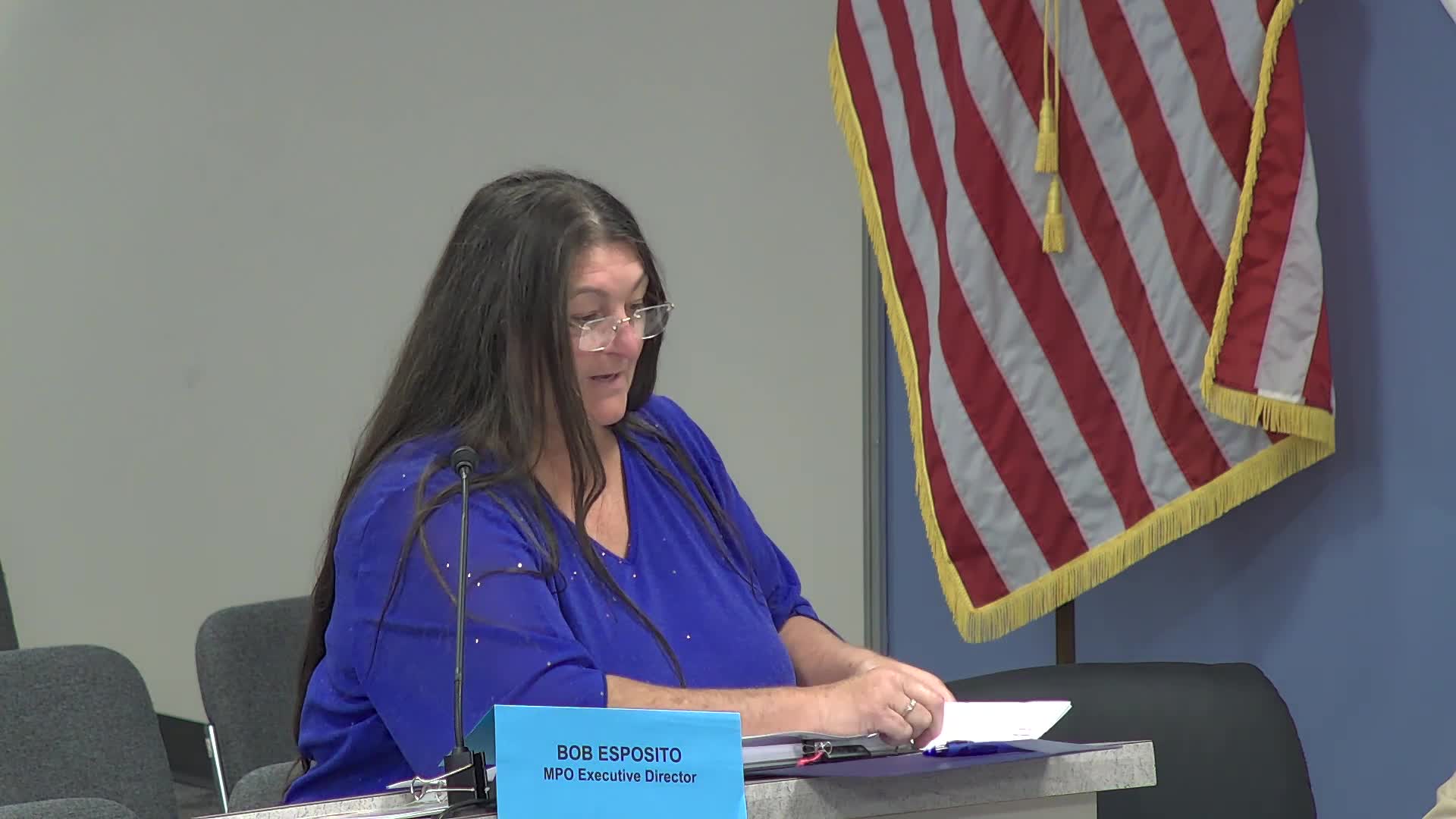
Directors of public transit in Citrus and Hernando counties outlined ridership levels, cost-per-trip figures and funding sources during the Hernando-Citrus MPO meeting, prompting county commissioners to press for clearer data and possible alternatives such as voucher pilots and microtransit.
The briefing explained why the two systems report different costs: Citrus County operates both the community transportation coordinator (CTC) and public service and runs a deviated fixed route, while Hernando operates fixed routes that do not deviate and a separate CTC handles Transportation Disadvantaged (TD) trips. Citrus Transit Services Director Joanne Granger told the board the National Transit Database(NTD) figure for Citrus for fiscal year 2024 was 56,086 total trips and that the agencyestimated a cost per door-to-door trip at about $70 and per fixed-route trip at about $35. Granger said the local portion of costs that year was about $8.37 per trip and that Citruslocal contributions in 2024 totaled roughly $469,000 (comprised of a 9-cent gas tax and ad valorem money).
Why it matters: board members said the numbers affect county budgets and tax bills if local matches rise. Commissioner Loco and others pressed for a clearer understanding of the per-client annual cost and whether alternatives such as Uber/Lyft vouchers, a microtransit pilot or fare increases could reduce the local subsidy.
Hernando Transit Administrator Darlene Molly described her systemas operating 30-foot buses and smaller vans, and said Hernando reported 2023 historic NTD data that showed fewer revenue vehicles in peak service but that Hernando is currently 100% grant-funded for operations (the countylocal match in the NTD 2023 line was listed as about $244,009). Molly emphasized that Hernandomust provide ADA door-to-door service for qualified riders: "If you qualify ADA, you have a door to door service. If you need to go get your haircut, we... have to come pick you up and take you to get your haircut." She also pointed the board to the NTD online dataset: "I went to the National Transit Database, and I pulled 2023 data... Ithas everything."
Board members and staff walked through several clarifying points raised by the directors. Citrus staff said a large share of fixed-route ridership is covered by TD bus passes (Granger said 17,448 TD bus passes were used on fixed routes and that there were about 285 unduplicated TD fixed-route clients). Citrus reported 3,077 wheelchair trips in the period discussed and said Medicaid and managed-care transportation gaps have produced stranded riders and increased demand for options that could be served by voucher programs or ISD (innovative service demonstration) grants. Hernando staff noted differences in accounting and service models make peer comparisons imperfect: Hernando includes TD trips in its counts differently because of the separate CTC model.
Commissioners asked specific policy questions. Commissioner Loco said, "When you can actually track the ones that are using it and they use it consistently throughout the year, what is it actually costing to transport that person?" Granger and Molly urged the board to rely on the Transit Development Plans (TDPs) and NTD data for policy decisions; Molly said capital purchases are largely federally funded and local dollars generally cover operating matches. MPO Director Bob Esposito confirmed the two counties' differences in service models and said the TDPs are the appropriate public documents for deciding whether to expand, reduce or redesign service.
Directors also discussed microtransit pilots and contractor models. Granger said Citrus can apply for innovative service grants to test voucher programs and that Lyft/Uber require accounts and credit-card payment unless an outside provider or pilot structure is put in place. Molly cautioned that private providers sometimes cannot carry wheelchair riders and cited a regional example where a contracted taxi vendor carried paratransit trips at rates that did not cover the transit agency's costs.
The board received several funding notes: CARES Act and ARPA dollars had previously reduced required local matches, state block grants and FTA 5307/5311 formula grants continue to underwrite service, and local 9-cent gas tax revenues and ad valorem contributions supply local matching funds. MPO staff signaled further work and modeling would be needed to estimate the fiscal impact of fare increases or voucher pilots.
Board direction and next steps: commissioners asked staff to return with clearer per-client annual cost modeling and to explore whether microtransit or voucher pilots could meet ADA and TD obligations. No formal board action on transit policy occurred at this meeting; staff said the October and December meetings may be canceled and that the November meeting will include FDOT review of the tentative work program.
Ending: Directors recommended the board use the TDPs and NTD data when weighing changes and cautioned that federal funding formulas mean cutting local service or changing eligibility could affect future grant awards. Molly offered the NTD files to board members: "If you want it, you guys have my email, shoot me an email, I'll send it to you."