Get Full Government Meeting Transcripts, Videos, & Alerts Forever!
Get email alerts on the Animal Shelter topic
No spam. Unsubscribe anytime.
Hernando County sheriff and shelter staff report major drop in shelter population, tout spay/neuter push and new veterinary services
Summary
Sheriff nd Hernando County shelter staff told commissioners they have reduced on-site animal counts, improved spay/neuter rates and added medical equipment and training; commissioners pressed staff on intake and surrender policy and volunteer supervision.
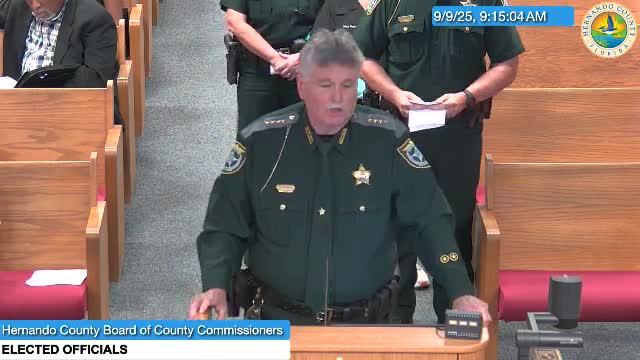
Sheriff nd Hernando County animal-shelter staff told county commissioners on Sept. 9 that the shelter's on-site population has fallen sharply since January and that new medical and records systems are speeding adoptions and returns to owners.
The update came as Capt. Johnny Cameron of the Hernando County Sheriff's Office and Dr. Tiffany Bogart, the county epartment veterinarian, described operational changes, new equipment and training grants intended to keep more animals healthy, adoptable and out of long-term shelter custody.
The sheriff—riefed commissioners that, "since January 1" staff and volunteers have dramatically cut the number of animals in shelter holdings and foster care through increased spay/neuter work, partnerships and volunteer recruitment. Capt. Cameron told the board: "Since January 1 to September 1, we've taken in a total of 1,970 animals. So that's 868 dogs, 924 cats," and said the shelter had adopted out 1,230 animals during that period.
The nut graf: Commissioners pressed staff for detail on intake policies after public questions about whether the drop in shelter counts reflected changes in pickup practices or greater use of foster placements. Shelter leaders said the decline reflects faster medical turnaround, more foster homes and stronger transfer relationships with regional rescues.
What staff said: Dr. Bogart described upgrades to the shelter—linic and records. "We added Chameleon, a very large shelter-based management software," she said, adding that microchip registration now happens automatically, which speeds returns to owners. She told commissioners she has performed more than 1,000 surgeries since joining the shelter and that staff have started a Trap-Neuter-Vaccinate-Release (TNVR) program for community cats. Capt. Cameron cited volunteer expansion to about 109 active volunteers and a live-outcome rate of roughly 98 percent, above the state average.
Operations and equipment: Staff said the shelter has added in-house x-ray and blood-testing equipment received from the sheriff's department and that a written pathways committee now reviews animals with behavioral or medical issues to avoid unnecessary euthanasia. Commissioners were told a $12,000 training package for staff and volunteers paid by a grant will bring "fear-free" handling and compassion-fatigue training to the shelter.
Questions from commissioners: Several asked about surrender and intake practices and whether faster adoptions could mask selective intake. Capt. Cameron said: "We make it a policy, and it's industry standard, that we don't take in healthy owner-surrender cats when we can do TNVR or help owners keep animals with targeted assistance." He added that the shelter conducts neighborhood canvasses to reunite chipped dogs and that "if we can't find them, we absolutely bring them in." Dr. Bogart said the nasal and surgical throughput means "about 99% of the time" an adoptable animal can leave the shelter altered and ready to go.
Community partners: Staff named site partners including PetLove, the Humane Society of Tampa Bay and area rescue groups, and said inmate labor and donated building supplies have helped with shelter repairs and planned intake/isolation construction. Commissioners and staff discussed future capital needs and potential state funding for facility improvements.
What's next: Commissioners requested continued reporting on intake policy, foster capacity, and volunteer training. They asked staff to return with specifics if additional funding or a capital project were needed in the coming budget cycle. The board did not take any formal action beyond receiving the report.