Get Full Government Meeting Transcripts, Videos, & Alerts Forever!
Get email alerts on the Forensic Services Fees topic
No spam. Unsubscribe anytime.
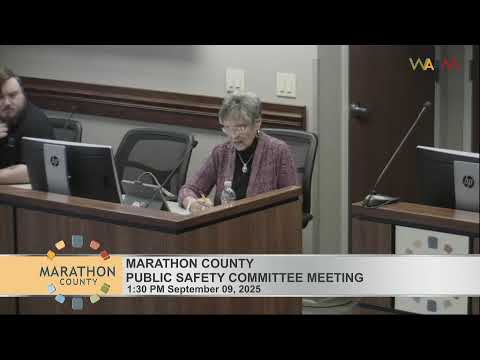
Public Safety Committee forwards resolution to set new forensic service fees as medical examiner office expands
Summary
The Marathon County Public Safety Committee on Sept. 9 voted to forward to the county board a resolution establishing new facility, transportation and private-autopsy fees for the county Forensic Science Center.
The Marathon County Public Safety Committee on Sept. 9 voted to forward to the county board a resolution establishing new fees for pathology and related forensic services as the county’s Forensic Science Center expands operations.
Administrator Jess Leonard said the county has transitioned the medical examiner’s office to a physician-led operation and is seeking revenue sources to reduce reliance on the tax levy. "That is why I'm asking you to approve these and move them to county board — the sooner we can get the facility use fees, transportation fees, and private autopsy fees in place, we can start charging those, and, generating revenue," Leonard said.
Dr. Schupner, the chief medical examiner, updated the committee on staffing and operations at the Forensic Science Center. She said the office onboarded two forensic pathologists and a full‑time autopsy supervisor, established a tissue recovery suite with two donation agencies onboarded so far, upgraded lab equipment and a new database, and completed about 45 autopsies since the May transition.
New fees and what they would cover: Committee materials and presenters described three categories the committee approved to forward: a facility-use fee for tissue procurement organizations using the county recovery suite; a transportation fee for moving decedents or tissue from hospitals to the facility; and fees for private autopsies and miscellaneous pathology services on a sliding scale. Leonard said these new fees are not generally charged to Marathon County families; private-autopsy charges would apply primarily to outside counties or when a family requests and pays for an autopsy the local examiner did not order.
Legislative fees under consideration: Leonard and staff also described two fee items that depend on state law changes: reinstating a death-certificate signing fee and increasing the cremation-authorization fee. Leonard said Marathon County previously adopted a death-certificate signing fee of $100 in 2015 but had to abolish it after state statute changes; the county is one of 19 in Wisconsin without such a fee. If state legislation allows, the county would reinstate the death-certificate signing fee and could increase cremation authorization fees from $283 up to $350. County staff estimated the combined effect of those two possible changes at about $107,000 in additional annual revenue.
Budget context and levy impact: Committee members raised whether fee increases would displace tax-levy funding. Leonard said the county is not likely to eliminate levy support entirely but is targeting a structure that could limit future levy needs. He said the current recommended levy support for the medical examiner’s office is about $68,500 for 2026; the county already increased levy support from $393,000 in 2023 to $545,000 in 2025 for the office and expects only a modest increase in 2026 as operations scale up.
Motion and vote: Committee member Jason moved and Deb seconded the motion to forward the resolution establishing pathology-service fees to the full county board. The committee chair called for the vote and the motion passed.
Next steps: Staff said they will pursue the state legislative request on death-certificate and cremation fees and return to the committee and county board as needed. Officials also plan to finalize contracts with additional tissue-donation agencies and to continue outreach to other Wisconsin counties that may refer cases to Marathon County’s facility.