Get Full Government Meeting Transcripts, Videos, & Alerts Forever!
Get email alerts on the Education Policy Wasda topic
No spam. Unsubscribe anytime.
Battle Ground board debates WASDA bylaws, legislative positions before upcoming vote
Summary
Board members reviewed several WASDA proposals — notice timing for bylaw changes, parent/guardian language, climate-education funding support and educator-certification pathways — and said how the district will vote at the association’s General Assembly.
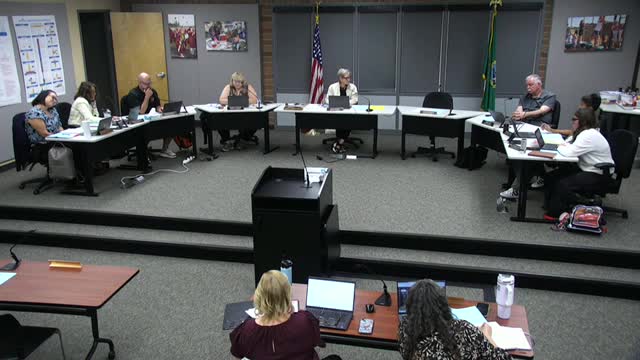
Board members of the Battle Ground School District discussed a slate of proposed positions and bylaw changes from the Washington State School Directors’ Association (WASDA) ahead of the WASDA General Assembly, and identified how the district’s vote will be cast.
The board’s legislative committee review centered on four items directors highlighted: (1) a proposed increase from 90 to 180 days’ notice before adoption of bylaw changes; (2) proposed bylaws tied to district and community input on WASDA model policies; (3) a position recognizing parents and guardians as primary stakeholders; and (4) several proposed state legislative positions, including one asking WASDA to support funding for climate science and sustainability education and one to expand alternative certification pathways for military-connected and out-of-state educators.
Directors said they will vote to keep the notice period at 90 days rather than the proposed 180, and to oppose the two suggested bylaw changes that would limit district flexibility on policy review. They expressed support for a WASDA position that explicitly names parents and guardians as primary stakeholders and indicated they will recommend a “no” recommendation on the WASDA position that would broadly promote state funding for climate education as written.
Board members discussed the trade-offs behind the WASDA proposals. Several directors said WASDA’s subscription-model service for model policies reduces legal and drafting costs for districts and warned that shifting more drafting responsibility to each district could increase attorney costs and staff time. “It would be very expensive if we had to do that for every policy,” a director said, noting attorney hourly rates and the labor required to draft and vet policies.
Directors who favored more district input on model policies also said they would like greater transparency about how WASDA develops model language. One director suggested returning the proposals to their authors for additional work so the policy-development process could be better defined.
On educator certification, the board discussed two competing WASDA positions. One (position 25) would “support all pathways to professional certification that meet state and federal requirements, including traditional and alternative routes, interstate teacher mobility compacts and the Service members Civil Relief Act.” Directors said the alternative clean language in 25 would more readily reduce barriers that military-connected and out-of-state educators face when moving between states. The board indicated support for the broader language in 25 and opposition to the amended 25a, following the recommendation provided by David Olson (referenced during the discussion).
Directors said they expected the WASDA floor could surface additional arguments or amendments and that the district representative will call board members if unexpected issues arise during the General Assembly so they can consider changing their positions before a final vote.
The discussion concluded with the president saying she will cast the district’s votes consistent with the positions the board identified during the meeting.