Get Full Government Meeting Transcripts, Videos, & Alerts Forever!
Get email alerts on the Environmental Health Fees topic
No spam. Unsubscribe anytime.
Caroline County health staff propose consolidated fees, seek clarifications on refunds and transfer charges
Summary
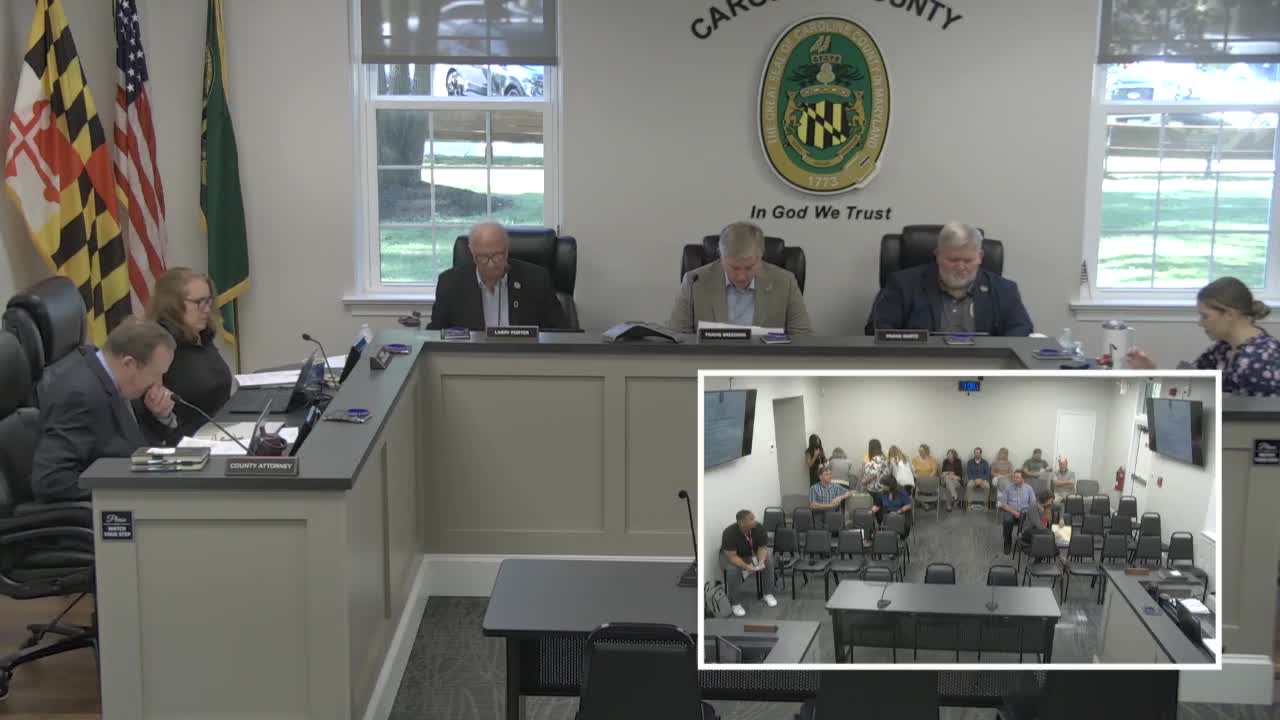
Robin Cahall, Caroline County health officer, and Josh Parker, environmental health, told the county commissioners on Sept. 9 that the department is proposing an updated environmental health fee schedule to account for staffing growth and rising costs.
Robin Cahall, Caroline County health officer, and Josh Parker, environmental health, told the county commissioners on Sept. 9 that the department is proposing an updated environmental health fee schedule to account for staffing growth and rising costs.
The department said its fee schedule has not been updated since February 2005 and presented a set of changes that would consolidate and add several charges. "The fee schedule has not been updated since 02/2005," Cahall told the board. Parker told commissioners the proposal includes an "all‑in‑one" residential soil and site evaluation fee, to be paid up front rather than in multiple follow‑on charges: "I propose putting it all in one fee." Staff said the consolidated fee is intended to reduce administrative follow‑up and unnecessary site visits and can be offered at a discounted rate compared with the current cumulative charges.
Why it matters: environmental health fees affect the cost and timing of on‑lot septic and well approvals, which in turn influence housing construction costs, subdivision timing and agricultural property transactions. Commissioners and staff framed the proposal as an effort to better align charges with staff time and to make the application process more efficient while acknowledging the potential impact on housing costs.
Key details and proposed changes discussed
- Consolidated soil/site evaluation: Staff proposed an "all‑in‑one" residential soil and site evaluation to include initial soil testing, wet‑season monitoring when required, mound/perk testing as applicable and the plat review. Staff said paying a single fee up front reduces repeated administrative processing and can speed field work. Parker said the inclusive fee removes multiple small receipts and follow‑ups and lets sanitarians perform necessary field work in a single visit.
- Septic permit and repair fees: Commissioners and staff discussed separate fees for septic permits and repairs. Staff said the current charge for a new septic permit is $480 and the current repair permit is $200; they proposed aligning the repair fee with the new permit fee (raising the repair fee). (Staff characterized the change as moving both new and repair permit reviews to the same $480 level.)
- Plat review and plat evaluation: The health department currently charges a $90 plat review fee. Staff proposed standardizing plat evaluation fees at $90 per lot and adding a resubmission fee for repeated plan resubmittals, modeled on the planning and codes practice (staff cited a third‑submission fee approach used by planning and codes).
- Temporary food events and food‑service fees: Staff proposed charging a $30 fee for single‑operator temporary food events (excluding nonprofits with tax‑exempt numbers) and a higher fee for large, coordinated events. For permanent food establishments, staff proposed splitting the current combined moderate/high permit structure and raising high‑priority food‑service annual permits to $330 and increasing plan‑review fees for moderate/high priority projects (staff proposed raising plan review from $500 to $1,000 for those categories, citing the technical review time required).
- Transient noncommunity water systems: Staff proposed simplifying and modestly raising the annual fee structure for transient noncommunity water systems (farms, food trucks, other public‑access wells) to a single flat rate to cover sampling and reporting instead of multiple line items.
- New or clarified fees: The draft includes other new or clarified line items such as sanitary sewer system construction permit fees, mobile home park permit changes, recreation camp and natural bathing beach permit language, property status reports and a possible after‑the‑fact application fee. Staff also proposed an after‑the‑fact application charge for cases in which work or facilities are discovered later and need formal review.
Commissioner questions, concerns and next steps
Commissioners pressed staff for clarifications on several points, including: - Whether the county's county‑code transfer fee (developmental right transfer) is separate from the proposed wet‑season testing charge and whether it applies in addition to other fees; staff said they will return with the exact code references and how the transfer fee is applied. - Refund policy when a soil‑only evaluation shows a site is not buildable. Commissioner Breeding asked whether applicants would be entitled to refunds if a soil test makes it clear a site cannot support a system. Staff said there is not a standard blanket refund policy; they have approved case‑by‑case refunds in the past and will research options and regulatory consequences before proposing a formal refund policy. - How often soil evaluations result in a definitive failure. Staff agreed to research and report back on the county's historical failure rate for soil/site tests.
Finance and staffing context
Staff said environmental health expenditures for FY25 were roughly $808,000 and collections were roughly $357,000, noting that about 95% of the department's expenditures are salaries. Cahall and Parker said salary and staff growth over recent years — including converting contract positions to merit staff and hiring new licensed sanitarians — were major drivers for revisiting fees.
No final vote; board requested follow‑up
No final vote was taken. Commissioners asked staff to return with clarifications on the transfer code citation, historical failure rates for soil/site tests, proposed resubmission fee amounts and a more detailed projection of revenue versus workload. Cahall said the fee schedule must also be reviewed by the county Board of Health before implementation and that staff would return for further discussion and revisions.
Ending note: staff work plan
Cahall and Parker told the commissioners they will refine the draft fee schedule, research refund precedents and the transfer‑fee code reference, and return to the board with recommended language and updated justifications. The county finance and planning offices will be involved in subsequent reviews.