Get Full Government Meeting Transcripts, Videos, & Alerts Forever!
Get email alerts on the Business Licensing Fees topic
No spam. Unsubscribe anytime.
Surprise council reviews business licensing process, fees and Spark Surprise support for startups
Summary
City staff outlined the business licensing steps, public-safety and tax roles, and current fees ($168 initial, $84 renewal). Councilmembers discussed cutting the initial fee, rebates for startups, and using Spark Surprise to help small businesses, while staff warned lower fees would reduce revenue and require budget adjustments.
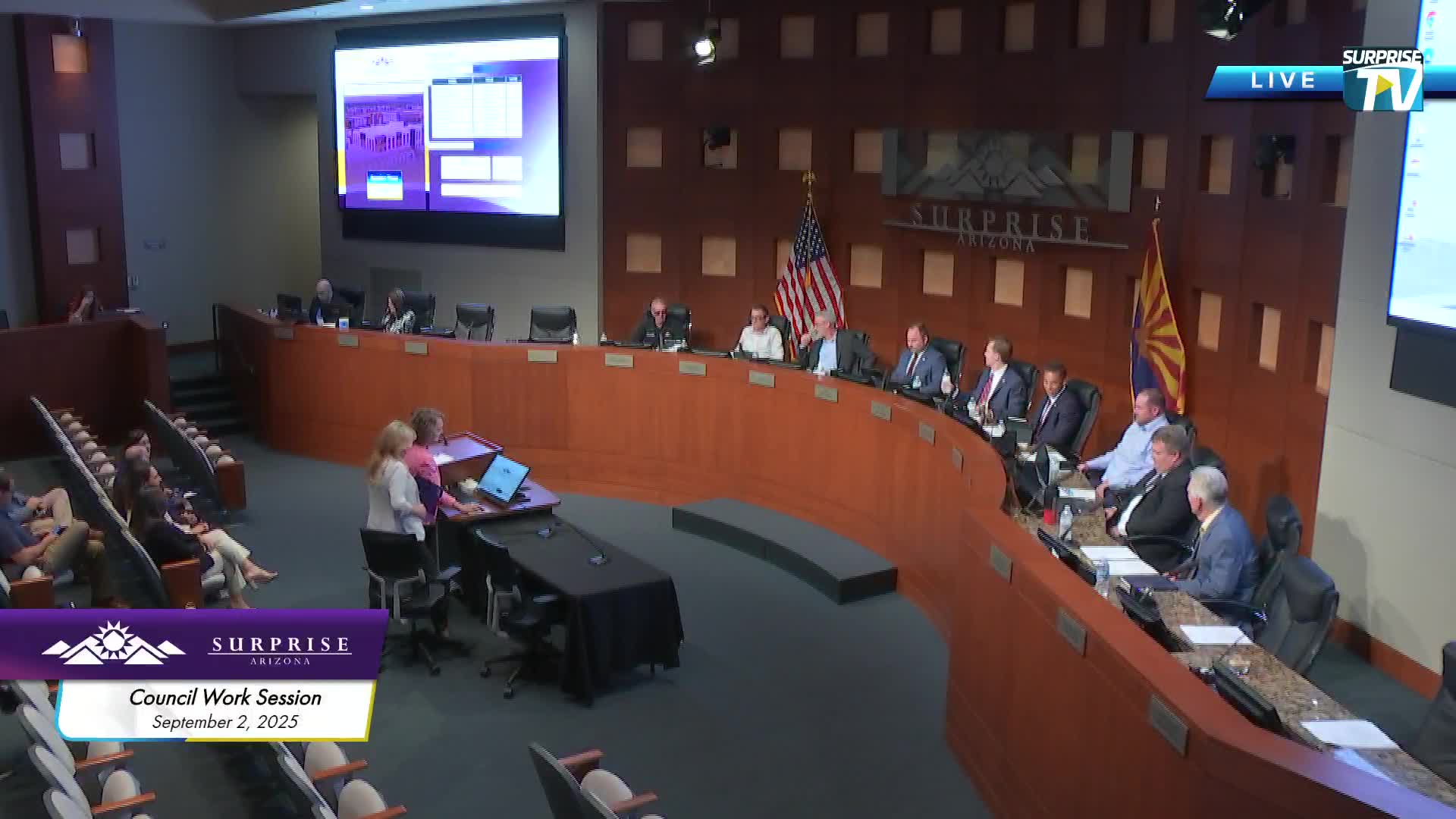
City staff told the Surprise City Council on Sept. 2 that the city’s business license program exists to protect public safety, ensure regulatory compliance and connect new businesses to economic-development services.
“The purpose of a business license is to ensure safe, compliant, and responsible business operations,” said Community Development staff during the work session. Staff described a three-phase review process they said typically results in a license issued within about 15 to 20 days.
City staff also gave the council specific cost and process figures: the current initial city business-license fee is $168 and the annual renewal is $84. Staff said the $168 initial fee does not fully cover city costs and that the city estimates it is subsidizing between roughly 10% and 30% of processing costs since additional business-support services have been added.
Why it matters: Councilmembers framed the licensing discussion around competing goals — protecting residents through inspections and code checks, and reducing upfront costs that can be a barrier for startups. Several councilmembers linked the fee conversation to Spark Surprise, the city’s new business incubator, and asked staff to develop options that could make it cheaper to start a business in Surprise.
How licensing works Staff outlined the intake and review timeline used for applications. Finance performs an intake completeness check in days 0–5, affected departments perform substantive review in days 5–15, and final processing — including payment and issuance — occurs in days 15–20. Common reasons for delay include incomplete applications, missing third-party approvals, or pending industry-specific permits.
Staff emphasized the public-safety role of licenses: Surprise Fire-Medical conducts fire-prevention reviews and annual inspections; police and fire use licensing records and maps (for example, for group homes, assisted-living and sober-living homes) to prepare emergency responders.
Council discussion and proposed policy ideas Councilmember Judd urged a targeted relief approach: “I would prefer to have some sort of just grant rebate program available … give Janine's group the power to waive that fee the first year.” Vice Mayor Jack Hastings, Councilmember Haney and Councilmember Duffy said they supported lowering the one-time initial fee (suggesting cutting it to the renewal level of $84), while also keeping “skin in the game” to prevent abuse of a free-license approach.
Councilmember Greenberg, who identified himself as an experienced entrepreneur, warned against masking more fundamental problems: “Undercapitalization is the number 1 reason why businesses fail. If they can't afford $168 they need to do more work.” He suggested exploring a graduated scale tied to firm size or other objective measures if the council wanted differential fees.
Staff cautioned that lowering or waiving fees reduces revenue and would require budget adjustments. “If the fee was to be reduced or removed, that would be an impact to the revenue stream,” staff said, noting the city would need to close any gap during the budget process.
Next steps Council asked staff to research models from other cities, return with options for a rebate/waiver program or graduated scale tied to a council-defined “small business” threshold, and to make changes in time for the annual renewal notices (licenses use a calendar-year renewal cycle). Staff agreed to update forms and software as needed and to provide a menu of options and estimated fiscal impacts.
Ending Councilmembers generally expressed support for measures that would reduce upfront costs for startups while preserving inspection and compliance functions. Staff will return with recommended options and fiscal estimates so the council can consider a policy change before annual renewal notices are mailed.