Get Full Government Meeting Transcripts, Videos, & Alerts Forever!
Get email alerts on the Municipal Finance topic
No spam. Unsubscribe anytime.
Council approves business-license updates; consent agenda includes Cultural Access Program amendment
Summary
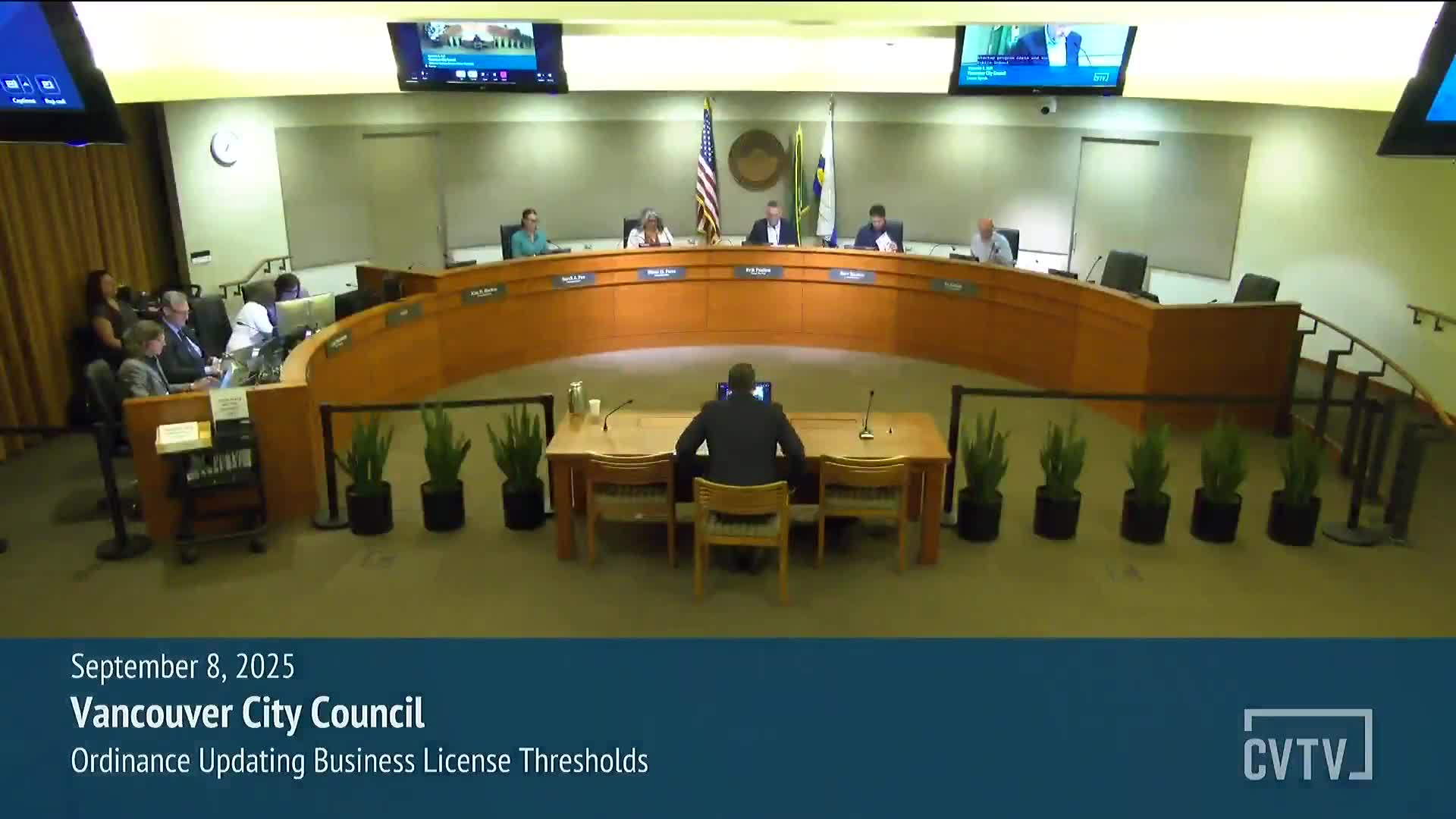
Vancouver City Council unanimously approved an ordinance updating business-license gross-receipts thresholds and passed a consent-item ordinance adjusting the Cultural Access Program. City staff said the business-license changes will reduce revenue about $140,000 annually and align local thresholds with recent state law changes.
Vancouver City Council on Sept. 8 unanimously approved two ordinances: a consent-item amendment to the Vancouver Cultural Access Program and a separate ordinance updating city business-license thresholds.
The Cultural Access Program amendment (Vancouver Municipal Code 3.45.0.05) was included on the consent agenda and approved without discussion. The ordinance modifies the percentage allocated to startup costs and the public school cultural access program; council voted to approve the consent agenda after a motion by Councilor Hansen, seconded by Councilor Perez.
In a separate public hearing, Anthony Glenn, the city treasurer, presented an ordinance updating business-license thresholds (amending VMC 5.04.075 and 5.04.090). Glenn said the state raised the gross-receipts threshold for out-of-city businesses from $2,000 to $4,000 and the city is choosing to apply that higher threshold to all businesses. The ordinance also increases the upper gross-receipts threshold from $50,000 to $53,000 and ties thresholds to annual CPI adjustments. Glenn told council staff expect the changes to reduce business-license revenue by approximately $140,000 annually.
Glenn explained Vancouver’s tiered license structure: businesses with gross receipts from $0 to $2,000 do not pay a license; businesses with gross receipts above that tier pay a partial license (currently $52); and businesses at the top tier pay a full license ($331) plus an employee surcharge calculated at $145 per employee. The proposed threshold changes shift the mid-tier from $2,000–$50,000 to $4,000–$53,000 and align adjustments to the same CPI metric used for out-of-city businesses.
Councilors asked whether the change was mandatory and whether the city could configure the thresholds to avoid a general-fund loss. Glenn said the $2,000-to-$4,000 increase for out-of-city businesses stems from state law and the city opted to apply it citywide; the larger revenue impact comes from raising the $50,000 threshold to $53,000. He said license fees are scheduled to rise roughly 5% per year through 2029 and then will be tied to inflation, so license revenue should continue increasing year over year but at a lower rate than without the threshold change.
After a public hearing with no registered public commenters, council moved to approve the business-license ordinance. Council performed a roll-call vote: Councilor Fox, Councilor Perez, Councilor Hansen, Councilor Stober, Councilor Arlis and Mayor Pro Tem Eric Paulson voted aye; the motion passed unanimously.
The city clerk recorded both ordinances as passed; the business-license ordinance includes severability and an effective date as stated in the ordinance language.
Votes at a glance
- Vancouver Cultural Access Program ordinance (VMC 3.45.0.05) — Action: consent-item ordinance; Mover: Councilor Hansen; Second: Councilor Perez; Outcome: passed unanimously; Details: adjusts percentage allocated to startup costs and public school cultural access program; effective date: not specified in public record.
- Business-license thresholds ordinance (amends VMC 5.04.075 and 5.04.090) — Action: ordinance after public hearing; Mover: not specified on the record; Second: Councilor Fox; Outcome: passed unanimously by roll call; Details: raises out-of-city gross receipts threshold from $2,000 to $4,000 (applied citywide), raises upper threshold from $50,000 to $53,000, ties thresholds to CPI; estimated revenue reduction approximately $140,000 annually; license fee tiers and surcharge amounts stated in staff report.