Get Full Government Meeting Transcripts, Videos, & Alerts Forever!
Get email alerts on the Speed Limits Traffic Calming topic
No spam. Unsubscribe anytime.
Committee approves measures letting municipalities seek 20–25 mph limits where state law allows
Summary
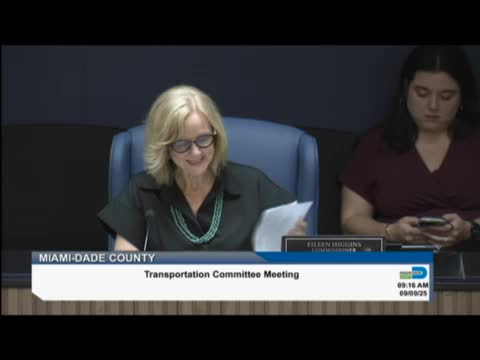
Miami-Dade County Transportation, Planning and Mobility Committee approved two items that give municipalities a mechanism to pursue lower speed limits and traffic calming where state law and required studies permit.
The Miami-Dade County Transportation, Planning and Mobility Committee on a voice vote approved two companion items that give municipalities a pathway to seek local 20- or 25-mph speed limits and other traffic-calming measures, subject to applicable state law and required field studies.
Committee members said the changes are intended to provide local officials more flexibility to respond to neighborhood concerns about safety and to add “tools in the toolbox” such as speed tables and other traffic-calming devices. Commissioner Steinberg, who presented one of the items, said, “This is not something we are doing automatically. This is only giving the ability to… giving us just more tools in the toolbox to try to address the needs of the communities that came out.”
The items — numbered on the committee agenda as 2b and 2e — were discussed together. Vice Chairwoman Regalado said neighborhood associations and residents have been calling commission offices with requests for traffic calming and that the demand is often concentrated around schools, parks and libraries. “I can list off five different groups in UMSSA that want this,” Regalado said, urging that the measure not be overburdened with parameters that would slow implementation.
County staff said a formal memo describing the field-assessment process, required studies and sign‑replacement costs is nearly complete and will be provided before full-board consideration. Staff and commissioners emphasized that any municipal action must comply with state law; “If the state requires us to do a study, we gotta do a study,” one commissioner said during debate.
The committee adopted the items by voice vote after a motion to consider 2b and 2e together. Commissioners indicated the intention that the county and municipalities coordinate implementation and that staff avoid duplicative work when other internal directives or memos address the same topics.
The items now move to the full Board of County Commissioners for final approval and any technical revisions described by staff.