Get Full Government Meeting Transcripts, Videos, & Alerts Forever!
Get email alerts on the Police Oversight topic
No spam. Unsubscribe anytime.
Public Safety Commission forwards recommendation on Office of Police Oversight compliance, reads 25 questions into record
Summary
The Public Safety Commission on Sept. 8 approved a recommendation asking the Office of Police Oversight to present to City Council, publish a compliance plan and make complaints data searchable and accessible.
The Public Safety Commission discussed the Office of Police Oversight’s (OPO) compliance with the Austin Police Oversight Agreement (APOA) and related obligations during its Sept. 8 meeting and approved a recommendation calling for greater transparency and accountability.
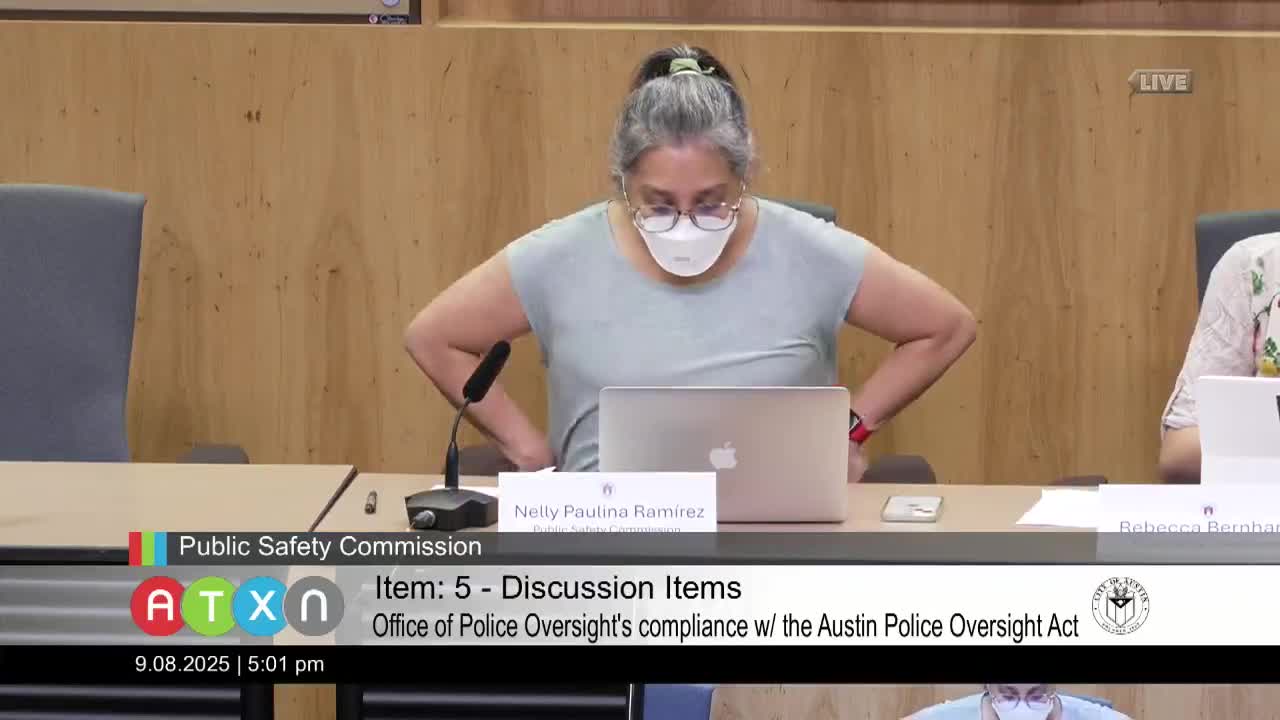
The chair opened the item by saying OPO had previously appeared before the commission but has since refused to present in person; OPO agreed only to answer questions via email. The commission’s chair and members read a set of questions into the public record and discussed next steps for council and the commission. Commissioner Bernhardt moved the recommendation and Commissioner Carroll seconded; the commission approved the recommendation unanimously by show of hands.
Scope of the recommendation. The recommendation asks that the Public Safety Commission request several actions or disclosures from OPO and City Council, including: - That OPO present its annual report at a publicly held City Council meeting as directed in the city ordinance; - That OPO document and publish a plan for compliance with the APOA and Resolution 99; - That OPO create a searchable, accessible complaints database (including anonymous complaints and compliments) with formats usable by translation and accessibility tools; - That the city clerk’s office assign a staff liaison to the Community Police Review Commission (CPRC) in place of OPO staff to ensure meeting consistency and relieve OPO staff burden; and - That OPO perform a review of internal processes for effectiveness and timeliness.
Reading questions into the record. Commissioners read a list of 25 questions into the public record to ensure they were part of the meeting transcript. Topics covered by the questions included the timing and publication schedule for annual reports; which departments have edit/approval access to OPO reports; whether anonymous complaints and compliments are published; the transparency and searchability of complaints data; training for complaints officers to ensure impartiality; the supervisory referral disposition and its tracking and effectiveness; whether OPO tracks repeat complainants or repeated supervisory referrals; outstanding obstacles to the CPRC’s ability to review cases and the process for filling vacant CPRC seats; OPO participation in officer‑involved‑shooting press conferences; recent OPO funding changes; and what resources OPO believes are required to meet its goals.
An item of particular attention was supervisory referrals. Commissioners noted that supervisory referral is the largest complaint disposition in OPO’s annual report and asked for specifics about training, follow‑up, metrics and automatic triggers to flag cases for full investigation.
Votes and motions. Commissioner Bernhardt moved the recommendation, Commissioner Carroll seconded, and the commission approved the recommendation by unanimous vote. Commissioners later moved and approved an amendment to append the 25 questions read into the record and to request that OPO’s responses be made publicly available; that amendment also passed unanimously.
Commission direction and next steps. Commissioners asked staff to explore procedural options to forward the recommendation and appended questions to Council and to clarify whether the clerk’s office will accept the questions as backup material. The chair encouraged commissioners to share the approved recommendation with council members while staff confirm procedural steps for forwarding it to the council public safety committee.
Why it matters. The recommendation seeks to increase transparency and operational accountability for OPO by requesting documented timelines, public reports, searchable complaint data and an independent staff liaison for the CPRC. Those items relate directly to public expectations about oversight, timely disclosure and the ability of the public and city officials to review complaint outcomes.