Get Full Government Meeting Transcripts, Videos, & Alerts Forever!
Get email alerts on the Forensic Science topic
No spam. Unsubscribe anytime.
Director Dana Cataby outlines Austin Forensic Science Group: staffing, accreditations and caseload
Summary
Director Dana Cataby told the Public Safety Commission the Austin Forensic Science Group has 89 full‑time staff, multiple accredited laboratory sections, a 2024 average turnaround of 51 days for assault kits and a 2024 output that included more than 7,500 forensic reports and disposal of about 140,000 eligible evidence items.
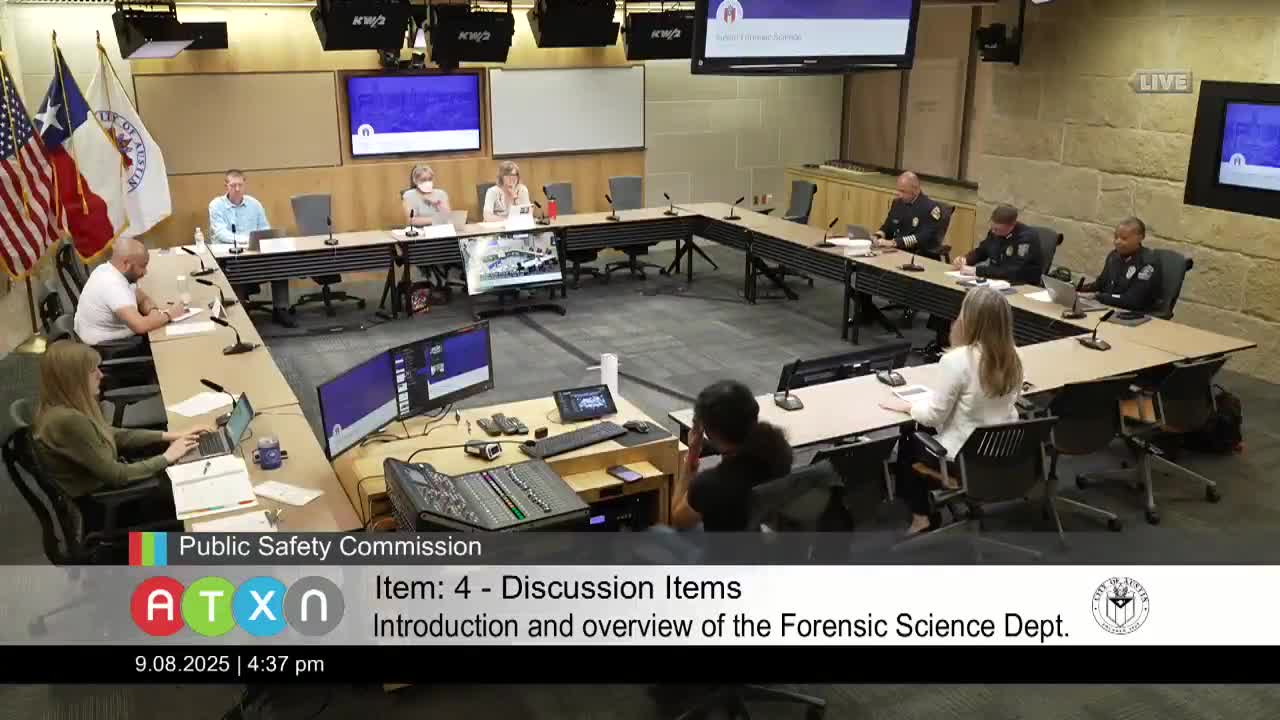
Dr. Dana Cataby, director of the Austin Forensic Science Group, presented an overview of the department’s mission, organization, accredited sections and 2024 workload to the Public Safety Commission on Sept. 8.
Cataby said the laboratory’s mission is “to provide accurate and impartial scientific analysis and support services to the legal system while maintaining the highest level of quality and professionalism,” and summarized the department’s unofficial tagline as “truth through science.” She described the unit as a department within the city’s public safety group and said she reports to Assistant City Manager of Public Safety Eddie Garcia.
Organization and staff. Cataby said the laboratory employs 89 full‑time equivalents across operations and support functions. She described four managers who oversee operations, evidence control and the quality management system: Kim Frierson and Emily Esquivel (operations managers), James Gibbons (Evidence Control Manager) and Catherine Sanchez (Quality Management System and Information/Document Management).
Accredited laboratory sections. Cataby outlined key accredited and support sections: the 24/7 crime scene response team; firearms and tool‑marks (ballistics); latent prints; seized drugs (analytical chemistry); toxicology; DNA and case management; evidence control and warehouse operations; and quality assurance. She explained how crime scene technicians collect and preprocess items for analysis, how seized drugs are confirmed with orthogonal testing and how toxicology focuses on blood alcohol analysis with a plan to validate additional drug testing methods.
Evidence and volume. Cataby said the evidence control unit manages roughly 1,400,000 items and handles daily evidence transports from substations to the central warehouse. She provided a 2024 snapshot: an average turnaround time of 51 days for assault kits received that year; an assertion that the department prevented an assault‑kit backlog for the sixth consecutive year; more than 2,000 major crime scene responses; roughly 25,000 items processed; and about 7,500 forensic reports issued. Cataby said each report has primary analyst work and a second analyst review.
Disposal and safety. The evidence unit, Cataby said, disposed of approximately 140,000 eligible items in 2024, including more than 9,000 seized drugs and about 1,000 firearms. She said disposals occur by court order and under retention policies to prevent long‑term accumulation.
Quality and accreditation. Cataby described accreditation by the ANSI National Accreditation Board (ANAB) to ISO/IEC 17025:2017 and noted oversight by the Texas Forensic Science Commission, which includes licensing requirements for some disciplines. She said the lab pursues voluntary licensing where available (for example, latent prints and crime scene) and is an early implementer of OSAC (Organization of Scientific Area Committees) registry standards.
Case management, discovery and disclosure. Cataby explained that a case management unit coordinates outsourced DNA testing under an interlocal agreement with the Texas Department of Public Safety (DPS) and supports discovery processes for the courts. In response to a question about Brady disclosures and timeliness, she said the lab has policies and preliminary notice mechanisms to alert partners about quality incidents and that Texas DPS’s forthcoming TLR Connect portal is intended to simplify statewide discovery exchange.
Commissioner questions and next steps. Commissioners asked about seasonal trends in caseload; Cataby said volume can ebb and flow and that recent years show more complex requests, not necessarily predictable seasonality. Commissioner Carroll asked whether the assault‑kit backlog is resolved; Cataby said the backlog work concluded years earlier. Commissioners also discussed integrating forensic science more consistently into public safety conversations; the commission chair said the department had not appeared before the commission since the panel previously recommended establishing an independent forensic science department around 2020–2021 and urged regular updates going forward.
Why it matters. Forensic laboratory capacity, turnaround times and evidence management affect prosecutions, victim services and public safety transparency. Cataby’s presentation emphasized accreditation, quality management and efforts to manage evidence and backlog risk while supporting disclosure obligations to prosecutors and courts.