Get Full Government Meeting Transcripts, Videos, & Alerts Forever!
Get email alerts on the Emergency Medical Services topic
No spam. Unsubscribe anytime.
Austin-Travis County EMS reports lower vacancies, wider use of advanced life‑support squads and fewer lights‑and‑sirens responses
Summary
At the Public Safety Commission meeting, Austin-Travis County EMS reported falling civilian vacancies, ongoing paramedic training classes, distribution of Narcan, station completions, a planned March 2026 CAD auto‑aid go‑live and a dispatch reprioritization that reduced lights‑and‑sirens responses from about 89% to 55%.
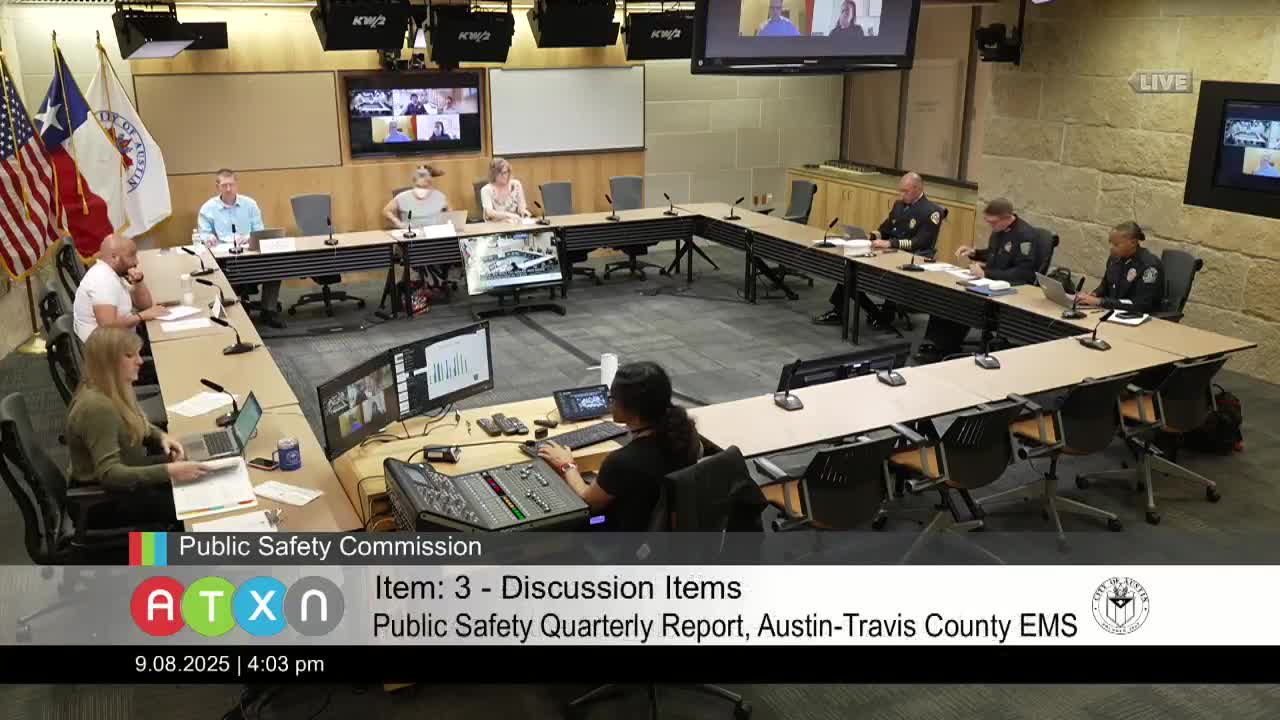
Wes Hopkins, chief of staff for Austin‑Travis County Emergency Medical Services, presented the department’s fiscal‑year 2025 third‑quarter report to the Public Safety Commission on Sept. 8, outlining staffing changes, operational updates and an evidence‑based overhaul of dispatch priorities.
Hopkins said the department’s authorized sworn strength remains 714 with 609 in the field and about 105 total vacancies. He called out 27 open field medic positions and one communications vacancy, putting the sworn vacancy rate at roughly 13.8 percent. Civilian vacancies, he reported, are at an all‑time low of about 8 percent.
The department is running multiple training pipelines. Hopkins said the July academy (7/25) had 19 cadets — 18 field medics and one communications medic — graduating Sept. 12, and an October academy (10/25) will enroll 22 cadets, including 21 field medics and one direct‑hire clinical specialist. He described the internal paramedic program as a key tool to address a national paramedic shortage: the current paramedic class has 14 candidates and another 12 begin in April 2026, with a cohort of internal candidates currently completing a PL5 credentialing academy in October.
Hopkins reported transitions of grant-funded opioid work: the SAMHSA grant for Narcan rescue kits is closed and supplies are now supported by opioid settlement funding. In Q3 the department distributed 4,308 Narcan rescue kits; 172 of those were reported used prior to EMS arrival by law enforcement or fire personnel. Hopkins referenced a multi‑agency response to an overdose cluster on Sixth Street and said the system worked as intended with law enforcement, fire and EMS administering Narcan.
Hopkins described facility milestones: all five EMS stations funded by the 2018 bond — stand‑alone stations 1 and 5 and co‑located stations 7, 10 and 13 — are complete and staffed. A handful of smaller renovation projects remain, such as work at Station 3 (15th and Red River).
Regional computer‑aided dispatch integration and auto‑aid. Hopkins said Travis and Williamson counties, plus ESD1 Lago Vista and ESD2 Pflugerville, migrated CAD systems to a cloud environment in September and that interlocal agreements cleared legal review. The plan is to start with auto‑aid for the highest‑acuity calls only, run extensive testing in February 2026, and aim for a March 2026 go‑live.
Deployments and after‑action planning. Hopkins outlined the department’s Kerr County flood deployment with Texas Task Force 1 and the Texas Emergency Medical Task Force: Austin‑Travis County EMS supplied swiftwater boat teams, an AMBUS, an ambulance strike team (five ambulances) and multiple incident management roles. He said the last deployed medic returned the week of Aug. 25 and that the department will conduct a large after‑action review.
Advanced life‑support (ALS) squads and staffing strategy. To reduce overtime and maintain credentialing for non‑transport specialists, EMS has been flexing existing community health paramedics, mental‑health responders, opioid‑use‑disorder staff and training personnel into 911 coverage for roughly 10 hours per week. Hopkins described those staff as able to preserve their primary program duties while keeping operational skills current. He said the move reduced reliance on overtime — which had reached unsustainable levels earlier in the year — and that ALS‑style squads can respond to both high and lower‑acuity calls.
Dispatch reprioritization and outcomes. Hopkins described a multi‑year, multidisciplinary review of three years of outcome data that compared dispatch priority assignments to clinical and hospital outcomes. The department implemented updated dispatch determinants and a priority 1–5 matrix to reserve the highest priorities for cases requiring critical interventions. Hopkins said the changes reduced overtriage: before the project “we went lights and sirens to 89% of our calls,” he said; after the changes about 55% of calls are responded to with lights and sirens. He added that priority 2 calls — previously a catch‑all — shrank substantially and that priority 4 and 5 calls increased as more calls were routed through the collaborative care communications center (C4) and alternative response pathways.
Hopkins emphasized the changes are iterative. Call takers retain authority to upgrade priorities when warranted and the department will maintain continuous QA/QI review with medical direction. He said the overall work aims to improve safety for the public and providers by reducing unnecessary lights‑and‑sirens responses and matching resources to patient needs.
Commissioner questions and follow‑up. Commissioners asked about changing measurement priorities from raw response time to outcome data; Hopkins said outcome measures are now possible and desirable. Commissioner Bernhardt asked about collaboration with Central Health on low‑acuity calls; Hopkins agreed that a focused agenda item with integrated services and Central Health staff would be useful and offered to schedule it. Commissioner Carroll asked which software produced the opioid heat maps; Hopkins said he would confirm but believed ArcGIS and OD Maps had been used and that integrated services plots opioid alert locations to guide outreach. On morale for staff assigned to squads, Hopkins said feedback is mixed but generally manageable, and that the squads helped keep administrative leaders conversant with field work.
Scaling back the squad program. Hopkins said the department intends to reduce the squad cadence as staffing improves but does not plan to eliminate operational time for non‑transport staff entirely. He pointed to plans beginning Oct. 1 to ramp down squad tempo and to a budget year review to reduce overtime pressure while preserving some operational flexibility.
Why it matters. The EMS changes touch staffing, frontline safety and how limited emergency resources are dispatched in high‑demand conditions. The department’s shift to more evidence‑driven dispatch determinants, cross‑jurisdiction CAD integration and targeted use of ALS squads represent operational choices that will affect response patterns across the city and county.