Get Full Government Meeting Transcripts, Videos, & Alerts Forever!
Get email alerts on the Animal Shelter Euthanasia Policy topic
No spam. Unsubscribe anytime.
Austin Animal Center creates monthly "rescue placement list," sets 5-business-day commitment window for rescues
Summary
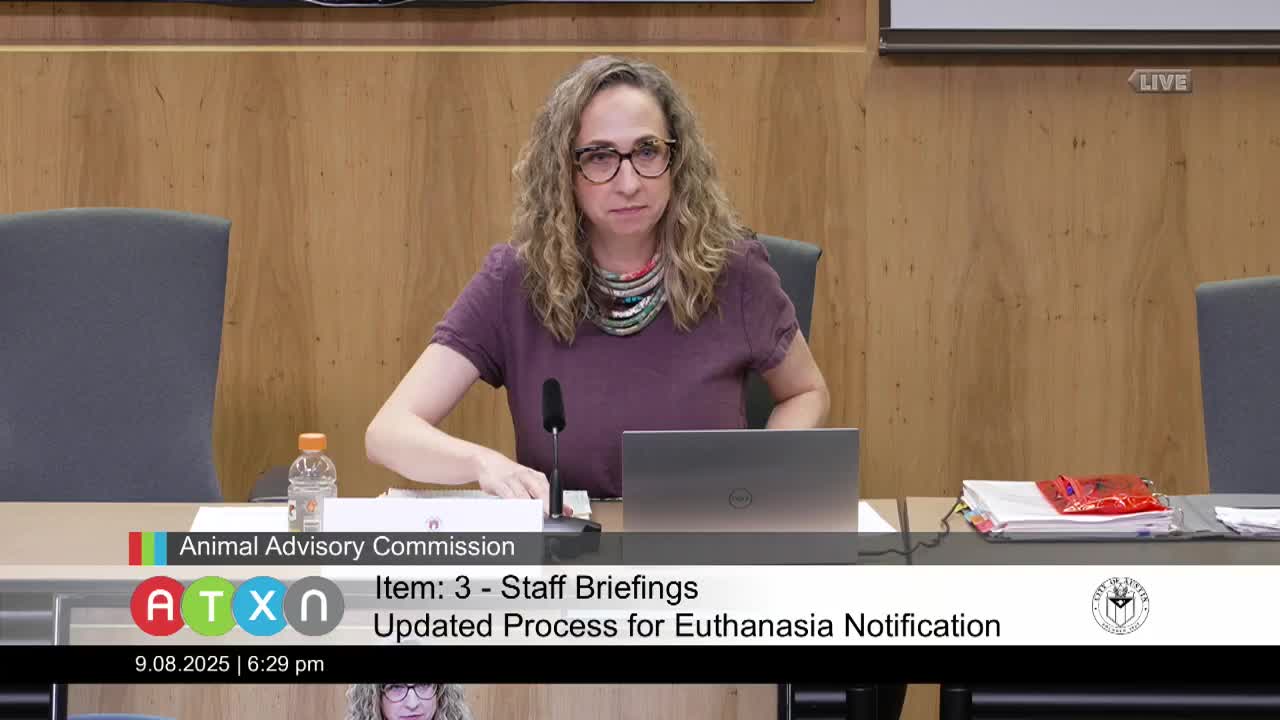
Interim Austin Animal Center leadership described a new monthly Rescue Placement List and updated Urgent Placement List at the Sept. 8 Animal Advisory Commission meeting, drawing praise for clearer timelines and criticism from rescue partners and volunteers who said the change risks shortening evaluation time for dogs with behavioral needs.
Interim Austin Animal Center Chief Rolando Fernandez and Program Manager Rebecca Monty told the Austin Animal Advisory Commission on Sept. 8 that the shelter will publish a new monthly Rescue Placement List (RPL) by the fifth business day of each month and will follow that with a five-business-day commitment period for qualified rescue partners to evaluate and commit to dogs on the list.
Commissioners and dozens of rescue volunteers and officials said the change aims to increase transparency and consistency in notifying rescue partners about dogs the shelter believes pose a public-safety risk or have significant behavioral concerns. Under the new timeline, if no viable rescue option is confirmed during the commitment period, the shelter will issue the 48-hour euthanasia notice required by city code (referred to in the meeting as "Code 3-1-26").
The commission heard presentations and public comment from several Austin Pets Alive leaders and volunteers who said the new process did not make clear whether rescue partners retain the previous 10-day evaluation window they had been using. Claire Callison, senior director of operations at Austin Pets Alive, told the commission that APA typically assumes about 17% of the animals AAC takes in and that many of those animals require extended medical or behavioral care. Chelsea Reisman, dog behavior director at Austin Pets Alive, said her team needs predictable access and time to evaluate dogs and warned that a compressed or unclear timeline could increase euthanasia of dogs that could be rehabilitated and placed.
Rebecca Monty described how the RPL will differ from the already-published Urgent Placement List (UPL). She said the UPL will remain a regularly updated library on the ASO website and will be distributed weekly; it documents dogs with behavior concerns, bite histories that do not pose a public-safety threat, or animals suffering poor quality of life in the shelter. The RPL, Monty said, will be limited to dogs whose bite history or "significant behavior concerns" create a risk if the animal were placed without specialized behavioral support and will be distributed to rescue partners who have been onboarded to receive RPL notifications.
Monty and Fernandez said the RPL process will include three notifications: the published list (by the fifth business day), a week-later call for commitments from rescue partners (the five-business-day commitment period), and then a 48-hour euthanasia notice under the cited city code if no confirmed rescue placement exists. Both staff members said the objective is to create consistent timing and clearer communication so rescue groups can prioritize evaluations and transports.
Staff also described a formalized internal review for dogs with bite history they called the "Dunbar team," an audit-style panel that applies the Dr. Ian Dunbar bite classification (which staff stated the council adopted on Feb. 1, 2024) and reviews each incident for consistency. Monty said behavior observations will begin at intake and the center is developing behavior-modification programming, continuous monitoring and targeted interventions to increase outcomes and safety.
Rescue partners and volunteer speakers raised multiple concerns: they asked for (1) clarity about whether the formerly available 10-day evaluation period for rescue-intake remains available in practice, (2) explicit documentation of who serves on the Dunbar review team and their behavioral qualifications, and (3) assurance that the shelter will collaborate with rescue organizations on timing, transport and case-specific evaluations. Chelsea Reisman said APA’s behavior team previously evaluated hundreds of behavior cases and that an inconsistent daily list had already delayed APA's response to some dogs.
Fernandez and Monty defended the revision as adding notification windows and an explicit five-business-day commitment period on top of regular posting and ad-hoc outreach staff already do. Fernandez said his office had met with APA leadership before public release and that the RPL does not change the existing TLAC/APA development agreement, which he called a separate process. Fernandez also said he would continue to work with rescue partners and volunteers to improve responsiveness and that staff had been meeting regularly with multiple rescue organizations.
Commissioners pressed staff on timing and minimum notice. Commissioner Niemeyer repeatedly asked whether rescues would have less time under the new policy; Fernandez and Monty said no dog would have fewer than eight days total under the published process (publication by the fifth business day, the five-business-day commitment period, then the 48-hour notice). Monty also said the RPL can be updated between monthly publications if animals later meet the RPL criteria, but only those published during the monthly notification would be part of that month's commitment window.
Rescue incentives and operational details were raised. Monty said the shelter has used rescue incentives previously for large dogs (historically about $500 for kennel-clearing pulls and up to roughly $750 to $1,000 for dogs with bite histories) and that medical expenses such as heartworm treatment are sometimes provided to rescues the same way the shelter would fund treatment for an adopter. Monty said the shelter had been offering incentives approximately once to twice a month prior to the RPL, and staff indicated they would continue incentives as operational need dictates.
Several speakers and commissioners suggested the shelter include credentialed behavior expertise in formal decision-making. Commissioner Loyningen and other commissioners urged the shelter to integrate qualified behavior practitioners directly into evaluation and foster-placement processes, with one commissioner proposing a formal "behavior foster evaluation" step prior to placing animals on the RPL.
Fernandez said he would provide additional summaries and reports about incidents raised in public comment, including the medical-safety failure that volunteer commenters described. He also said staff will continue working with rescue partners to refine the RPL and UPL operations.
What happens next: ASO staff said the RPL will be posted to the ASO website and sent to onboarded rescue partners, and Monty described the internal timelines staff will use to publish and update the RPL. Fernandez said he would set follow-up meetings with rescue leadership to discuss operational details and respond to specific questions from APA and other volunteers.
"Our goal is transparency and consistent communication," Fernandez said. "We want rescue organizations to step up and assist us with placement of these animals in our care. If nothing happens in response, we have a duty to act in the best interest of the animal." (Rolando Fernandez)
"We hope the RPL will reduce last-minute surprises and help rescues target their resources. We also want to maintain flexibility for real-world rescues who sometimes confirm placement very close to a deadline," Rebecca Monty said.
Commissioners and rescue partners left the Sept. 8 discussion divided on whether the new timelines sufficiently protect rescue evaluation time; commissioners requested continuing conversations and a scheduled follow-up with rescue leadership to clarify evaluation windows and behaviorist involvement.