Get Full Government Meeting Transcripts, Videos, & Alerts Forever!
Get email alerts on the Live Music Fund topic
No spam. Unsubscribe anytime.
Austin live music fund collections down 18% year-to-date; city narrows noncompliance on FY23 grants
Summary
City staff reported an 18% year‑to‑date decline in hotel-occupancy-tax receipts supporting the Live Music Fund and described progress closing out legacy FY2023 grant reporting issues; 34 awardees remained noncompliant, staff said.
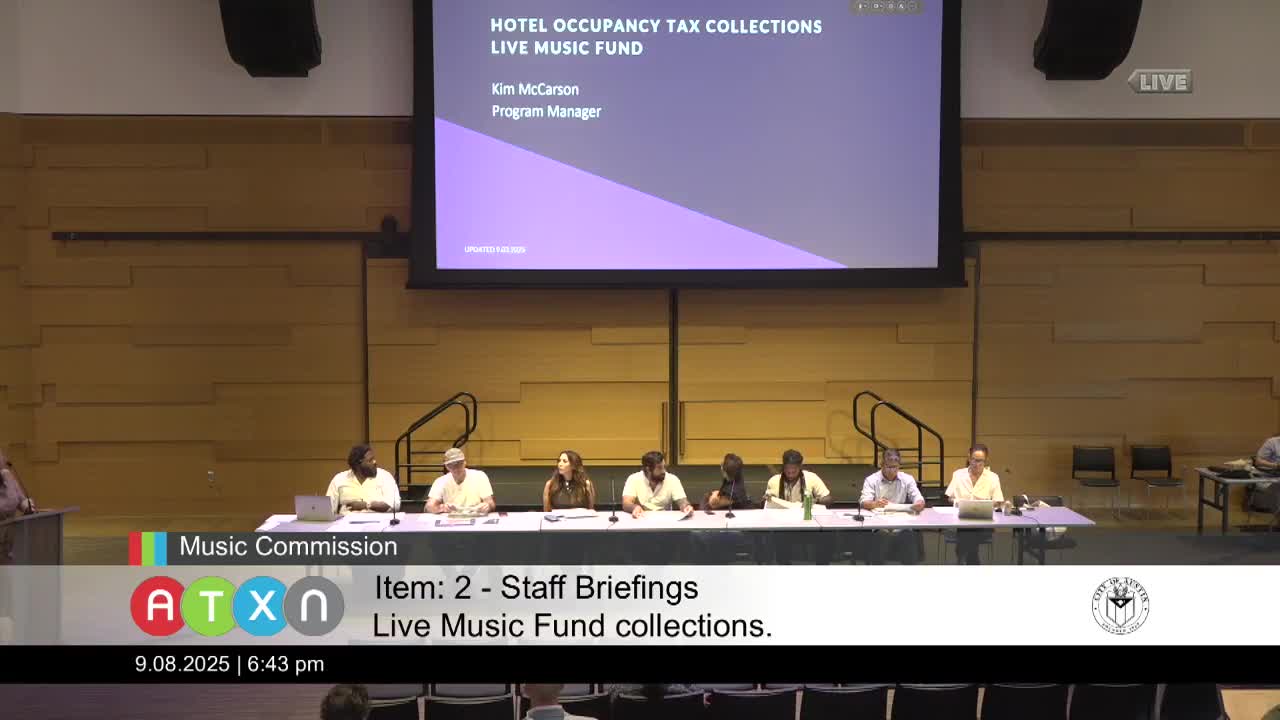
City staff told the Austin Music Commission on Sept. 8 that hotel-occupancy-tax (HOT) receipts designated for the Live Music Fund are down about 18% year to date compared with 2024, and that staff are continuing efforts to close out outstanding reporting from the first Live Music Fund cohort.
Kim McCarson, program manager for the Music and Entertainment Division in Austin Arts, Culture, Music and Entertainment (ACME), told the commission that July HOT collections for the Live Music Fund were $21,687 compared with $716,095 in July 2024 and that year-to-date encumbrances were reported as $3,254,590. “So the year to date encumbrances number is 3,254,590 but that represents … an 18% less year to date,” McCarson said, adding that she did not yet have an explanation for the difference.
Why it matters: HOT receipts feed the Live Music Fund and other arts and cultural programs; a sustained shortfall can reduce grant dollars available to Austin musicians, venues and arts organizations.
Erica Shamley, division manager for the Music and Entertainment Division, updated the commission on final reports tied to the FY2023 Live Music Fund, the program’s first cohort administered through the Self-Made program at the Economic Development Department. Shamley said the FY2023 rollout experienced “a host of reasons” for reporting problems and that ACME revised later programs in response. She said that of that cohort staff had reduced outstanding noncompliance from 41 to 34 awardees after sustained outreach, and described differing payment statuses: roughly half of a subgroup had received two payments but not a third, while the other half had received only a first payment.
Shamley also reviewed a separate, later cohort: 136 awardees under two‑year agreements, of which she said 95 second payments and 41 final payments had been disbursed so far.
Commissioners inquired about sanctioning noncompliant awardees. Shamley said noncompliant recipients are placed on a city ineligibility list and are currently barred from city funding for five years under the program’s stated policy, but she said the department was seeking community feedback on whether that penalty is the appropriate remedy. “Is it just banning them for life, banning them for five years? I think right now, we have it at five years, but I … would welcome your feedback on this because it's so new,” she said.
Commissioners asked staff for additional details. Commissioner Price requested an impact study summarizing the common reasons awardees failed to submit reporting; Shamley said staff had been collecting that information and expected to report the top three to four reasons identified. Commissioner Strickland asked for clearer descriptions of how recipients used grant money and why projects stalled; Shamley said the program now allows more flexible eligible expenses to reduce future reporting barriers and that staff and program coordinators have increased one‑on‑one support for awardees.
Staff said the department sends multiple rounds of outreach — email followed by certified letter — before classifying an awardee as noncompliant. Commission members discussed whether the five‑year ineligibility period was overly punitive and suggested a recommendation from the commissions to city staff and the Arts Commission to review alternatives (for example, skipping one funding cycle rather than a five‑year ban).
What’s next: Staff said they will continue outreach to remaining noncompliant awardees and will present more consolidated data on reasons for noncompliance and on HOT revenue changes in coming updates to the commission.
Ending: Commissioners thanked staff for the outreach work and asked for monthly updates on collections and progress closing out FY2023 final reports.