Get Full Government Meeting Transcripts, Videos, & Alerts Forever!
Get email alerts on the Business Subsidy Policy topic
No spam. Unsubscribe anytime.
Inver Grove Heights EDA reviews draft business public subsidy policy, schedules hearings
Summary
The Inver Grove Heights Economic Development Authority reviewed a draft update to the city's business public subsidy policy at its Monday meeting, discussing eligibility criteria, a $2,000 pre-application review option and next steps for public hearings; no final action was taken.
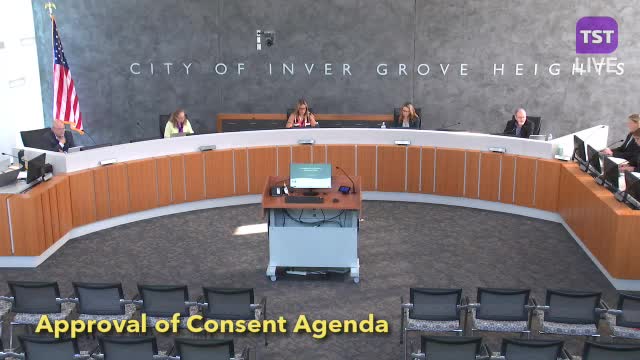
The Inver Grove Heights Economic Development Authority on Monday, Sept. 8 reviewed a draft update to the city's business public subsidy policy and discussed eligibility criteria, reputation standards and next steps for public hearings, but did not vote to adopt the policy.
The policy revision, presented by Director Zemer, would replace a 1999 policy (Resolution 99-202) and establish a defined application process, minimum and desired qualifications for public financial assistance and a transparent review involving city staff and the EDA. Director Zemer described the draft as intended to be consistent with similar policies in other cities and to make the process clear for staff, developers and business owners.
Under the draft, public assistance could include business grants and loans, tax increment financing or tax abatement, fee waivers, and land contributions or infrastructure. The draft also lists examples of non-subsidy assistance such as local funding under $25,000, façade improvement grants, revolving loan programs and utility-installment agreements or forgivable loans tied to continued operation. Director Zemer said, “These are the most common types that cities typically see and that what I would envision that we might see here such as business grants and loans, tax increment financing or tax abatement, fee waivers, and land contributions or infrastructure.”
The draft sets minimum employment and wage criteria for projects seeking subsidy: applicants would generally need to create at least two permanent full-time-equivalent jobs with benefits, and those positions must pay at least 200% of the state minimum wage. Director Zemer cited the state minimum wage figure used in the draft, $11.13 per hour, and noted the policy's 200% requirement translates to $22.26 per hour under that baseline. The policy also ties desired qualifications to the city's 2040 Comprehensive Plan, listing priority development areas such as the Concord Boulevard neighborhood plan, Robert Street and 70th Street West, Arbor Point and the Cahill commercial area.
Staff would review applications with the city's financial consultant and prepare findings for EDA consideration. Director Zemer said the draft includes a pre-application review option intended to save applicants time: for about $2,000 the city's financial consultant would perform an early evaluation to indicate whether a full proposal is likely to qualify. "You provide us with all the data. Our financial consultant will sort of do a review. That way, you're not spending a lot of time, energy, and money to sort of get a result that says it doesn't qualify," Zemer said.
Members asked how "but-for" analyses would be produced and whether the city contracts with a single firm for that work. Member Murphy asked, "Is there one firm that does the actual but-for analysis? Or do we have several to choose from?" Director Zemer replied, "So right now our financial advisor is Ehlers. Ehlers. So we would work with them to do that type of analysis."
Commissioner Takach and other members discussed language in the draft that refers to an applicant's "general reputation." Takach asked how staff would evaluate reputation and cited the Yellow Tree project as an example of past concerns. Some members said the EDA and council should be able to consider an applicant's history on a case-by-case basis, while several members expressed reluctance to direct staff to investigate routine contractor or subcontractor disputes. As one member put it, staff time should not be spent chasing unverified rumors about contractors. The group discussed leaving investigatory weight to the council at the recommendation or hearing stage rather than requiring extensive pre-application background checks for every applicant.
On procedural points, Director Zemer confirmed the EDA would review and recommend subsidy requests to the City Council; fee waivers could go directly to council and tax-increment financing requires council action to create a TIF district. Zemer said both the EDA and council would need independent public hearings to adopt the same policy.
No adoption vote occurred. Staff said it would prepare a revised draft with minor language changes suggested by members and circulate it in advance of a future meeting. Zemer said staff is considering a special EDA meeting on Oct. 6 (a council workshop night) or the regular Oct. 13 EDA meeting for the required public hearing and possible adoption in order to keep timelines aligned with an active project related to Interstate Industrial, LLC.
The discussion combined policy detail (eligibility, wage and job minimums, types of assistance), procedural constraints (public hearings, EDA recommendation to council, council authority over TIF) and implementation details (use of consultant Ehlers, $2,000 pre-application review). Several members pressed staff to clarify how reputation language would operate in practice and to limit staff time spent investigating contested subcontractor claims before council review.
Staff did not present a final recommendation or vote on the policy at the meeting; the EDA directed staff to return a revised draft and schedule the public hearing(s) necessary for adoption.