Get Full Government Meeting Transcripts, Videos, & Alerts Forever!
Get email alerts on the Privacy Surveillance topic
No spam. Unsubscribe anytime.
Council orders review after public concern over license‑plate reader vendor sharing and Flock Safety
Summary
After city residents raised privacy and civil‑liberties concerns about Flock Safety and license‑plate reader deployments, the Cambridge City Council asked staff to review implications of recent developments and recommend adjustments to the city’s deployment plans.
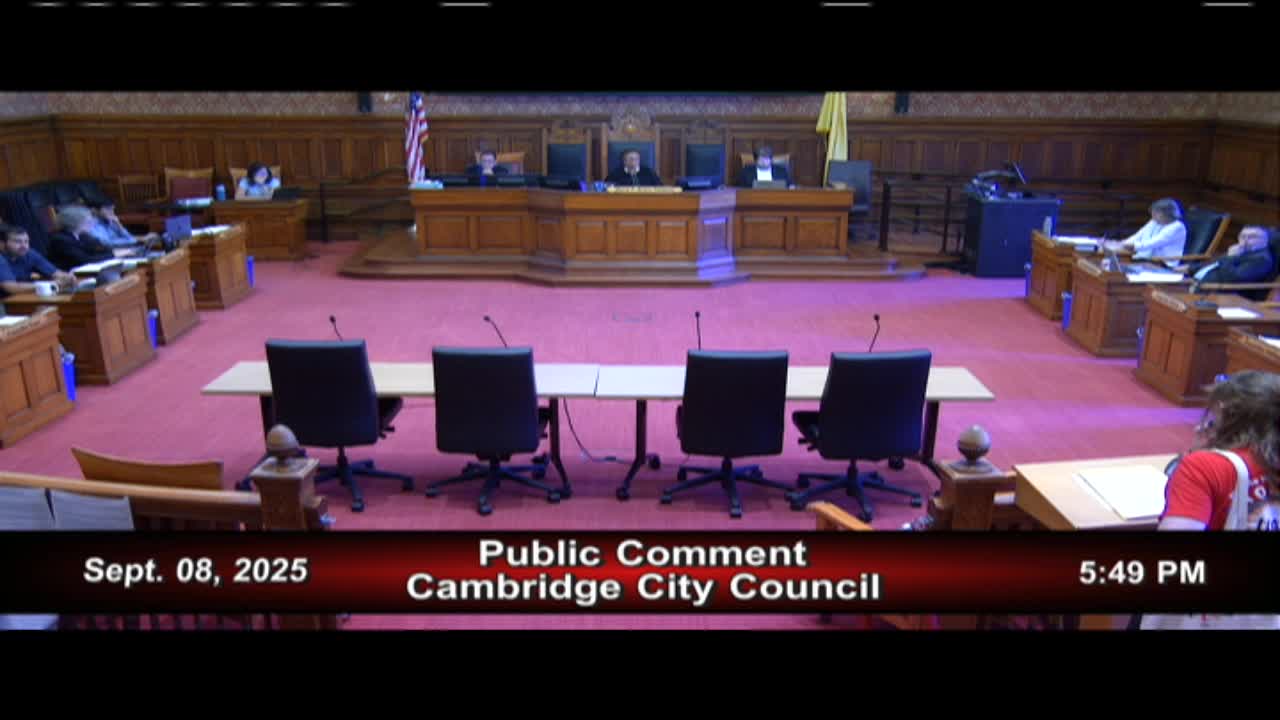
Public commenters urged the Cambridge City Council on Sept. 8 to pause or re-evaluate any contract with Flock Safety, a private license‑plate camera vendor, following news that the company had shared data with federal agencies in other jurisdictions.
Siobhan McDonough, who identified herself with the Democratic Socialists of America, said Cambridge should “protect our neighbors from the lawless federal government and deceptive surveillance contractors,” and urged a yes vote on Policy Order 10 to block cooperation with the federal government. Other speakers — including Alex Matthews and Jacob Brown — warned that Flock’s algorithms and features (for example, convoy searches and multi-location queries) can create suspicion without probable cause, and that Flock has acknowledged sharing data in ways that raised legal questions in other states.
The council considered a staff review request addressing the implications for Cambridge of deploying license‑plate readers. Sponsors noted Boston’s pilot using Flock cameras had resulted in a decision to prohibit sharing the city’s database with outside agencies out of concern about potential misuse. Councilors amended and adopted a motion asking the city manager to consult relevant departments and report back with recommendations on whether Cambridge should change plans for deployment in light of recent developments.
City staff said the Cambridge Police Department has sought to design agreements to keep city data segregated and under local control, but the manager and several councilors said technology and vendor practices have evolved quickly and merit a fresh look. The law department and police leadership were asked to participate in the review.
Why it matters: License‑plate readers capture granular movement data tied to vehicles and can be accessible across networks operated by private vendors. Residents and civil‑liberties groups urged the city to ensure that any program preserves local control of data and prevents sharing that could lead to misuse by federal or out‑of‑state actors.
What’s next: Council adopted the amended policy order and asked the city manager to prepare recommendations; staff will consult police, law, privacy advisers and civil‑liberties stakeholders before returning with a report.