Get Full Government Meeting Transcripts, Videos, & Alerts Forever!
Get email alerts on the Economic Development topic
No spam. Unsubscribe anytime.
Cambridge business groups ask council to redirect tourism dollars to neighborhood associations
Summary
Leaders of neighborhood business associations urged the City Council to repurpose municipal tourism funding toward local business improvement groups and event support, arguing local groups run day-to-day programming that drives foot traffic and benefits small businesses.
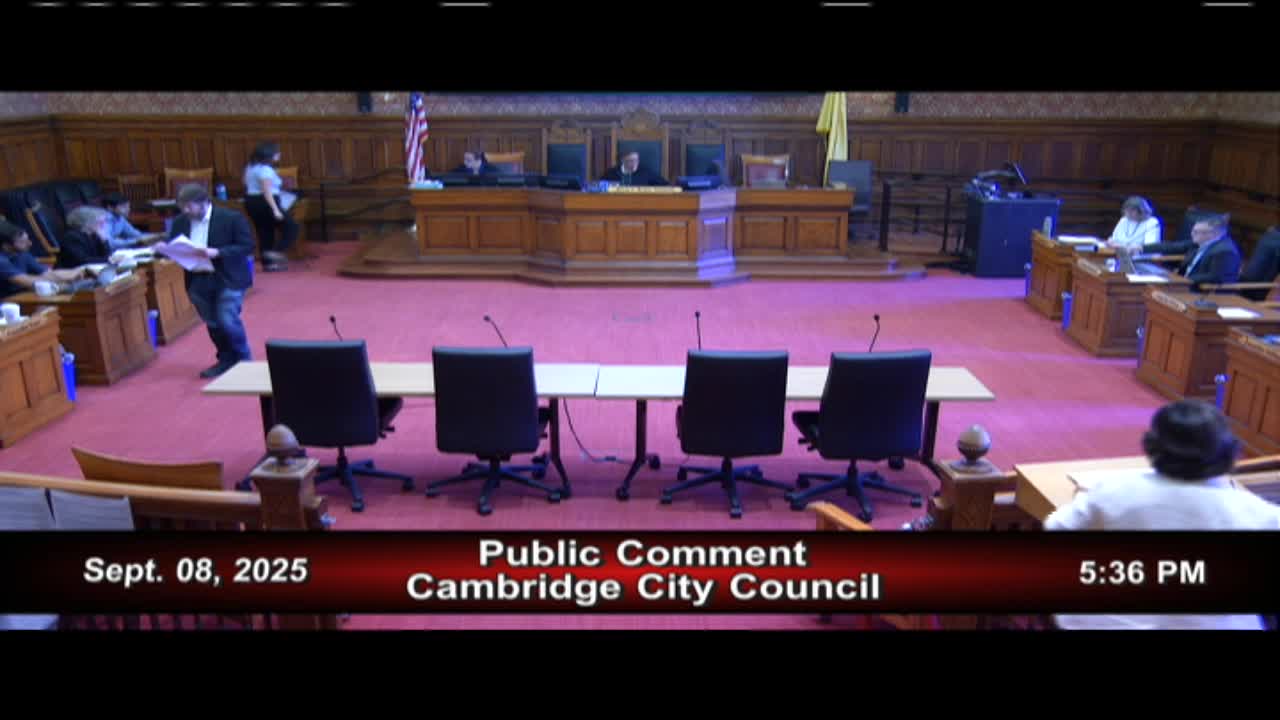
Denise Jillson, executive director of the Harvard Square Business Association, told the Cambridge City Council on Sept. 8 that Policy Order 116 — which would define the city’s financial role in supporting large-scale events hosted by Cambridge nonprofits — and Policy Order 117 — which would redirect municipal tourism dollars to neighborhood business associations — should be adopted to help neighborhood organizations afford public programming.
“These events require thousands of dollars in funding,” Jillson said, and “over the years the responsibility has fallen on the shoulders of the organizers who have been primarily the business associations.” She noted the council recently appropriated $25,000 to study a Porter Square association and argued the city should treat neighborhood associations as partners in preserving vibrant commercial districts.
Jessica Scully, board chair of the Harvard Square Business Association, told the council the Cambridge Office for Tourism now has nearly $2 million annually through the Tourism Marketing District (TDMD) program and that municipal tourism allocations would have greater impact if they directly supported the four place-based organizations that manage on-the-ground services: the Central Square BID, the East Cambridge Business Association, the Harvard Square Business Association and the Kendall Square Association.
“Investing locally ensures Cambridge stays vibrant square by square,” said Michael Monastem, president of the Central Square BID, who noted that arts and cultural programming “are part of our civic identity and economic life.” Monastem said a clear policy would help nonprofits plan and budget for events such as Porch Fests, block parties and markets.
Supporters urged coordination between the city tourism office and the neighborhood groups, and recommended accountability measures such as annual operating plans and quarterly reporting so the council can evaluate results. Opposition was not recorded in public comment at the Sept. 8 meeting; council debate on the orders was deferred under charter rights to allow further review and outreach.
The council did not vote on Policy Orders 116 or 117 at the Sept. 8 meeting. Councilors asked staff to coordinate and report back so the council can consider precise implementation steps and equitable distribution formulas.
Why it matters: Cambridge’s neighborhood business associations operate day-to-day programming that directly affects retail and restaurant vitality; shifting municipal tourism dollars to those groups would change how the city allocates local resources for place-based activation and could alter accountability and reporting lines for those funds.
What’s next: Sponsors said they will continue outreach and bring revised proposals back to the council for committee review before a final vote.