Get Full Government Meeting Transcripts, Videos, & Alerts Forever!
Get email alerts on the Land Use topic
No spam. Unsubscribe anytime.
Frederick Health master plan continued after multi‑hour traffic review; developer to return in November
Summary
The Frederick City Planning Commission continued consideration of the Frederick Health Village master plan to the Nov. 10, 2025 meeting after hours of staff, applicant and public discussion focused on traffic impacts, proposed road improvements and phasing of up to 750 residential units.
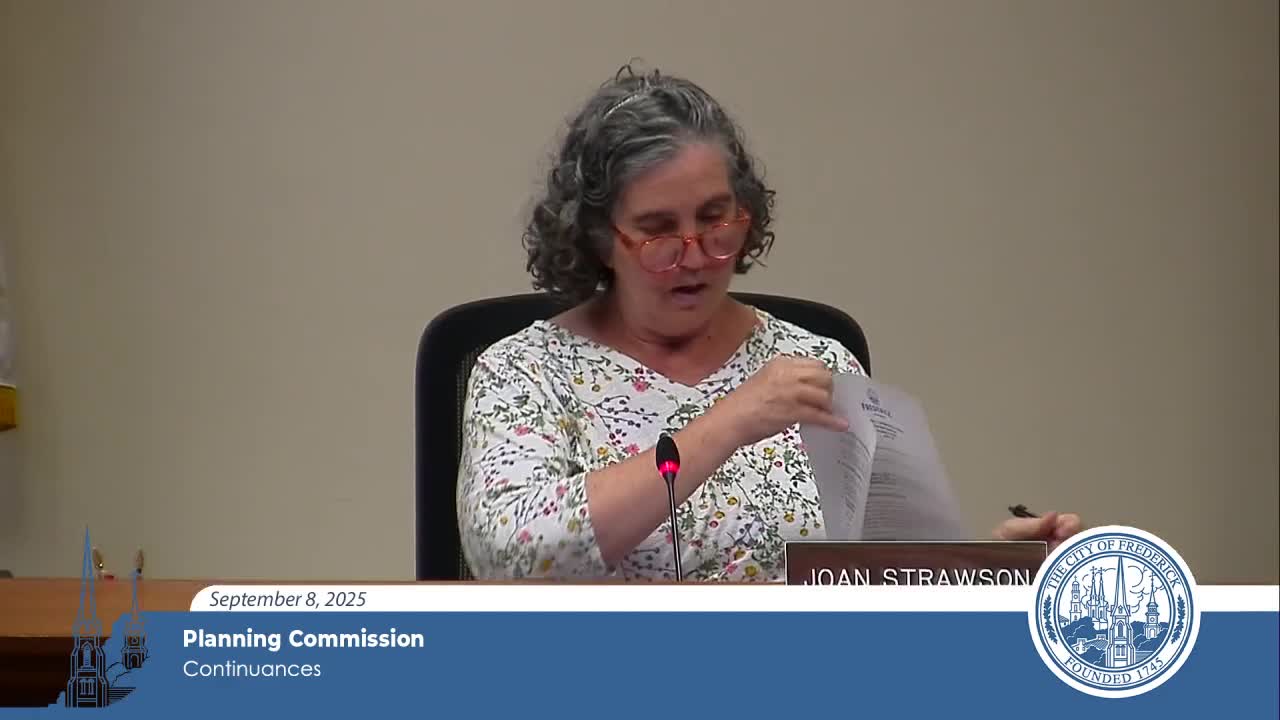
The Frederick City Planning Commission on Sept. 8 continued action on PC-24-662, the Frederick Health Village master plan, to the Planning Commission hearing on Nov. 10, 2025. Commissioners voted unanimously to continue the matter after a multi-hour presentation and public comment period concentrated on a traffic impact analysis and a package of mitigation measures the applicant says will reduce localized congestion.
The application before the commission is for a mixed‑use master plan that would include medical campus uses and up to 750 residential units; the applicant’s original traffic study also modeled a larger, higher‑density scenario. Bruce Dean, attorney for the applicant, told the commission the larger study was intentional. “This is not a typo,” Dean said, describing an earlier study scenario that modeled up to roughly 1,200 residential units to test a range of potential future build‑out. The applicant emphasized, and documents before the commission confirm, that the plan currently under review proposes 750 residential units.
Why it matters: Commissioners and members of the public repeatedly said traffic and roadway capacity along Monocacy Boulevard and Maryland 26 are already strained, and signaled they needed clearer phasing and mitigation commitments from the applicant before voting on findings of adequacy under the city’s Adequate Public Facilities rules. The applicant and its traffic consultant described a mix of developer‑funded improvements and longer‑range state projects they say will be required to maintain acceptable operations.
Most important facts
- The applicant reduced its earlier request from seven intersections to four for findings of road adequacy after revising the traffic analysis; several intersections remain the subject of mitigation or longer‑term plans.
- Traffic engineer Joe Colajaro of The Traffic Group described the study methodology and told the commission the team collected counts during 7–9 a.m., 4–6 p.m. on weekdays and 11 a.m.–1 p.m. on a Saturday to develop capacity, operations and 90th‑percentile queue analyses. “We collect data from 7 to 9 in the morning, 4 to 6 in the evening, and 11 to 1 on a Saturday,” Colajaro said.
- The developer described immediate and near‑term off‑site work it will fund, including a 100‑foot northbound left‑turn lane extension on Monocacy Boulevard at Mill Pond Road and restriping to create a two‑way left‑turn lane at selected locations. Joe Colajaro estimated the developer‑side improvements presented in the traffic materials will cost on the order of $8,000,000.
- The project team also pointed to longer‑range improvements listed in the Maryland State Highway Needs Inventory and the city’s comprehensive plan (2020), including a comp‑plan “Grange Mill Road” parallel facility and a potential future interchange on Maryland 26. Those latter elements require state planning and funding and are not developer commitments.
What commissioners and the public said
Planning commissioners pressed the applicant to show clearer links between phasing, building permits and delivery of roadway improvements. Commissioner Manelas repeatedly asked which roads and which phases would be built when; the applicant said the primary comp‑plan road connection would be required as part of Phase 1 because the residential subdivision cannot be created without a city road providing frontage.
Public commenters voiced mixed views. Some neighborhood residents said existing congestion at Monocacy Boulevard, Shorebird Road (Walmart entrance) and the Maryland 26 corridor is already severe, with drivers running red lights and long queues. Supporters told the commission the proposal would provide neighborhood services, health care access and 306 net new workforce‑housing opportunities within walking distance of services.
Applicant perspective
Don Schilling, vice president of business development for Frederick Health, said the health system acquired the property in 2019 and has looked at multiple long‑term options to serve future health needs. Schilling told the commission that without a master plan approval the project cannot proceed to necessary site planning, which he said could jeopardize planned investments. “We’ve done what we can on our part to satisfy the criteria,” Schilling said.
Next steps and the commission’s action
After hearing staff, the applicant and public comment, the commission voted unanimously to continue consideration of the master plan to the Nov. 10, 2025 Planning Commission meeting so the applicant can provide a clearer phasing schedule and written commitments tying specific mitigation steps to building permits and phases of development.
Ending note
Staff emphasized that three of the constrained intersections identified in the traffic analysis are already operating at degraded levels and that some mitigation will depend on capital projects the state must fund. Commissioners asked the applicant to return with a clearer, visually organized phasing plan showing the timing of key road improvements, the relationship to building permits, and any commitments on affordable housing or senior housing types that could reduce trip generation.