Get Full Government Meeting Transcripts, Videos, & Alerts Forever!
Get email alerts on the 2026 State Legislative Agenda topic
No spam. Unsubscribe anytime.
DeKalb Operations Committee vets proposed 2026 state legislative agenda; rental registry, 9‑1‑1 funding and annexation reforms highlighted
Summary
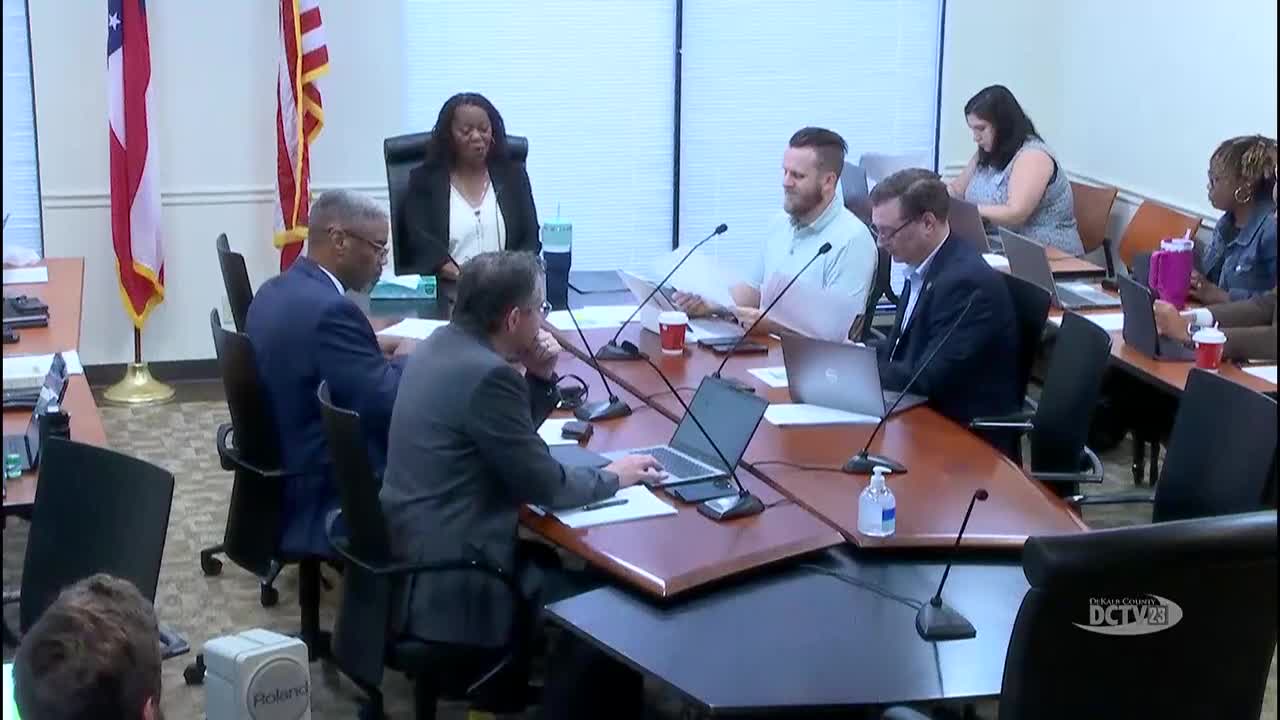
Marita Davis Johnson, chair of the DeKalb County Board of Commissioners’ Operations Committee, opened a special meeting to review a proposed 2026 state legislative agenda and directed staff and outside counsel to refine the packet for a follow‑up vote.
Marita Davis Johnson, chair of the DeKalb County Board of Commissioners’ Operations Committee, opened a special meeting to review a proposed 2026 state legislative agenda and directed staff to refine the package for a follow‑up vote.
The committee considered a staff and outside counsel proposal that condenses 16 initial ideas into 10 recommended legislative priorities and a set of support statements. Dan Baskerville of Dentons, who helped draft the packet, told the committee the material groups items into three categories: matters the county can handle locally without state law changes; issues that are primarily federal; and items that require additional review or did not meet voting thresholds during an earlier retreat and work session.
Committee members focused discussion on several recurring topics. The top item on the draft list is a “comprehensive property ownership database (rental registry).” Committee members and counsel clarified that existing state law currently prevents requiring all rental property owners to register, but the county can compile owner information from public records and existing administrative sources. Dan Baskerville and county counsel advised that the most complete statutory solution to identify owner‑ versus tenant‑occupied properties would require a change in state law; the county can, in the interim, gather data from utility accounts, business licensing, tax records and the Secretary of State.
Commissioners pressed several operational options: creating a local opt‑in registry tied to business license renewal, requiring property owners to designate an in‑state registered agent, or seeking narrowly tailored state legislation limited to investor‑owned properties. County staff agreed to research whether corporate ownership records and registered‑agent information could be provided to the county without further state action.
Tenant protections were discussed together as related items. The packet notes a pending bill from the prior session (listed in the material as House Bill 687) that would require disclosure of fees commonly called “junk fees” in advertisements and leases. The committee also discussed a separate proposal to authorize the county to forgive a tenant’s water bill and charge the amount back to a landlord when the bill is in the tenant’s name and the tenant has provided written notice of a leak that the landlord fails to repair. Staff told commissioners the county can already choose to write off tenant charges internally, but the ability to seek reimbursement from owners or place a lien would likely require state law change because the county’s current contractual recourse follows the named ratepayer.
Annexation and new‑city reforms were among the items committee members urged keeping on the agenda. Commissioners said they view measures that would limit annexation without county support or restrict use of taxpayer funds for annexation consultants as high priority. Members noted Georgia Municipal Association (GMA) typically opposes many county‑led annexation reforms and that these bills have a predictable, often contentious path at the legislature.
NextGen 9‑1‑1 funding was identified as another priority. Staff noted DeKalb has already invested $8 million in an ESInet platform to support NextGen 9‑1‑1 integration and would seek clearer statutory authority or additional state funding to ensure flexibility to use designated 9‑1‑1 revenues for related technologies such as a county real‑time crime center. Committee counsel said most functions of a real‑time crime center likely fit existing funding categories but recommended adding explicit allowable language to remove doubt.
Other items discussed included: increased behavioral health funding with emphasis on crisis‑diversion and crisis‑center capacity; expanded eligibility and reimbursement from the state solid‑waste trust fund for large or repeated tire dump cleanups (with a carve‑out for counties over 500,000 in population); expansion of teleconference authority for certain boards and agencies (the group noted state law currently requires a quorum to be present in person for elected bodies); parity for county authority to adopt ordinances about possession of small amounts of marijuana (to match municipal authority); and authorization for community service aides to handle minor injury and property‑damage traffic incidents under an optional local opt‑in model.
Commissioners also asked staff to revisit a support statement about MARTA capital‑funding reform that had not been included in the top 10 because more work is needed to identify whether the desired changes would be negotiated with MARTA and other jurisdictions or would require state law. The committee also discussed who the relevant stakeholders and likely opponents might be for each item (for example, apartment owner associations or municipal groups), and whether drafting narrower, targeted language could improve the prospects of passage.
Next steps the committee directed: staff and Dentons will rework several items into clearer statutory language where needed; staff will collect additional data (for example, the number of code enforcement cases where owners could not be reached, and a list of boards that currently meet virtually); the committee will circulate written suggested edits and memos to commissioners and staff; and the Operations Committee planned to vote on the refined legislative agenda at its next meeting (the chair asked that comments be submitted in advance so that the committee can select a final top three priorities to present to the county’s legislative delegation at an October delegation lunch).
The committee motioned and voted to adjourn before the scheduled close of the special meeting.
Sources: remarks and exchanges on the record at the Operations Committee special call on DeKalb County’s proposed 2026 state legislative agenda, including presentations by Dan Baskerville (Dentons) and remarks from Operations Committee Chair Marita Davis Johnson, Commissioners Robert Patrick and Ted Terry, staff representing the CEO, and county legal staff including Michael Penning.