Lifetime Citizen Portal Access — AI Briefings, Alerts & Unlimited Follows
Council urges water director to exempt Pulelehua phase 1 from availability policy as West Maui housing delay draws criticism
Loading...
Summary
Maui County Council passed Resolution 25-171 asking the Department of Water Supply to find phase 1 of the Pulelehua project exempt from the county’s water availability policy, citing West Maui’s post-fire housing emergency and the project’s 240-unit, 100%-affordable phase.
The Maui County Council on Sept. 8, 2025, adopted Resolution 25-171 urging the Department of Water Supply to find that phase 1 of the Pulelehua project in West Maui is exempt from the county’s water availability policy, a step proponents said is needed to advance a 240-unit, 100%-affordable first phase of a larger 800-unit project.
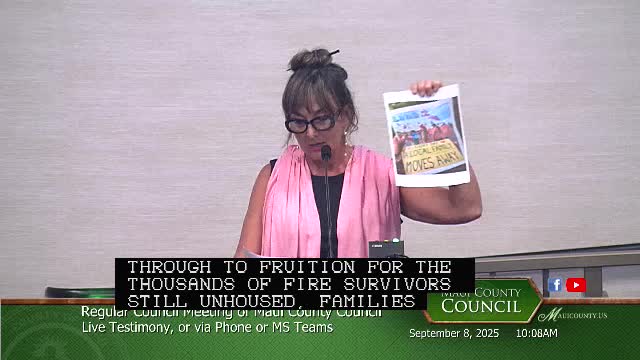
Council members and public testifiers framed the action as urgent recovery work following the August 2023 wildfires. Kai Nishiki of Maui Nui Resilience Uhui told the council that hundreds of fire-affected families remain displaced and that Pulelehua is a fully entitled site that could deliver affordable homes quickly.
The resolution cites a 2019 Hawaii housing planning study and FEMA program timelines to argue for expedited action; it asks the water director to negotiate with private well owners and water service providers to allocate additional storage and reach equitable outcomes. Proponents said the county has previously applied the same exemption to other projects and urged consistent application.
Opponents and cautious council members noted constraints. Vice Chair Yuki Lee Sugimura said Seawater/Commission on Water Resource Management (CWRM) and state processes play a central role in allocations in West Maui’s water management area and cautioned that the county alone cannot commit new uses without coordination. Several council members sought and secured an amendment transmitting the resolution also to the Commission on Water Resource Management to ensure coordination and consistency across state and county authorities.
Council debate balanced a demonstrated housing need against legal and technical limits on water allocations. Supporters argued the exemption is narrowly tailored to phase 1 (100% affordable), would help unlock federal and private financing, and could speed housing for displaced residents. Council members also expressed concern about perceived delays in other West Maui projects and asked the administration to be proactive in reaching solutions.
The council adopted the resolution with an amendment to include the state water commission among recipients; the motion passed in the final roll call (majority in favor with two members recorded as excused). The resolution transmits copies to the Department of Water Supply, the Board of Water Supply, the Commission on Water Resource Management, and the mayor.
Clarifying details: the resolution identifies Pulelehua phase 1 as 240 rental units that are 100% affordable and references the project’s earlier entitlements; it points to FEMA and other timelines that proponents say make rapid housing essential. The resolution asks the Department of Water Supply to seek additional storage and to negotiate with private well owners or water service companies where appropriate.
Next steps: the resolution is an urging measure; it asks the water director to consider an exemption and to work with water providers. It does not itself alter water law or guarantee allocation; the director and state agencies retain legal authority over water-use decisions.