Get Full Government Meeting Transcripts, Videos, & Alerts Forever!
Get email alerts on the Affordable Housing Ke Kahua topic
No spam. Unsubscribe anytime.
Maui Council approves exemptions for Ke Kahua (Waiʻahu) affordable housing amid disputes over title and cultural claims
Summary
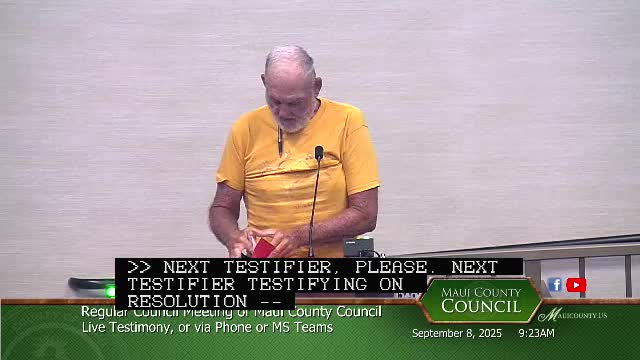
The Maui County Council approved Resolution 25-167, granting exemptions tied to an affordable housing project in Waiʻahu despite testimony from multiple lineal descendants and community members who questioned clear title and raised cultural, water and traffic concerns. The vote was close at 5-4 after an amendment restricting transfer language.
The Maui County Council approved Resolution 25-167 on Sept. 8, 2025, authorizing exemptions from parts of Maui County Code for the Hale Maha Olu–Ke Kahua affordable housing project in the Waiʻahu area, with a final 5-4 vote after an amendment limiting how project interests could be transferred.
Supporters, including representatives of housing and social service groups, argued the project will add needed affordable units in a county facing severe housing shortages. Paul Tonneson, a child advocate, said he has seen people sleeping in cars and called projects like Ke Kahua “tremendously impactful” for families and survivors of domestic violence seeking stability.
Opponents — many of them identifying as lineal descendants of families with historical ties to the Waiʻahu area — urged delay and committee review. Testifiers raised three recurring concerns: whether Maui Economic Opportunity (MEO) has clear title to the parcel, the presence of iwi (ancestral remains) and kupuna burial sites, and whether the surrounding infrastructure (water, roadways and school capacity) can support the development.
“Something smells,” said Bridal Saracen, vice president of the Waihi Community Association, noting the project was approved in 2022 but had seen no ground-breaking and warning the housing might not remain affordable if costs have risen since approval. Several other speakers echoed concerns about clear title and water access. Ruben Ignacio, a retired Hale Maha Olu staffer, said waitlists for existing affordable housing can run five to 10 years and urged the council to make the process “easier, not more difficult.”
Lineal descendants repeatedly invoked historical documents and court filings. Several speakers, including Joycelyn Costa and Kainilo Kamanu, asked the council to refer the item back to committee to allow a fuller review of cultural- and title-related evidence and to protect traditional and customary rights under Article XII, Section 7 of the Hawaii Constitution.
Developers and project proponents told the council they needed the council action to secure financing. At the meeting, developer representatives said the change the council was being asked to approve would allow the financing structure to proceed while the landowner (MEO) would remain the land lessor. The council amended the resolution’s exemption wording to explicitly allow a leasehold interest in the project to be transferred while providing that “Maui Economic Opportunity Inc. remains the land lessor.” That amendment was added to address concerns raised during public testimony about transfers of ownership of improvements on the land.
Council debate focused on balancing the urgent local housing need with the public testimony about title and cultural claims. Members emphasized that the county does not determine land title and that disputes generally are resolved in court, but several members said they were mindful of community concerns and wanted clear guarantees that cultural practices and any discovered iwi would be protected during development.
The final vote on the resolution as amended was 5 in favor and 4 opposed. The council also adopted a companion amendment to limit the scope of transfers of leasehold interests and to require that MEO remain the land lessor.
The project and exemptions approved by the council remain subject to the terms approved in the measure and to any other legal or regulatory steps required for development, including archaeological monitoring and any further judicial actions regarding title. Proponents said they expect to proceed with financing steps; opponents said they were considering next steps for protecting cultural and ancestral interests.
Clarifying details: the project has been on the county’s approvals pathway since 2022, testifiers said; opponents argued that no ground has been broken since approval. Witnesses raised water and traffic capacity as substantive concerns and said prior analyses may be void or outdated. Testimony referenced a MEO deed dated in the 2000s and a claim that litigation and court findings leave potential title issues unresolved.
Next steps: the project’s backers said they will continue to pursue permits and financing; several lineal descendants urged additional committee-level review and said they will pursue protections for access and cultural practices. The county’s role is limited to land-use exemptions and financial approvals; questions about legal title remain matters for the courts.