Get Full Government Meeting Transcripts, Videos, & Alerts Forever!
Get email alerts on the Surveillance Flock Cameras topic
No spam. Unsubscribe anytime.
Hundreds of residents urge Eugene leaders to cancel Flock camera contract; council schedules work session
Summary
At the Sept. 8 Eugene City Council meeting, about 69 people used the public comment period to call for cancellation of the Eugene Police Department's contract with Flock Safety, citing privacy, immigration enforcement and accuracy concerns. Councilors scheduled a work session to review the system but took no vote to end the contract.
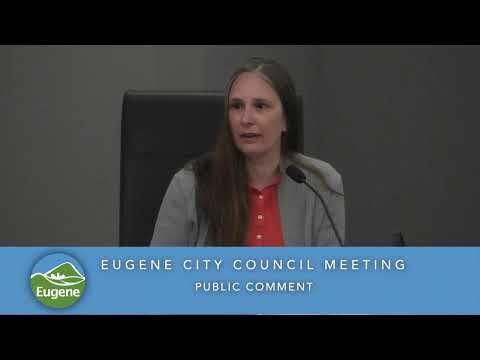
About 69 people who signed up for public comment pressed the Eugene City Council on Sept. 8 to halt the city's use of Flock Safety's automatic license plate reader (ALPR) camera system and to cancel the police department's contract.
The speakers, representing residents, community advocates and faith leaders, said the cameras create a nationwide database that can be accessed by other agencies, risk misuse by federal immigration authorities, are vulnerable to errors and hacks, and may violate Oregon law and the city's sanctuary commitments. No formal council vote was taken; Councilor Yeh said a work session on the technology has been scheduled after she advanced a council poll, and the mayor said the issue will return to the council for further discussion.
The concerns focused on a few recurring points. Kaylee Bronson Cook, who identified herself as a local resident and immigration advocate, said the system's national database makes it ‘‘easy for outside agencies, including ICE, to get access’’ and cited reports of Flock data used in immigration enforcement. Naftali Renshaw warned that Flock's corporate ties and data practices could put immigrants and other vulnerable people at risk and quoted a company acknowledgment that it had not created distinct permissions to ensure compliance with federal users.
Several speakers said the cameras do more than read license plates. Chloe Longworth noted the contract's master service agreement and said, ‘‘Flock picks up faces with facial recognition software. It picks up clothing. . . . That's not what a license plate is.'' Jacob Griffin, a resident who said he is a trans man, described fear among marginalized residents and said the cameras' presence had undermined trust in local officials.
Technical and legal concerns were raised by people who identified themselves as cybersecurity or legal professionals. Sam Edwards, who said he works in computer security, described the risk of a centralized, nationwide database with tens of thousands of authorized users and urged that the system's "attack surface" be reduced. Seth May read a letter from the Civil Liberties Defense Center arguing that the system likely violates Oregon Revised Statute 181A.250 (as cited in public comment) by collecting and maintaining information about people's activities without a criminal nexus.
Speakers also cited recent national examples in which ALPR data and Flock's systems were used by outside agencies, and noted local budget concerns. Justin Burns and Erin Kirkman pointed to the city's reported budget shortfall (reported in local media as approximately $11,500,000) and questioned spending on subscription surveillance rather than social services. Several speakers cited a $315,000 grant mentioned in public comment as the source of initial procurement funding.
Council response was limited during the meeting. Councilor Yeh thanked speakers and said, "I will admit that I did not educate myself to the level that I should have, and I'm learning a lot right now," and confirmed that a work session request she filed received enough support to proceed. The mayor said the council values public comment and that the topic will be back before the council for open discussion.
What the council did not do on Sept. 8 was vote to terminate the contract or to disable cameras immediately. Multiple speakers urged immediate suspension; others asked for a permanent ban on ALPR systems in Eugene. Several speakers referenced lawsuits and settlements in other cities stemming from misidentification and wrongful stops tied to ALPR systems.
The meeting record shows broad public opposition and a range of legal, technical and community-safety arguments for removing the system. Councilors and staff indicated they will examine the issue further in a work session and return to the council with more information; no formal direction to staff to cancel or suspend the contract was recorded on Sept. 8.
Votes at the meeting: the council approved two consent calendars earlier in the agenda. Consent Calendar 1 (minutes, tentative agenda, interim police commission appointments and voting delegate for League of Oregon Cities business meeting) passed on a motion from the council president, seconded and recorded as "8 2 0." Consent Calendar 2 (resolutions annexing land at 388 South Garden Way and 301 Azalea Drive) passed on a similar motion, recorded as "8 2 0." The council did not take votes related to the Flock contract during this meeting.
Looking ahead: councilors said the Flock issue will be discussed in an upcoming work session. Residents and advocacy groups in Eugene said they plan to continue public pressure and to provide legal and technical information for the council's review.