Get Full Government Meeting Transcripts, Videos, & Alerts Forever!
Get email alerts on the Variance Parliament Cove topic
No spam. Unsubscribe anytime.
Board defers decision on Parliament Cove height variance after mixed votes, asks staff to clarify variance vs. special-exception process
Summary
The Lago Vista Board of Adjustment on Sept. 8 deferred action on a requested height variance at 3109 Parliament Cove after votes both to approve and to deny failed to reach the 75% supermajority required by state law; the board unanimously voted to table the item and asked staff for legal and procedural clarification.
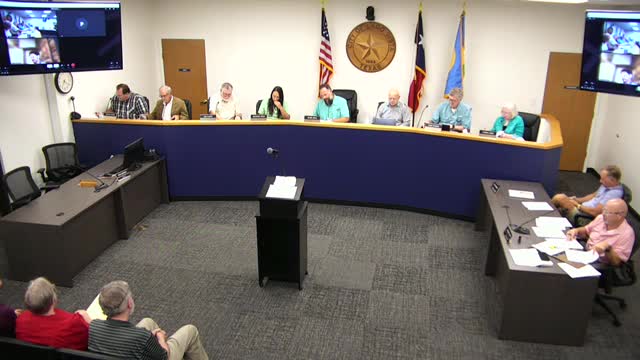
The Lago Vista Board of Adjustment on Sept. 8 deferred final action on a variance request from Michael and Vicky Belcher to exceed maximum height limits for a proposed single-family home at 3109 Parliament Cove (Highland Lake Estates). After an extended public hearing and an executive-session consultation with the city attorney, the board failed to adopt either approval or denial — several motions failed to receive the 75% supermajority required to authorize a zoning variance — and instead voted to table the item until staff returns with clearer legal guidance and corrected notice/application materials.
Applicants Kelsey Lynette Belcher and Vicky Belcher spoke in favor of the variance. Kelsey Belcher, who identified herself as the owner living behind the subject lot, said she is “the only resident whose view would be in any way affected” and said the additional 3 feet 4 inches would “greatly enhance” a craft loft used by her mother. Vicky Belcher said the lot is irregular, on a slope, and that the design preserves permeable surface and avoids windows facing neighboring backyards; she told the board that “there are no windows on the side that would look into anyone's yard.”
Neighbors opposed. Resident Vera Thompson's written opposition raised privacy concerns; Paul Prince asked the board to deny the request, saying the neighborhood has “0 homes built above the build ridge 15 feet” and warned that approval could set an unwelcome precedent for architectural consistency.
Staff reported the request was filed as a variance to exceed the maximum height; the city attorney explained the agenda wording described the requested relief sufficiently to put the public on notice but cautioned the board that legal standards for a variance differ from the special-exception provisions in the city code. During closed-session advice, the board reviewed the legal standard and the procedural history of the application.
Board members conducted multiple floor votes. An initial motion to deny failed to reach the 75% threshold required under state statute for variations; a later motion to approve also failed to reach the necessary supermajority. After discussion the board adopted a unanimous motion to table (defer) the item and requested that staff prepare a clear presentation explaining whether the request should be processed and considered as a variance or a special exception under city ordinance, verify mailed-notice lists, and confirm application materials before the item is re‑noticed and re‑scheduled.
The board also raised concerns about topography and lot uniqueness in deliberations: some members said the lot’s slope and the house footprint’s siting were arguments in favor of flexibility, while others emphasized consistency with nearby properties and precedent.
Actions recorded: two substantive motions (one to deny and one to approve) failed to reach the 75% approval threshold required for a variance; final motion to defer/table item (25-2852-VAR) — passed unanimously.
Proper names in the record include Michael and Vicky Belcher; Kelsey Lynette Belcher; Paul Prince; Vera Thompson; City Attorney Brad Bullock; City of Lago Vista (Chapter 14 zoning); and references to Texas statutory provision 211.009 (vote threshold for zoning variations) and the city ethics policy (section 1.1803) that limits certain appearances by council members before boards.
Board direction: staff to return with (1) clarification whether the application must be considered as a variance or a special exception under local ordinance; (2) corrected mailed-notice records and re-notification as needed; and (3) a staff presentation that aligns city code with the state statutory thresholds discussed in closed session.