Get Full Government Meeting Transcripts, Videos, & Alerts Forever!
Get email alerts on the Elections Residency topic
No spam. Unsubscribe anytime.
Lynnwood amends residency rules for elected officials; council adopts ordinance with changes
Summary
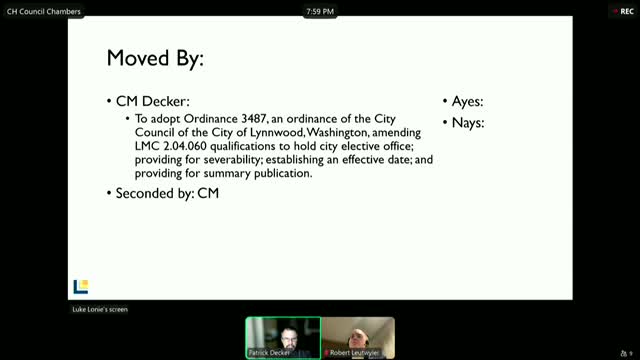
The council adopted Ordinance 3487 to amend qualifications to hold city elective office, requiring an annual residency affidavit, allowing hardship affidavits, and increasing a temporary non‑residency window from 60 to 120 days after debate on enforceability and vacancy language.
The Lynnwood City Council on Sept. 8 adopted Ordinance 3487, amending LMC 2.04.06 on qualifications to hold elected city office. The final ordinance, adopted unanimously, requires annual confirmation of residency and allows for limited temporary non‑residency with an affidavit; councilmembers also amended the draft during debate to replace a 60‑day allowance with 120 days and to add the word “paid” to a clause about holding another publicly elective office.
Key provisions: the ordinance, as adopted, keeps an annual affidavit requirement that councilmembers confirm they resided within Lynnwood city limits for the prior year, and permits a hardship/temporary non‑residency affidavit in narrowly defined circumstances. Council amended the draft to change the earlier language that had limited temporary non‑residency to “not to exceed 60 days in total” to a 120‑day limit. Council member Coelho successfully offered a technical amendment to insert the word “paid” before “publicly elective office” for clarity.
Debate and enforceability: the council spent substantial time debating whether the ordinance’s residency and vacancy language would be enforceable without court action. City legal counsel explained that an ordinance can state the qualifications and consequences, but if a sitting councilmember refuses to resign or accept a determination of non‑residency, enforcement would require judicial action. Councilmember Patrick Decker argued the ordinance and its “vacate/ resign” language set clear expectations: “I think it’s quite reasonable that if any council member ceases to reside within city limits, the council member shall vacate their position immediately.” Councilmember Escamilla said she was open to striking provisions that would appear to be unenforceable without litigation, adding that a court process would be required to compel removal.
Amendments and votes: an amendment to replace 60 days with 120 days passed on a unanimous roll call (7‑0). A separate motion to strike language that would direct immediate vacancy (lines 38–41 in the draft) failed (2‑5). A final roll‑call vote to adopt Ordinance 3487, as amended, passed 7‑0.
Why it matters: the ordinance clarifies expectations for residency among elected officials, establishes an annual attestation and a narrow hardship process, and signals the council’s intent to maintain local residency as a qualification while acknowledging practical limits to immediate enforcement.
Ending: staff will publish the ordinance summary and implement the affidavit process; councilmembers and staff discussed potential future clean‑ups of language to address timing and notice procedures.