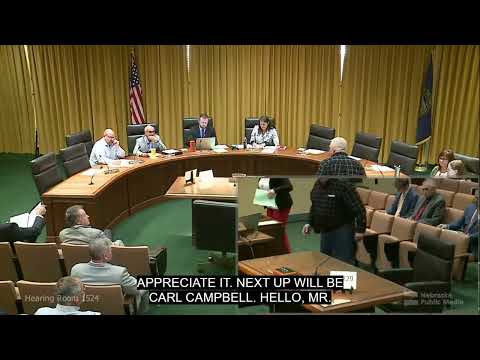
Nebraska committee studies firefighter cancer benefits, hears push for worker-comp presumptions
Loading...
Summary
The Nebraska Legislature’s Business and Labor Committee on Sept. 5 held an interim study hearing (LR229) to review the Firefighter Cancer Benefit Act of 2021 and proposals including LB400 that would change how firefighter cancer claims are handled under the Nebraska Workers' Compensation Act.
The Nebraska Legislature’s Business and Labor Committee on Sept. 5 heard invited testimony under LR229 examining the state’s Firefighter Cancer Benefit Act of 2021 and proposals — including LB400 — to change how firefighter cancer claims are treated under the Nebraska Workers' Compensation Act.
The study hearing brought career and volunteer firefighters, union leaders, medical experts and municipal representatives to the Capitol to describe the health risks firefighters face, to outline screening efforts and to debate whether presumptive coverage through workers’ compensation is necessary and financially feasible.
LR229 was introduced to gather information after earlier debate on LB400. Senator Stan Klaus, who said he was carrying the resolution at the League of Nebraska Municipalities’ request, described the study as an opportunity for additional dialogue after LB400 was pulled during the recent legislative session.
“Firefighters are 9 percent more likely to receive a cancer diagnosis than the general public. They’re 14 percent more likely to die from that same diagnosis,” said Trevor Towey, president of Omaha Professional Firefighters. “Our occupation is a class 1 carcinogenic. The highest classification of a known cancer causing agent is my profession.”
Several testifiers described research showing that modern building materials and combustion products contain carcinogens — benzene, polycyclic aromatic hydrocarbons, formaldehyde, dioxins and other volatile organic compounds — and that contamination of gear and stations creates secondary exposure routes. Sarah Janke, director of the Center for Fire Rescue and EMS Health Research, told the committee that “fires today burn faster, hotter, and dirtier than they ever have before,” and pointed to a 2022 International Agency for Research on Cancer (IARC) determination classifying firefighting as a Group 1 carcinogenic occupation.
Multiple witnesses urged expanded screening and earlier detection. Chelsea Connor, a physician assistant with Frontline Global Health, said her organization screened about 17,000 public-safety professionals and that “15 percent of them were found to have clinically significant findings that resulted in additional follow-up and screening for cancer.” Testimony and questioning also addressed available midcareer screening options (low-dose lung CT, full-body MRI, liquid-biopsy tests), the variable costs of those tests and practical barriers for rural departments to access mobile screening services.
Several firefighters gave personal accounts of diagnosis and treatment. Carl Campbell, a 39-year veteran of the fire service, described being diagnosed after a chest x-ray and CT-guided biopsy; “on April 2, I went into surgery ... and had a 5 pound tumor removed from my lung,” he said, and later began chemotherapy. Campbell told the committee he was able to continue pay and benefits because he had accumulated sick leave; without it “it would have been financially devastating to myself and my family.”
Union leaders pressed for a shift in the burden of proof. John Corrigan, speaking for Nebraska Professional Firefighters, said the current system requires the sick firefighter to establish work-relatedness and to fund expert opinions. “You pray for the dead and you fight like hell for the living,” Corrigan said, arguing LB400’s approach would place the initial burden on employers to rebut a work-related presumption.
Gary Bruns, president of the Nebraska Professional Firefighters Association, told the committee that the 2021 statute uses permissive language and thus has not resulted in any paid benefits: “Since its passage in 2021, not a single firefighter has ... received benefits under this act,” he said, urging consideration of LB400’s rebuttable-presumption model used by many other states.
Representatives of municipal governments — represented in the hearing record by a written statement from the League of Nebraska Municipalities — said municipal budgets make statewide, mandatory presumptions difficult to forecast and fund. The League’s statement said it opposed LB400 during the 2025 session and asked that the study examine models from other states and possible incentive or funding mechanisms before recommending an unfunded mandate.
Witnesses from other states described different approaches. Ryan Hanhian, retired Iowa firefighter and president of Iowa Professional Firefighters, described Iowa’s recent statutory change and said coverage in that state now provides presumptive coverage for cancers he described as being treated “at 100%,” including medical costs and compensation for qualifying career firefighters; he noted those protections did not extend to volunteers in the Iowa model.
Testimony also addressed program design and cost-management options: pilot-screening programs, mobile screening units to reach rural departments, negotiated screening contracts between unions and municipalities, trust models in which departments contribute to a pooled fund, and the potential for earlier detection to reduce treatment costs and overtime/turnover expenses.
The committee did not take a vote or adopt any legislative text during the hearing. LR229 will remain an informational interim study; committee members and stakeholders said they will continue to gather data on program costs, state-by-state models and screening access for volunteer and rural departments. The League of Nebraska Municipalities said it plans discussions with stakeholders and committee members to explore implementable options.
The hearing record includes testimony from elected lawmakers, union leaders, medical experts and volunteers that the committee can use as it weighs whether to recommend statutory change, incentives, or alternative, locally implemented programs in future sessions.