Nebraska Natural Resources committee opens interim study of nameplate capacity tax; developers, counties call for new analysis
Loading...
Summary
A Natural Resources Committee interim hearing on LR159 opened the state's review of the nameplate capacity tax, with renewable energy developers urging certainty and counties warning about local revenue impacts; several testifiers recommended a new independent economic study.
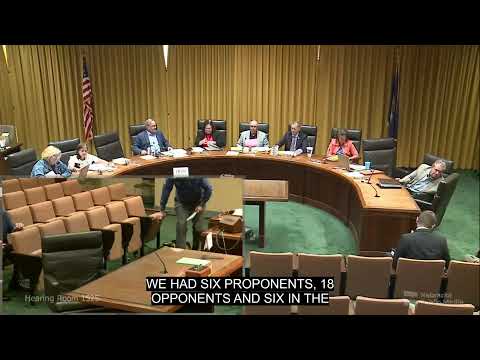
Senator Tom Brandt, chair of the Nebraska Legislature Natural Resources Committee, opened an interim study hearing on LR159 to review the state's nameplate capacity tax, the fixed excise charged per megawatt on utility-scale wind and solar. Testimony came from industry developers, county officials and utility representatives weighing competitiveness, local revenues and whether the 2010 formula remains appropriate.
The committee is examining whether the $3,518-per-megawatt rate set in 2010 still reflects current capital costs and county needs. "The nameplate capacity tax is a fixed excise tax and it's been fixed at that number for 16 years now," said David Levy, an attorney representing utility-scale project developers, who said a modern calculation could produce a different rate and recommended study by economists. "If we were to double the nameplate capacity tax, we would not be competitive. Full stop."
Why it matters: The nameplate capacity tax replaces a prior personal-property property tax regime for turbines and similar equipment and is distributed to local taxing entities in the same way as property tax revenue. Local governments, schools and special districts have relied on the revenue stream. Opponents and proponents agreed the amount has budgetary and competitive consequences; several urged a new, independent economic analysis before any statutory change.
What testifiers said: Levy, who said he helped develop the 2010 framework, described the original calculation and urged the legislature or stakeholders to commission a current study to recalculate an amount for wind, solar and utility-scale battery storage. "When solar was added to the nameplate capacity tax in 2015, we didn't redo the study," Levy said. He estimated, using assumptions he described as "lawyer math," that the equivalent nameplate amount for wind projects could be about $2,322 per megawatt today because equipment costs have fallen.
John Cannon, executive director of the Nebraska Association of County Officials, told the committee the excise tax was created to replace an earlier front-loaded personal-property tax that produced large early-year payments and little thereafter. Cannon said counties and local political subdivisions depend on the predictability of the excise tax and noted distribution changes made by LB50 in the last session that altered how some recipients (notably community colleges) are treated.
Industry perspective: Kevin Quinn, senior manager of government affairs for Invenergy, warned that late changes to the tax regime would delay or cancel projects. "In the short term, changing the nameplate capacity tax for projects and development will create delays," Quinn said, noting that developers and buyers price projects based on anticipated lifetime tax liability. AES's manager of government relations, Eric Stocker, said many projects are under long-term power purchase agreements and that a midstream tax increase could make projects uneconomic; Stocker said AES expected to pay about $5.5 million under current law for a particular project and that a near-doubling of the tax would create a substantial gap.
County and business interests: John Cannon repeated that counties that host projects receive most of the excise tax revenue and urged the committee to consider distribution when any change is proposed. Jennifer Krieger of the Greater Omaha Chamber framed the issue in economic development terms, saying businesses considering new facilities often consider generation capacity and the state's overall competitiveness.
Next steps and staff direction: Senator Brandt framed LR159 as an informational interim study and said he'd invited stakeholders and NACO to provide historical context. Several committee members and testifiers urged that any recalculation exclude existing, operating projects or projects under construction (a grandfathering approach) to avoid disrupting signed contracts and financing. Multiple testifiers recommended an updated, independent economic analysis (for wind, solar and battery storage) to supply the committee with current per-megawatt estimates before the next legislative session.
Ending note: No formal action or vote took place during the LR159 hearing; the committee heard invited testimony and signaled staff and stakeholder work to assemble updated studies and numbers for fall and for consideration during the next legislative session.