Get Full Government Meeting Transcripts, Videos, & Alerts Forever!
Get email alerts on the Social Services Performance topic
No spam. Unsubscribe anytime.
Glendale CDBG year-end report: 11 social-service partners meet or exceed goals; committee debates funding metrics
Summary
The CDBG advisory committee received a fiscal year 2024–25 year-end performance report showing all 11 funded social-service agencies met or exceeded service goals. Members debated how prior performance should shape future awards and discussed application minimums and monitoring.
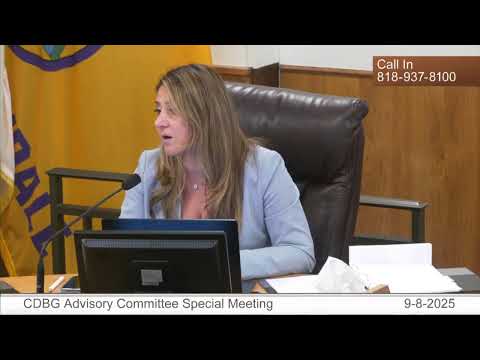
At a Sept. 8 special meeting, the Glendale Community Development Block Grant advisory committee reviewed year-end performance reports showing all 11 partner social-service agencies met or exceeded the outcomes in their contracts for fiscal year 2024–25.
Tamar Khabangian, project manager for the CDBG program, presented quarterly and year-end data for agencies that receive social-service CDBG grants. "All of our partner agencies have successfully reached their goals with some who have overachieved the goals," Khabangian said.
Performance highlights included: - Home Again Los Angeles (Crisis Aid for Homeless Families): served 57 households compared with a proposed 30; CDBG award: $15,498. - Armenian Bar Association (pro bono legal services): served 54 individuals compared with a proposed 25; CDBG award: $20,498. - Catholic Charities (Loaves and Fishes program): served 37 households compared with a proposed 35; CDBG award: $28,898. - Glendale Youth Alliance (youth employment): served 18 youths compared with a proposed 16; CDBG award: $15,498. - Armenian Relief Society (community outreach): served 207 individuals compared with a proposed 200; CDBG award: $65,498.
Khabangian and staff provided agency-by-agency outcome tables, program expenditures, and noted that most agencies had drawn down their awards. Committee members praised the agencies’ results but raised questions about how to weigh past performance in future award decisions and how to set realistic deliverables when committee award amounts differ from agency requests.
Committee discussion: minimums, application parameters and monitoring Several committee members suggested adding an explicit question in next year’s application asking agencies to state how many people they could serve at a proposed minimum funding level as well as at their requested level. Staff said the Zoom Grants application will include additional materials this year and that the committee will see prior-year performance data when reviewing proposals. Staff also said agencies often finalize their overall budgets in late spring when other funding sources are confirmed, which complicates setting fixed outcome numbers early in the application process.
HUD guidance and eligibility issues Committee members asked staff whether recent federal guidance — specifically executive orders and HUD direction staff had been asked to include in Glendale’s consolidated plan — will change eligibility or contract language. Staff said the consolidated plan was submitted to HUD with requested edits and that legal staff was reviewing executive orders. Staff noted HUD told cities to remove certain terms (examples cited generically in the meeting included immigration- and DEI-related language) from CDBG contracts where HUD has directed that wording be excluded. Staff also said HUD reminded agencies that HUD-funded activities must meet federal eligibility requirements (including income-eligibility verification); staff said that HUD clarified CDBG-funded activities cannot use HUD funds to directly serve undocumented populations where HUD guidance precludes it.
What the committee will do next Committee members asked staff to include prior performance summaries in the Zoom Grants packet and to consider adding a minimum-service parameter to the application. Staff said it would add an explicit question asking agencies to state how many people they could serve with a minimum award and would provide a report comparing requested versus funded amounts and the resulting goals.
Proper names and budgets noted in the presentation were provided in agency slides and are summarized in staff materials filed with the committee.