Get Full Government Meeting Transcripts, Videos, & Alerts Forever!
Get email alerts on the Fair Housing Policy topic
No spam. Unsubscribe anytime.
Planning commission approves fair-housing policy amendment, forwards recommendation to city council
Summary
Lake Oswego Planning Commission voted unanimously Sept. 8 to tentatively approve a comprehensive-plan amendment (LU25-0001) to add an “affirmatively furthering fair housing” policy and to direct staff to prepare findings for a recommendation to city council.
The Lake Oswego Planning Commission on Sept. 8 voted to tentatively approve a proposed amendment to the city’s Comprehensive Plan to adopt an affirmatively furthering fair housing policy and to direct staff to prepare findings, conclusions and an order for the commission’s next meeting.
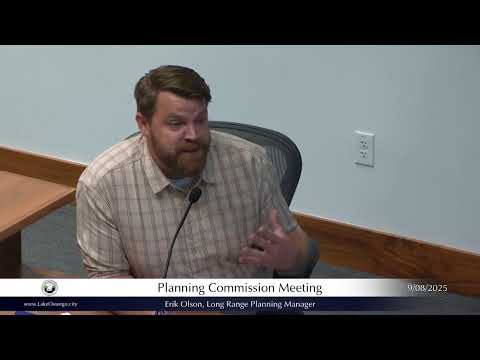
City planning staff described the amendment, LU25-0001, as a policy addition to the Complete Neighborhoods and Housing chapter that would add a new Policy B5: “employ strategies to affirmatively further fair housing by fostering inclusive communities, overcoming disparities in access to community amenities, enhancing housing choice for populations including, but not limited to, people in classes protected under federal and state fair housing regulations.” Eric Olson, the staff presenter, said the proposal was meant to create an explicit policy lens rather than to immediately change land use or production levels. Olson summarized the concept: “affirmatively furthering fair housing…really means that we have to consider sort of the location of housing” as well as the amount and types of housing.
The staff report tied the amendment to work the city already has completed: Lake Oswego adopted a Housing Needs Analysis in 2023 and a Housing Production Strategy (HPS) last year; the proposed policy is listed in the HPS as Strategy 13. Olson told commissioners the HPS and required state reviews provide regular, quantitative monitoring — while this policy is primarily a qualitative policy statement that will guide future findings and analysis.
City legal counsel Chris Crane, appearing for the city, said the amendment helps the city comply with state requirements and does not create new federal exposure. “The city is presently in compliance with all federal laws regarding housing, including fair housing,” Crane said, adding that the state requires jurisdictions above a certain size to adopt an HPS that addresses affirmatively furthering fair housing.
Commissioners discussed how the policy would be applied in future land-use decisions and how progress would be measured. Staff and commissioners noted that the city’s required monitoring of its HPS — including periodic reporting to the Department of Land Conservation and Development (DLCD) — would serve as a primary mechanism to track outcomes over time. Commissioners also referenced existing neighborhood planning issues, including Palisades and potential rezoning decisions such as the Foothills project, as contexts in which the new policy would be used to frame staff findings.
No public testimony was offered at the hearing. After deliberation, a commissioner moved to approve the proposal as written and direct staff to prepare findings and an order for the commission to adopt at its next meeting. The commission adopted that motion on a roll-call vote: Mitchell — Yes; Moreno — Yes; Rooney — Yes; Fly — Yes; Tween — Yes; Bruce — Yes. The motion passed unanimously.
Next steps recorded in the staff presentation: the commission expects to approve written findings and an order at its Sept. 22 meeting; the commission’s recommendation will go to city council for a public hearing Nov. 4, with council adoption anticipated on or about Nov. 18. Staff noted the education component of the strategy will continue through 2028 and beyond.
The amendment does not itself change zoning or authorize specific projects; staff and counsel emphasized the amendment is a policy commitment that will be applied when evaluating future land-use applications and that more detailed analyses (for example, an analysis of impediments to fair housing) are a later, required step under the HPS cycle.