Get Full Government Meeting Transcripts, Videos, & Alerts Forever!
Get email alerts on the Infrastructure Development Districts topic
No spam. Unsubscribe anytime.
Franklin reviews draft policy for state infrastructure-development districts amid concerns over scope and caps
Summary
City staff presented a draft policy for the state’s infrastructure development districts (IDDs) that would set measurable public-benefit criteria, disclosure requirements for buyers and propose an assessment-cap example; aldermen and members of the development community urged simplification and market alignment.
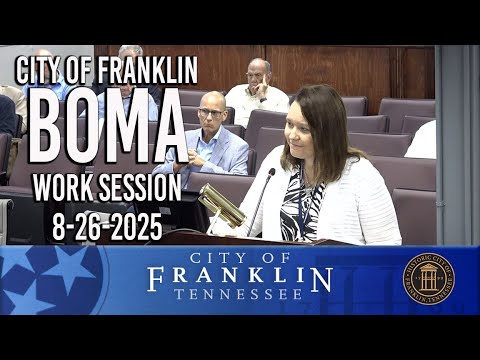
City staff and outside counsel presented a draft policy framework for Tennessee’s new infrastructure development districts (IDDs) to the Board of Mayor and Aldermen on Aug. 26, focusing on three sections: measurable public benefits, disclosure/transparency requirements and possible caps or parameters on special assessments.
Vernon (staff/counsel) outlined four categories of public benefits staff suggested the city require when granting an IDD: (1) construction or financial contributions to city priorities (multimodal improvements) valued at a minimum of 1% of the IDD-funded value; (2) public-infrastructure improvements beyond those required to serve the development, also valued at a minimum of 1%; (3) high‑quality placemaking and architectural elements exceeding base standards; and (4) preservation/restoration of historic resources or public art (also with a 1% valuation example).
A second category emphasized enhanced public service and safety, with items such as land dedication for public use (developers could dedicate at least 5% of site area or provide an equivalent cash contribution), additional public open space, emergency-service access design (4‑minute travel to 90% of units) and undergrounding off-site utilities. Staff also proposed long-term maintenance agreements to offset at least 50% of the city’s projected maintenance cost for nonstandard infrastructure created by a development.
On attainable housing, staff proposed that developments provide at least 10% deed‑restricted units for households between 50% and 150% of area median income (AMI) and an equal split between lower-income (<80% AMI) and workforce (80–150% AMI) units where applicable.
The transparency chapter would require developers and sellers to disclose district obligations, projected assessments and outstanding special-assessment debt to prospective buyers and to maintain a public website with formation documents, budgets, assessment rolls and other records. Staff suggested buyers acknowledge disclosures at least three business days prior to closing.
Staff also presented an illustrative cap approach tied to the city tax rate — for example, a five‑times multiple of the city tax line was used in an example to show how an assessment could appear on a tax bill. Counsel and staff emphasized the cap example was for discussion: the statutory protections (including a lien‑to‑value minimum commonly set at 2:1 by state law) and underwriting practices by bond purchasers also govern viability.
A lengthy board and public exchange followed. Multiple aldermen and development-industry speakers said the draft was overly prescriptive and potentially infeasible for market financing. Concerns included: overly detailed checklists that could exclude otherwise beneficial projects; redundant safeguards beyond the statutory lien/value rules; administrative burdens on staff; and the risk that rigid caps could make projects unfinanceable and shift costs back to developers or require buy‑downs at closing.
Speakers from the development community told the board that IDDs are a financing tool — not free money — and urged staff to craft a policy in partnership with developers so it is both market‑feasible and aligned with community objectives. Public commenters and board members flagged reputational risk if districts fail and asked staff to balance measurable returns to the public with market realities. Several aldermen highlighted transparency as crucial but said the benefits checklist should be broadened and made less prescriptive.
Staff said the draft would be revised with board feedback and that the policy includes additional implementation mechanics (application steps, bond underwriting and administration) not covered in this briefing. The transcript showed no formal vote; staff asked for direction and recommended further refinement with stakeholder input.