Get Full Government Meeting Transcripts, Videos, & Alerts Forever!
Get email alerts on the City Budget topic
No spam. Unsubscribe anytime.
Duluth mayor proposes 2.7% levy tied to inflation, plus trust-fund earnings and cuts to help close $7.3M 2026 gap
Summary
Mayor Reiner told the Duluth City Council the administration will recommend a 2026 property-tax levy equal to 2.7% (CPI-linked) and a mix of revenue and expense moves — including dedicating $1 million of Community Investment Trust Fund earnings and $800,000 of recurring line-item reductions — to narrow a projected $7.3 million shortfall.
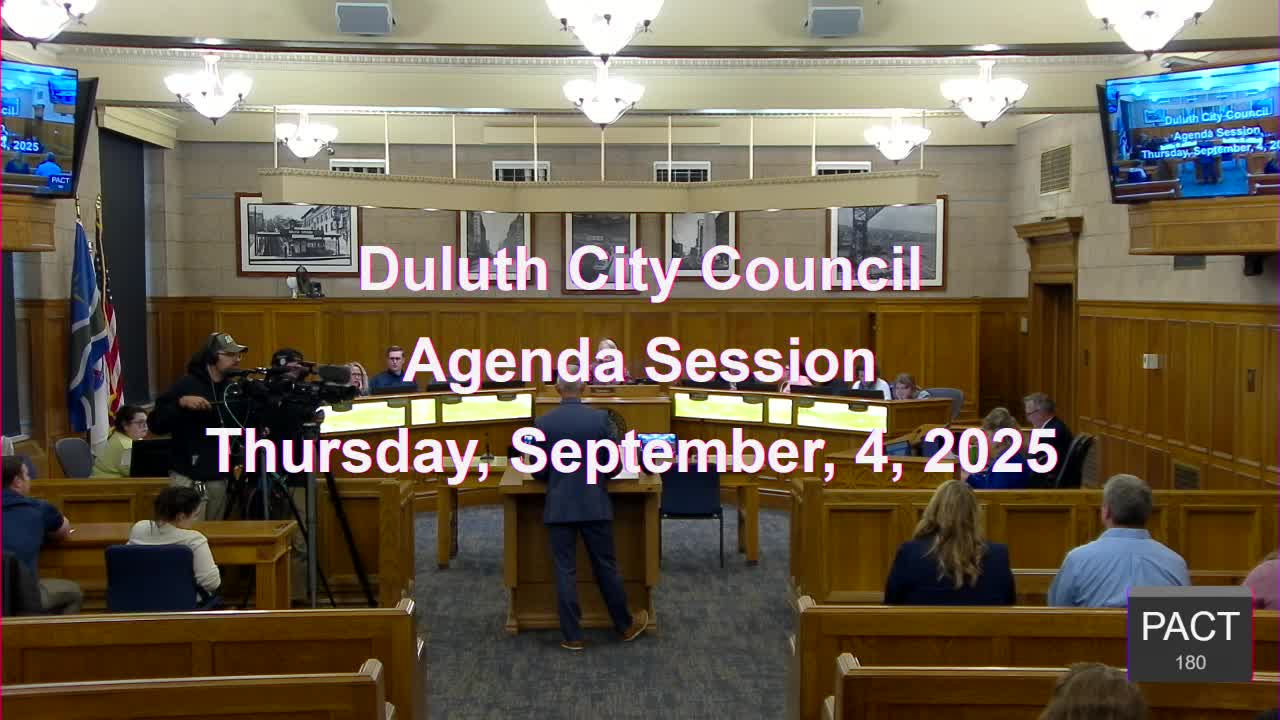
Mayor Reiner proposed on Tuesday that the City of Duluth set a 2026 maximum property-tax levy equal to 2.7 percent, tied to the Consumer Price Index for the 12 months ending July 2025, and pair that levy with a package of revenue and expense measures to address a projected $7.3 million general-fund gap for 2026.
The mayor told the council the two legally distinct statutory duties are to set the maximum levy in September and adopt a final budget by December; he urged voters and residents to understand how Duluth’s levy interacts with other taxing authorities. "Not every single tax dollar collected in the city Of Duluth goes to the city of Duluth," he said, noting that under last year’s levy roughly 41 percent of a dollar in property taxes went to Saint Louis County, 27 percent to the city, 26 percent to the school district and the remainder to parks and other taxing authorities.
Why it matters: the administration says wages and benefits drive Duluth’s budget pressure — roughly 85 cents of every city dollar goes to personnel costs — and recent collective-bargaining increases, along with flat local-government aid, have produced multi-year deficits. The mayor framed the 2.7 percent levy as an "inflation-only" step (the administration also proposes capturing 1.4 percent in new growth), producing a combined figure of about 4.13 percent when growth is counted; the administration calculates the levy portion would add just under $2 million in revenue.
Details of the package: the mayor and his finance team presented a six-part strategy the administration said would spread the burden across revenue and expense moves rather than relying solely on a large one-year levy or deep across-the-board cuts. Elements the administration described include:
- A proposed 2026 levy of 2.7 percent tied to CPI; capturing an estimated 1.4 percent of "new growth" in the tax base (the administration said "capturing new growth does not actually in itself increase anyone's property taxes").
- A proposed ordinance change to allow a targeted share of Community Investment Trust Fund investment earnings to be allocated to the general fund rather than all earnings flowing to general operations; Interim Finance Director Josh Bailey told the council the trust is valued at about $40 million and will generate roughly $1.9 million in coupon payments next year. Bailey said the administration will propose providing $1,000,000 of those investment earnings to the general fund in 2026 and reinvesting the remainder to grow the trust over time.
- Operational and personnel changes, including a department-by-department review of more than 55 currently vacant full-time equivalent (FTE) positions rather than an across-the-board hiring freeze; the administration said careful review and alignment of support functions could deliver a meaningful portion of the needed savings without cutting core service delivery.
- Targeted additions and reforms for public-safety overtime: the administration again proposed adding three FTEs in Duluth Fire to reduce overtime (the mayor said this is the same strategy discussed last year but the hires did not happen); the administration estimated the change would reduce a roughly $2 million overtime exposure to about $850,000.
- Identifying roughly $800,000 of recurring budget reductions through line-item adjustments and creating a contingency fund for about half of that amount to cover unusually heavy winters or other one-time pressures, according to Interim Budget Manager Missy (last name given in discussion as "Missy").
- Exploring earned-revenue opportunities and more accurate fee estimates (for example, the administration said absorbing credit-card fees currently costs the city about $60,000 a year and that some planning-and-development online fees could be adjusted to capture those costs).
Council questions and next steps: councilors pressed for more detail on several items. Councilor Forsman asked for a deeper explanation of the new-growth calculation and for examples of the "earned revenue" opportunities. The mayor and staff said the administration will bring a fuller budget package to a council retreat later in the fall (the administration and council discussed moving the retreat into October but the administration proposed a mid-November retreat to allow additional time for structural alignment work). The mayor reiterated that Minnesota law requires the council to set a maximum levy in September and adopt the budget by December.
Trust fund and housing-fund clarifications: Josh Bailey said the Community Investment Trust Fund holds about $40–$41 million and that per current ordinance all investment earnings flow to the general fund; the administration will bring an ordinance to alter that flow so some earnings can be reinvested to preserve and grow the trust. Bailey and other staff clarified the history of the housing trust fund: the council previously moved $4 million from the Community Investment Trust Fund to establish the Housing Trust Fund and that separate sources (including HUD and CDBG allocations and council-directed transfers) continue to be used for affordable-housing work. The administration said it is not proposing withdrawing principal from the Housing Trust Fund in 2026.
No final votes tonight: the mayor presented the proposed levy and outline of strategies; the council did not adopt the levy or the full budget at this meeting. Councilor Forsman asked that the council pull Resolution 697 (the formal resolution proposing the 2026 general-purpose levy) and related levy resolutions from the consent agenda for further consideration; the clerk confirmed those items will be removed and scheduled for the council’s Monday meeting and the finance committee review.
What stays and what won’t: the administration said it will not recommend deficit spending, blanket cuts that disproportionately hurt small departments, a hiring freeze, or targeting a single department for cuts; instead it said it will prioritize core, community-facing services (public safety, public works, parks, library) and continue the city’s crisis-response teamwork downtown, seeking county participation.
The council expects a detailed budget package and ordinance language for the Community Investment Trust Fund this fall and will need to set the statutory maximum levy before the end of the month.