Get Full Government Meeting Transcripts, Videos, & Alerts Forever!
Get email alerts on the Land Use topic
No spam. Unsubscribe anytime.
Planning commission defers commercial-compatibility overlay; staff backs substitute
Summary
The planning commission voted to defer consideration of a new commercial-compatibility overlay proposed by a councilmember, asking staff and the sponsor to refine a substitute that shifts from categorical bans to spacing, screening and context‑sensitive limits.
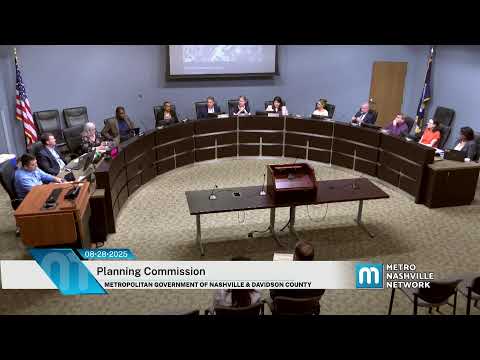
The Metropolitan Planning Commission voted to defer for two meetings a text amendment that would create a new commercial-compatibility overlay designed to limit heavier commercial uses next to residential neighborhoods.
Staff planner Dustin Shane told the commission the bill as filed would have outright prohibited several uses — including alternative financial services, automobile repair, car washes, and liquor sales — in overlay areas. Shane said staff recommends “disapprove as filed and approve with a substitute” that replaces categorical bans with spacing, enhanced screening and context-sensitive standards.
The substitute would limit the overlay’s application to a maximum acreage (staff proposed 50 acres), restrict it to collectors and local streets (not arterials), and introduce a half‑mile spacing requirement between certain uses to prevent overconcentration. Shane said the substitute “shifts the strategy from categorical prohibition to more context sensitive regulation.” He said the spacing standard in the substitute is roughly twice the separation distance currently used elsewhere in the code.
Councilmember Taylor, who filed the original bill, told the commission the measure aims to give neighborhoods “the tool to sustain their values and manage the encroachment of commercial activity while still encouraging businesses that residents have asked for.” Taylor said she supports the substitute’s emphasis on spacing and buffering but asked that beer-and-cigarette markets and alternative financial services remain prohibited inside the overlay.
Commissioners generally supported the staff substitute but raised questions about scope. Commissioner Leslie said she supports the substitute’s fine‑tuning approach. Commissioner Smith cautioned against creating an overlay that is simply “more restrictive than our current zoning” and noted many of the same objectives can sometimes be achieved through site‑specific conditions on rezoning applications. Commissioners also asked staff to map where the overlay might apply and to study whether a 50‑acre cap or a larger cap would be more appropriate.
Dustin Shane clarified that existing businesses in a corridor would be able to remain (be grandfathered) and that the overlay would primarily affect new businesses or new development after an overlay is adopted for a corridor. Taylor and staff said they will use the deferral period to work on the draft and neighborhood mapping; Taylor asked the council public hearing be moved to October so the commission’s recommendation could reach the council before the hearing.
The commission approved a motion to defer the item for two meetings; the sponsor indicated the council public hearing will be deferred to October to allow additional refinements.
Next steps: staff will work with the sponsor on edits, study mapping and spacing impacts during the deferral period and return at the next scheduled hearing.