Get Full Government Meeting Transcripts, Videos, & Alerts Forever!
Get email alerts on the Education Policy topic
No spam. Unsubscribe anytime.
Policy committee presents 12 MSBA-recommended policy revisions for first reading
Summary
The policy committee presented 12 policy updates recommended by the Minnesota School Boards Association; changes reflect legislative updates on student data privacy, overdose medication, weapons reporting, the Read Act, and transportation. The board did not vote; the items will return Oct. 6 for second reading.
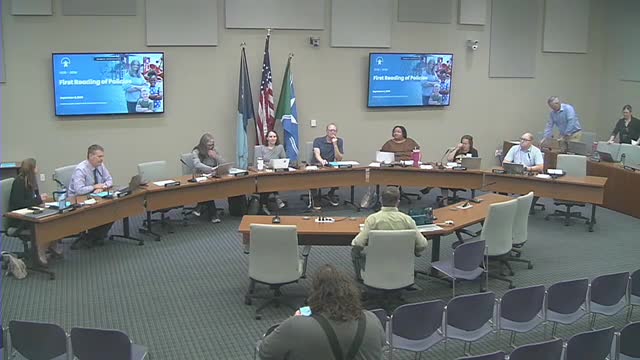
The Mankato Area Public Schools policy committee presented 12 policy revisions to the school board on Sept. 2 for first reading, saying the changes align district policy with recent legislative updates and MSBA model recommendations.
The presentation matters because several of the updates revise how the district handles student privacy, weapons reporting and overdose response — topics that affect student safety and federal/state reporting obligations.
The committee chair (name not specified in the transcript) summarized the packet as “12 of 21 policies” the district is reviewing after recent legislative action. Key changes the committee highlighted include:
- Policy 414 (mandated reporting): adds references to specific statute sections in the definition of a threatened injury. - Policy 418 (drug-free workplace/school): adds protections for students participating in a tribal medical cannabis program, clarifying anti-retaliation language. - Policy 501 (school weapons): adds language to align the district with required reporting to state education authorities and describes after-action review coordination with the Minnesota Fusion Center for active-shooter incidents. - Policy 515 (student data privacy): updates reflect state restrictions that classify certain directory information — including parent contact information and addresses — as private under Minnesota law. - Policy 516.5 (overdose medication): incorporates state clarifications allowing students in grades 9–12 to possess and, if necessary, administer naloxone/Narcan at school and confirms immunity protections under state law. - Policy 631 (literacy/Read Act): clarifies family notification and screening guidance for dual-language immersion and screeners/assessments tied to the Read Act. - Policy 535 (online instruction): broadens the supplemental online course-provider definition to include state-sponsored schools. - Policies 707 and 709 (transportation): clarify special-education placement transportation and remove a now-repealed training deadline while reiterating prohibitions on handheld phone use while driving district vehicles. - Policy 802 (disposition of obsolete equipment): adds language allowing donation of surplus books without a competitive bid process. - Policy 809 (crisis management): expands violence-prevention training requirements and includes steps to report dangerous activity to anonymous threat-reporting systems.
Policy committee members said most edits are non-substantive clarifications, but they flagged two policies for minor typo correction. The committee intends to return the 12 policies for a second reading and board action at the Oct. 6 meeting.
Board member Miss Henke asked about language in the Internet-use policy addressing regulation of off-campus student speech. “Was that added in 2020? Or where does this language come from? Can you give me a little bit more history?” she asked. Committee members responded that student free-speech jurisprudence and the rise of social media have expanded the contexts in which schools address off-campus speech and that the committee did not recommend changes to that section at this time.
No formal votes were taken on the policy revisions at this meeting; the committee presented the changes for first reading and recommended bringing them back in October.