Get Full Government Meeting Transcripts, Videos, & Alerts Forever!
Get email alerts on the Downtown Plan topic
No spam. Unsubscribe anytime.
Boca Raton CRA updates downtown plan to add community policing policy, adjust project list; board approves
Summary
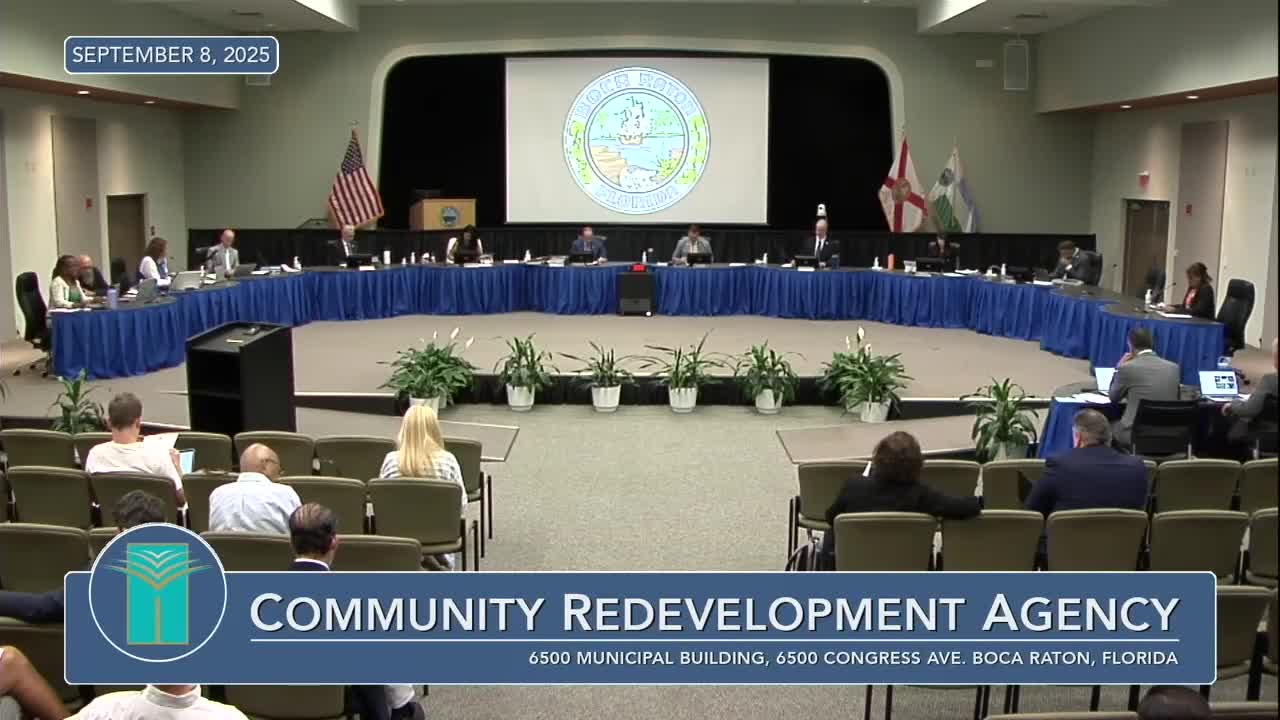
The Boca Raton Community Redevelopment Agency on Sept. 8 approved amendments to the amended downtown plan to update a marketing policy, add a community policing policy and revise the list of planned infrastructure projects, and recommended adoption of Ordinance No. 57‑48 to the City Council.
The Boca Raton Community Redevelopment Agency on Sept. 8 approved Resolution No. 2025‑05 CRA recommending adoption of Ordinance No. 57‑48 to amend the amended downtown plan. The amendments update marketing policy 1.2, add community policing policy 1.4, and revise Section 11 (planned services and infrastructure improvements) to reflect recently completed work and proposed new projects.
According to staff, the proposed edits remove completed projects (downtown walkability enhancements and metered parking), replace a previously listed Meissner Park Amphitheater roof replacement with a new, broader project covering all improvements at Meissner Park Amphitheater, add a project for relocation of a historic public building, and remove fiscal‑year references from individual project entries so TIF allocations can be managed more flexibly. Arlene Chees Nelson, DDRI planning analyst, presented the item and said the ordinance was introduced at the Aug. 26 City Council meeting and is scheduled for City Council consideration on Sept. 9.
Staff cited Florida Statute 163.387 as the statutory basis for deploying remaining tax increment financing (TIF) funds at the end of a fiscal year for redevelopment projects consistent with the amended downtown plan. Chair Wachter and staff emphasized that reserving projects in the plan does not obligate immediate spending; funds can be reallocated later through plan amendments and the city’s budgeting process.
During public comment, John Perlman of 498 Northeast Eighth Street urged the CRA to disclose detailed expense line items for fiscal years 2024–26, citing what he described as a large projected increase in capital outlay. “The capital outlay was roughly over a million dollars in 2024. In fiscal year 26, it’s anticipated that the capital outlay is over $40,000,000. This is a massive change,” Perlman said, and asked staff to provide an itemized list showing amounts for each project across the three fiscal years.
Staff acknowledged the request and committed to provide the information. A staff member noted that the CRA is audited annually and that audited financial reports and budget materials are publicly available; staff said they would supply more detailed line items to the requester.
Perlman also questioned an item to relocate the Singing Pines building, referencing a Historic Preservation Board designation. In response, Mr. Wagner clarified that the Singing Pines house was moved in 1976 and said the ordinance scheduled for the City Council would designate the house itself as historic. Wagner urged clarity for residents amid “misinformation.”
The motion to adopt Resolution No. 2025‑05 CRA and recommend Ordinance No. 57‑48 passed on a roll call vote, 5‑0. No amendments were made during the CRA hearing.
In the directors’ report and ensuing discussion, the board reiterated the CRA’s role in financing downtown infrastructure through tax increment financing (TIF) and the need to plan spending over the remainder of the agency’s term. Staff said work is underway on quick‑build projects at Meisner Boulevard and Palmetto Park Road and that the Alta downtown study and a public workshop with consultant Jeff Speck are planned for January (dates under review). Commissioners discussed starting public engagement earlier and noted the need to plan for the possibility of future state legislation affecting CRA terms.