Get Full Government Meeting Transcripts, Videos, & Alerts Forever!
Get email alerts on the Infrastructure Sewer Conversion topic
No spam. Unsubscribe anytime.
Escambia CRA discusses reinstating septic‑to‑sewer connection grant for non‑homestead homeowners; commissioners ask staff for eligibility and take‑up analysis
Summary
The Community Redevelopment Agency discussed reinstating a previously paused septic‑to‑sewer grant for non‑homesteaded homeowners on Sept. 4; staff said environmental review and federal funding rules are factors and commissioners requested a breakdown of eligible properties and connection rates before further commitments.
At its Sept. 4 meeting, the Escambia County Community Redevelopment Agency discussed reinstating a previously placed‑on‑hold septic‑to‑sewer connection grant targeted at non‑homesteaded homeowners in county redevelopment areas.
Staff told the board the program had been paused and that the county is currently using Community Development Block Grant (CDBG) rehabilitation dollars for some connections, which triggers federal environmental review requirements. “We’re utilizing some of our community development block grant, rehab dollars for this,” a staff member said, and described a broad Tier 1 environmental review in place for a multi‑phase project off Gulf Beach Highway.
Commissioners raised three recurring concerns: 1) who is eligible and how many eligible homeowners have not connected; 2) affordability of plumbing/tap fees for lower‑income households; and 3) whether the county’s funds are being used to subsidize ECUA (Emerald Coast Utilities Authority) tap fees and developer‑paid impact/tap fees.
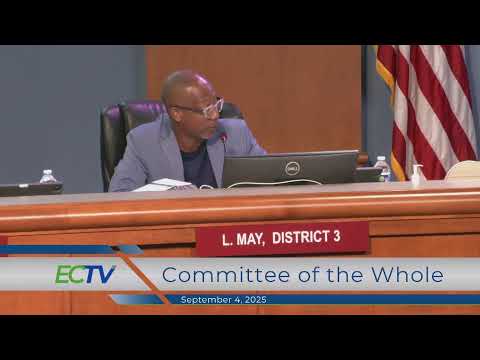
Commissioner May pressed for more data: “We got hundreds of thousands of dollars, and people are not connected. I just want to figure out why,” he said, asking staff to produce an analysis of how many homesteaded and non‑homesteaded parcels in the affected CRAs remain unconnected and to return to the next CRA meeting with that information. Staff said they can use the property appraiser’s data to identify homestead status and whether properties are held in trusts.
Staff said low‑income assistance is available through a NED program tied to income limits (staff indicated 80% of area median income as the likely threshold) and that the low‑income assistance pool “is hundreds of thousands” of dollars. Commissioners noted connection costs cited in the discussion — “people can’t afford $5,000, $6,000, $7,000 to tap in” — and asked whether ECUA will partner on outreach (mailers, QR codes) to notify homeowners of available assistance.
Board members referenced recent project outcomes when questioning effectiveness: staff said Lee Street work had included about $3,000,000 in county investment; 92 laterals were installed with only 21 currently connected. By contrast, Beach Haven had over 300 laterals and more than 200 connections, demonstrating variation by neighborhood and median income.
The board also discussed permitting authority for septic systems. There were differing statements on record during the meeting: one staff comment said septic permits are issued by the health department, and another correction stated the Department of Environmental Protection began issuing septic permits in January 2025. A staff member also referenced a state statute that, if sewer is available, requires hooking to the sewer and that DEP would not issue a septic permit in that circumstance.
Outcome: Commissioners asked staff to return to the next CRA meeting with a targeted analysis — including the number of eligible homeowners who remain unconnected by CRA area, homestead vs. non‑homestead counts, trust ownership flags, available low‑income funding totals, and recommendations for outreach and ECUA partnership. No formal appropriation or policy change was adopted at the Sept. 4 meeting.
• Votes at this meeting: none specific to the sewer grant; staff directed to report back.