Ottawa County housing commission readies open‑source small‑home package to push zoning changes
Summary
At a recent Ottawa County Housing Commission meeting, staff and partners outlined plans to publish open‑source small‑footprint house plans, pursue Planned Unit Development approvals in Holland, and conduct outreach to townships and employers to address a county housing shortfall.
The Ottawa County Housing Commission on a recent meeting outlined steps to publish a package of open‑source small‑footprint house plans, pursue local zoning pathways and community outreach, and support pilot projects intended to prove the concept to townships and developers.
The package is intended to make architected house plans — ranging from roughly 440 square feet to about 1,056 square feet — available to residents, contractors and developers while the county and project partners work with municipalities to overcome zoning barriers that currently limit smaller units.
Matt, a project presenter for the small‑footprint effort, said the team has prepared four plan footprints and “we have 4 different sizes of, home plans that we're producing that will be open source.” He told the commission the plans have been reviewed with local code officials and that an energy study is being pursued to clear another compliance box: “the last hurdle that we're working to get over right now is, getting an energy study done for all the plans.”
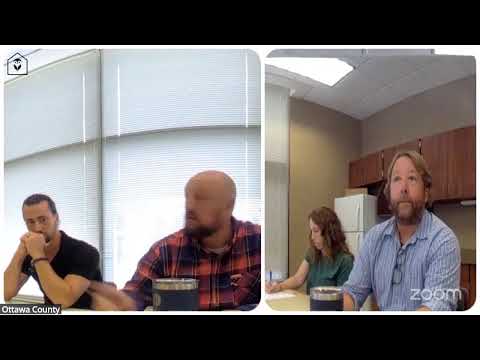
David Rosnick, executive director of Lakeshore Habitat, gave a public‑comment update on partner projects tied to the county's housing work, saying Jubilee had “framed in their first 3 year townhome and is starting on their next 1” and that Lakeshore Habitat had begun digging foundations this week, contingent on weather. He also said Lakeshore Habitat is in discussions about a donated parcel that could support about 25 Habitat homes and has an MOU to do due diligence on property that could hold “potentially over a 100 plus units.”
Why it matters: county staff and commissioners framed the small‑footprint package as a pragmatic, limited‑scale tool to add for‑sale units affordable to middle‑income buyers where larger efforts or subsidies are not required. Commissioners repeatedly returned to a county housing‑needs figure cited in the meeting — roughly 9,004 for‑sale units in the 51%–120% AMI range plus additional rental needs — to explain why multiple strategies are required.
Local zoning strategy and pilot projects
County staff described a two‑track approach to deployment: (1) make the design product broadly available and easy to use for individuals and small contractors, and (2) pursue site‑specific approvals with municipalities using Planned Unit Development (PUD) tools and targeted variance language where needed. Staff cited an active PUD application in the City of Holland as the current pilot, with a public open house planned for early October and a PUD approval target in December.
Presenters said PUDs can be tailored by municipality and that Holland’s process allows early engagement with city staff and planning commissions. The county team also described drafting model variance language and a white‑paper style package to help municipal planners and elected officials evaluate the product and reduce back‑and‑forth at township hearings.
Homeownership protections and deed‑restriction plan
During the Holland pilot review, planning commissioners raised concerns about long‑term ownership and the possibility a nonprofit developer might operate the site as rentals for many years and later sell to an investor. The developer agreed voluntarily to a condition that would deed‑restrict three units to owner‑occupancy if the development is sold in the future and to establish a homeowner association in that event. County staff characterized that as a voluntary, developer‑led commitment rather than a regulatory requirement.
Accessibility, outreach and scaling
Commissioners and public commenters pushed for accessibility features in the plans and outreach to employers and community groups. Staff said the larger two plan sizes were being checked so they can accommodate 36‑inch doors, wider hallways and zero‑barrier entries, and that an ADA specialist will review the plan sets. Commissioners suggested county‑led workshops to mobilize employers (cited as having “skin in the game” where workers earning $18–$24 an hour commute) and neighborhood organizing to bring residents to township hearings.
Limitations and next steps
Presenters emphasized small‑footprint homes are only one tool among many needed to address a multi‑thousand‑unit county shortfall; they described the approach as suited to incremental infill, pilot PUDs and single‑site projects rather than rapid mass production. Staff said they will finalize the open‑source plan sets, complete the energy studies, document model variance language and begin a tracking system for downloads and users. The commission scheduled further discussion of a countywide, infrastructure‑aware housing strategy as a future agenda item and set the next housing commission meeting for October 2.
Ending
The commission said it will continue packaging design, code compliance materials and outreach templates to present to townships and to employers while advancing the Holland pilot and coordinating with nonprofit partners including Lakeshore Habitat and Jubilee.
AI generated
The text on this page is AI generated. Summaries, highlights, analysis, and video transcripts are all produced from the original source material.
AI can make mistakes, so if you spot one, and we will fix it for everyone.
Note: the source content is unaltered by us. Any content source we link to, be it a video, an audio recording, or a document, is presented exactly as its publisher released it. That publisher is usually a government body, sometimes an individual official or another organisation.