Get Full Government Meeting Transcripts, Videos, & Alerts Forever!
Get email alerts on the Homelessness Pit Count topic
No spam. Unsubscribe anytime.
Point-in-time count: Clark County recorded 1,530 people experiencing homelessness on Jan. 30; unsheltered numbers rose 11%
Summary
A Clark County presentation reported 1,530 people counted as experiencing homelessness on Jan. 30, 2025 — a 12% increase year over year — with 742 unsheltered. County staff emphasized the count is a one-night snapshot required by HUD and Washington state and described demographic disparities and limits of the method.
Dale Whitley, chief assistance officer for Accounts for the Homeless, told the Clark County Community Action Advisory Board that a total of 1,530 people were counted as experiencing homelessness on Jan. 30, 2025, an increase of about 12% from the previous year.
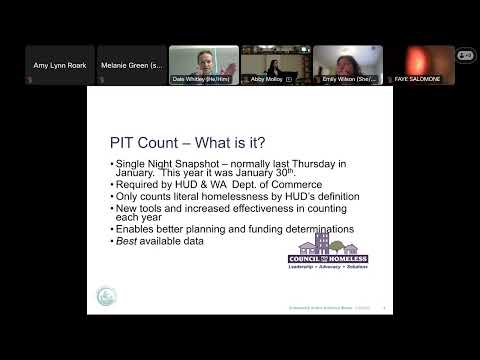
The point-in-time count is “a single night snapshot,” Whitley said, and is required by both the U.S. Department of Housing and Urban Development and the Washington State Department of Commerce. “HUD requires an unsheltered count to happen at least every other year, but Washington state has required us to do one every year,” he said.
Why it matters: the count is used for planning and funding decisions but captures only people who meet HUD’s definition of literal homelessness on that one night, Whitley said. It does not include people who are doubled up or staying temporarily with friends or family.
Key findings reported to the board: - Total counted: 1,530 (up 12% year over year). - Unsheltered: 742 (up 11%). - Emergency shelters: 560 (up 16%) — Whitley said that rise largely reflected added shelter beds, including an extra winter overflow site. - Transitional housing: 228 (up 7%). - Chronically homeless: 439 (28% increase). Whitley explained HUD’s chronic definition requires a year or more of homelessness (or four episodes in three years) plus a disability. - Survivors of domestic violence: 152 (55% increase from 98 in 2024).
Demographics and disparities: Whitley told the board 42% of the people counted identified as women and 57% as men. He reported notable racial disparities: while roughly 25% of Clark County’s population identifies as BIPOC in census data, 38% of people counted identified as BIPOC. Whitley highlighted that Native Hawaiian and Pacific Islander people made up 12% of those counted—despite being about 1.2% of the county population by the most recent census.
Seniors and veterans: Whitley said unsheltered seniors (age 62+) rose from small numbers in 2017 to higher counts in recent years; the 2025 unsheltered senior count was 30. Veterans counted in 2025 totaled 39, equal to the 2024 total.
Limits and sources: Whitley repeated that the point-in-time count is a best-effort, one-night snapshot. “We should say that it’s the best available data,” he said, and noted outreach teams, school liaisons and a Project Homeless Connect service fair were used to find and survey people on the count night. The full methodology and additional analyses — including ZIP-code reports and longer-term system data — are published on the county’s homeless-services website, Whitley said.
Board questions focused on drivers for increases and data detail. Board members asked whether new apartments should reduce homelessness; Whitley and other staff responded that market rents and eligibility hurdles for benefits often mean new market-rate units are not affordable to people exiting homelessness. He also said the county collects a custom survey question asking people why they became homeless and that staff would pull that item for further analysis.
Ending: Whitley said the county will continue refining methods and encouraged board members to review the full reports online for ZIP-code breakdowns and system‑wide data. “We always know that there’s probably somebody who wasn’t counted for whatever reason,” he said, noting the value of consistent methods for year‑to‑year comparison.