Get Full Government Meeting Transcripts, Videos, & Alerts Forever!
Get email alerts on the Labor topic
No spam. Unsubscribe anytime.
Oxnard City presents three-year labor package covering majority of staff, estimated $12.9 million cost
Summary
Steve Naboe, director of human resources for Oxnard City, presented a proposed three-year package of successor memoranda of understanding (MOUs) and a resolution that would set pay and benefits for several employee groups if approved.
Steve Naboe, director of human resources for Oxnard City, presented a proposed three-year package of successor memoranda of understanding (MOUs) and a resolution that would set pay and benefits for several employee groups if approved.
The package covers agreements with the Oxnard Mid Managers Association (OMA), the International Union of Operating Engineers (IUOE) and a resolution for unrepresented and executive employees for the term July 1, 2025, through June 30, 2028. Naboe said that if the items are approved, about 67 percent — roughly 1,000 of 1,495 allocated city positions — would be under contract.
Naboe told the meeting the city sought to remain competitive in the labor market while exercising fiscal management amid uncertain state and federal actions and the impending end of voter-approved Measure O local funding. He said the package uses a mix of higher city health-care contributions, salary-range adjustments and one-time cash payments to balance those goals.
Key financial figures cited in the presentation include an estimated total cost of $12,856,996 for the four covered employee groups over the three-year period and a net ongoing fiscal impact of $9,510,338 beginning in fiscal year 2028. Naboe said one-time payments during the term total $3,346,658 and do not continue after fiscal year 2027–28. He characterized the package as an approximate 6.06 percent increase per year and about an 18.19 percent increase of total compensation over the package term.
On health benefits, Naboe said the city would increase its contribution to employee health care by 5 percent annually to help reduce employees’ out-of-pocket costs. He cited a projected average HMO premium increase of 6.06 percent in 2026 and said the 5 percent city contribution increase is intended to help employees maintain coverage.
On salary structure, the presentation described a 9 percent increase to salary ranges during the term of the MOUs, intended to maintain alignment with peer agencies. Naboe clarified that an adjustment to the salary range is not the same as an across-the-board salary increase and that, in the short term, the change primarily affects employees who are at the top of the current salary range.
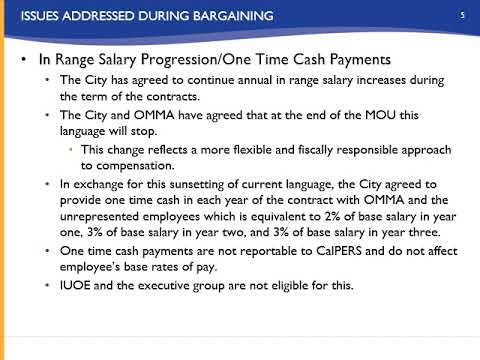
Naboe described one-time cash payments tied to the “sunsetting” of existing language for some groups but said the agreement language and amounts differ among bargaining units. He said the IUOE did not agree to the sunsetting language and therefore would not receive the one-time cash payments that OMA and unrepresented employees would receive; the transcript did not clearly specify the annual percentage amounts for those one-time cash payments.
On signing bonuses, Naboe said the city had offered contingent signing bonuses to four bargaining groups as part of overall negotiations. He said the IUOE signing bonus is $1,500 per employee and that the signing bonus for OMA and for unrepresented employees is 2 percent of base salary; bonuses would be one-time payments paid the first full pay period after council approval, contingent on ratification.
Naboe also outlined that the city uses two costing methodologies (labor and budget) to estimate the fiscal impact and provided a breakout of costs by bargaining unit for IUOE, OMA and the unrepresented/executive employees. He concluded the presentation by summarizing the package components and fiscal impacts. The transcript of the presentation did not record a formal council vote or final action on the items.
Next steps referenced in the presentation: ratification by bargaining-unit members (some ratifications already occurred, Naboe said, noting IUOE ratified in August) and council approval before any signing bonuses tied to council action would be paid.