Get Full Government Meeting Transcripts, Videos, & Alerts Forever!
Get email alerts on the Budget Taxation topic
No spam. Unsubscribe anytime.
Monroe County adopts FY2026 tentative budget, raises millage and trims county size; nonprofits face funding cuts
Summary
Monroe County commissioners adopted a tentative FY2026 budget and tentative millage rates after a public hearing that centered on rising state oversight, proposed reductions to nonprofit grants and an increase in county emergency reserves.
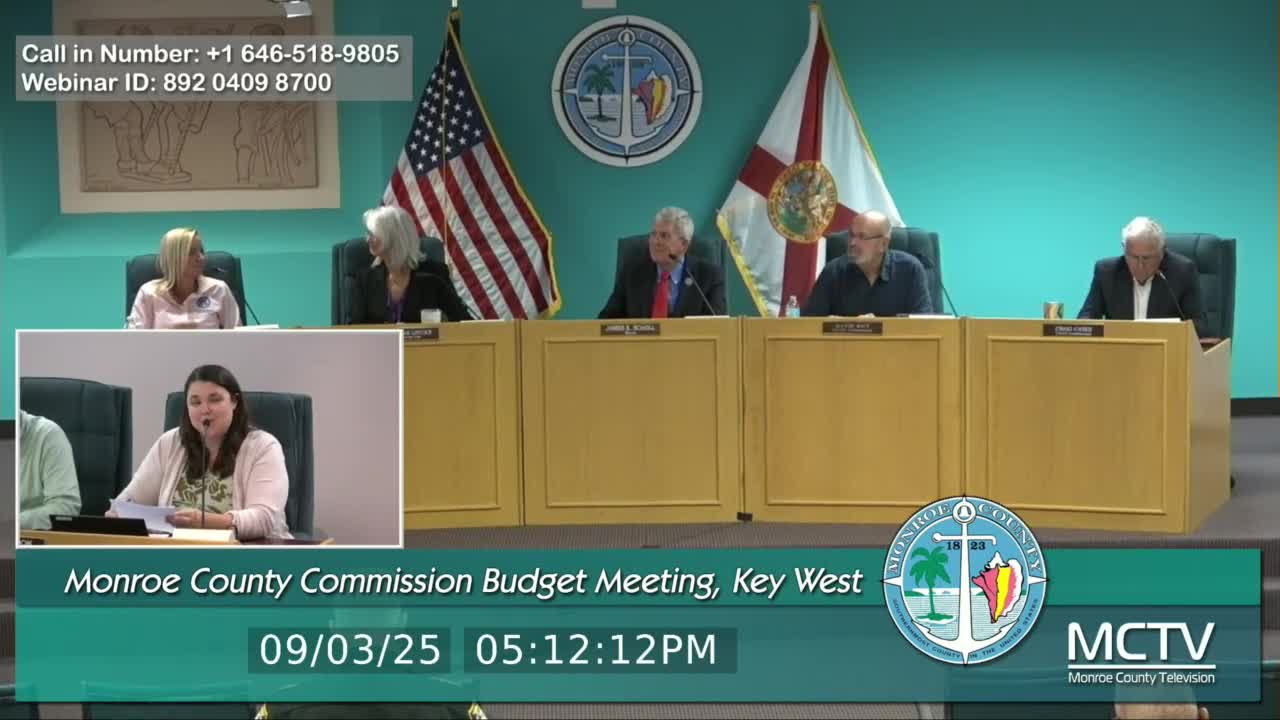
Monroe County commissioners adopted a tentative FY2026 budget and tentative millage rates on Wednesday after a lengthy presentation and public comment period that focused on state oversight of local spending and steep cuts to nonprofit grant funding.
County budget staff presented the tentative FY2026 figures and said the county faces an uncertain near term because of a state initiative to review local government spending. "The teeth that the bill had was if the executive office of the governor finds that a local government is not participating with them, they can fine that local government $1,000 a day," County Administrator Christine Hurley told the commission while outlining the governor's executive order and subsequent data requests from the governor's office.
John Quinn, the county budget presenter, said the FY2026 tentative budget reflects a year‑over‑year reduction driven by capital spending and tourist development dollars being shifted to the capital plan; he and staff summarized the tentative countywide ad valorem levy as approximately $170.8 million and noted an aggregate tentative millage rate of 3.3965. The countywide millage rate was set at 2.7327, an increase the county said is intended to increase emergency reserves; staff said that increase and other reductions will raise the county’s emergency reserves from $10 million to $14 million.
The tentative budget reduces county staffing by 45.32 full‑time equivalents, according to the presentation, and implements three levels of cuts the county began considering earlier in the summer. Staff said the savings will help absorb contractually required compensation and insurance increases for public‑safety personnel while preserving funding for law enforcement, fire and EMS.
Budget staff also flagged federal changes that could reduce FEMA reimbursement rates and increase local cost shares for disaster recovery. "We just need to be prepared that we could be heading into a new reality where fewer storms qualify for federal aid," Lisa Tennyson, director of legislative affairs, told the commission in a FEMA briefing included in the budget packet.
A central theme of the meeting was how to balance building reserves against continuing grant funding to local nonprofits. Staff told the commission the FY2026 tentative budget reduces the county’s funding for nongovernmental organizations (NGOs) and that the change aligns with priorities staff said they were given to respond to state direction. Commissioners debated whether to hold more money in reserve or to restore some nonprofit funding and discussed a possible midyear re‑appropriation pending clearer guidance from Tallahassee. A proposed motion to set aside an additional portion of the tentative increase in reserves as a conditional operational reserve for nonprofits was defeated on a roll call; the budget was later approved as presented.
Public testimony at the hearing included representatives of many human‑services organizations. Jay Good, identifying himself as a long‑time county resident, said: "Many of the services funded through HSAB — food security, mental health care, elder services — are essential to the health and stability of this community." Mary Stella, vice chair of the Human Services Advisory Board, urged restoration of grant funds and said HSAB’s grant review process had shown a persistent need for services countywide. Sherry Schwab, executive director of the county’s domestic‑violence shelter, said her organization runs outreach offices in Key Largo, Marathon and Key West and that, "the county is not ever gonna be able to provide the services that we provide."
Diana Flennard of the Monroe Association of Remarkable Citizens said local nonprofits leverage federal, state and philanthropic funds and reported that MARC’s original $200,000 HSAB allocation produced more than $2 million in matching and related funds. Isabella McClain of Planning with Love asked the commission to restore at least 20% of funding cut in earlier rounds to preserve resilience and recovery capacity.
On the board’s actions: after discussion and several motions, the commission approved the tentative millage rates and the tentative budget. A roll call on adoption of the tentative budget recorded a majority in favor. The county will hold a final public hearing to adopt the final budget and millage rates on Sept. 10 at the Murray Nelson Government Center in Key Largo.
The budget packet and the presentation list capital maintenance projects, airport and bridge work funded from enterprise funds, and shifted $35 million in tourist development surplus to capital projects targeted for private‑sector affordable housing in future years. Staff said the tentative general‑fund ending balance is projected to be about $49 million, equivalent to roughly 5.1 months of operating reserves.