Get Full Government Meeting Transcripts, Videos, & Alerts Forever!
Get email alerts on the School Facilities Playgrounds topic
No spam. Unsubscribe anytime.
Board debates districtwide playground shade structures; tables decision to Oct. 14 for more data
Summary
Board debated adding shade structures at 272 elementary playgrounds at a projected cost of about $16.32 million; members asked for life-cycle, cost and metal-vs-fabric analysis and tabled the motion to Oct. 14.
Board members debated a motion to add shade structures over elementary school playgrounds that would cover an estimated 272 playgrounds lacking shade and cost roughly $16.32 million.
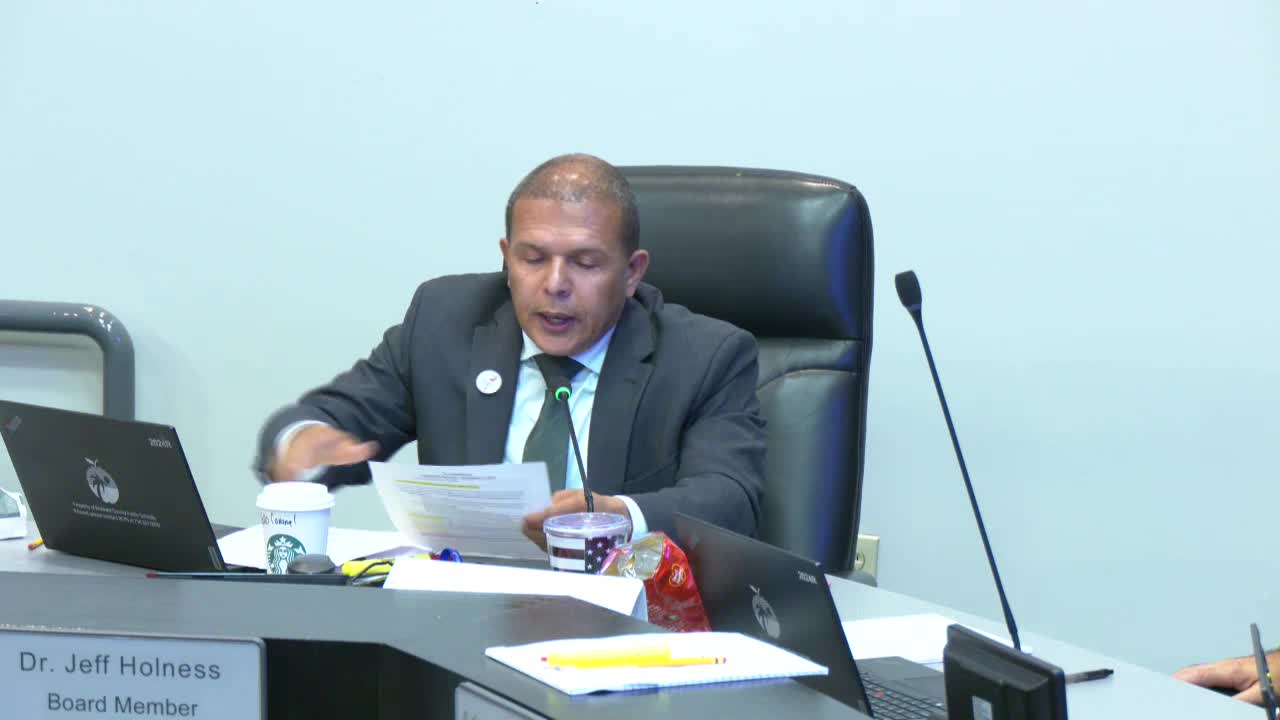
Dr. Holness moved to include installation of shade structures over all 272 elementary playgrounds currently lacking coverage, phased over 20 years and prioritized by need; he said the districtresponse estimated the total at approximately $16,320,000 based on about $60,000 per playground. "The estimated cost to install a 20 by 40 feet shade structure, over equipment, is approximately $60,000 resulting in a total projected cost of $16,322,000 to provide coverage for all 272 playgrounds," he said during debate.
Board members pressed staff on whether partners could share costs and on the pace of installation. Allison Wodzinski, director of environmental health and safety, told the board the original plan equated to "15 playgrounds a year" under a 20-year schedule and that the fabric shade lifespan was shorter than a metal structure: "...the 20 year plan was 15 playgrounds at, various number of schools... $900,000 a year... and, the lifetime of the shade is about 8 to 10 years of the fabric." Board members said they wanted a cost comparison for metal structures, estimates of the cost to remove and reinstall fabric after storms, and lifecycle/replacement plans.
After discussion and an amendment proposed by Mrs. Alhadeff to shorten the phase to 10 years, the board voted to table the motion and asked staff to return with additional analysis on fabric versus metal structures, lifecycle costs, and installation schedules. The board set a target to revisit the matter at the Oct. 14 meeting.
Public commenters also raised lifecycle concerns and asked whether partner funding could offset district costs. The board explicitly asked staff to provide: (1) metal-structure cost estimates; (2) fabric lifespan and replacement cost estimates; (3) estimated annual costs for take-down/put-back after storms; and (4) a proposed implementation schedule prioritized by need and data.
The motion to table carried; the item will return to the board with the requested information.