Get Full Government Meeting Transcripts, Videos, & Alerts Forever!
Get email alerts on the Sheriff Budget Ice Detainees topic
No spam. Unsubscribe anytime.
Sheriff Forstall defends 2026 budget; heated public comment urges end to ICE detentions at county jail
Summary
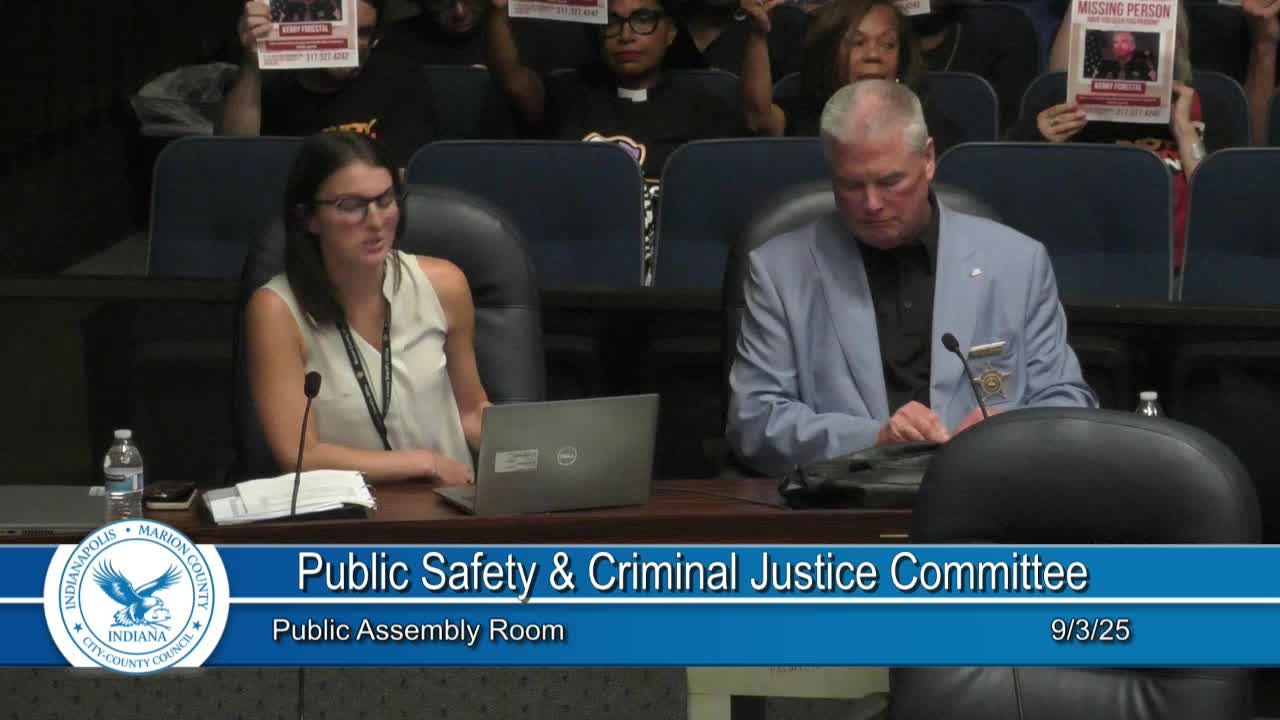
Sheriff Carrie Forstall and Marion County Sheriff’s Office CFO Callen Carr presented the agency’s 2026 proposed budget to the City-County Public Safety Committee on Sept. 3, 2025, drawing extended council questioning and sustained public comment about ICE detainees, jail deaths and conditions at the Marion County Adult Detention Center.
Sheriff Carrie Forstall and Marion County Sheriff’s Office (MCSO) Chief Financial Officer Callen Carr presented the agency’s 2026 proposed budget to the City-County Public Safety and Criminal Justice Committee on Sept. 3, 2025. The presentation prompted extended council questioning and sustained public comment focused on ICE detainees held at the Marion County Adult Detention Center (ADC), jail conditions, inmate deaths and staffing.
CFO Callen Carr told the committee the sheriff’s office is proposing increases to staffing in the 2026 introduced budget and described three budget columns for comparison: the 2025 adopted budget, a projected 2025 revised budget, and the 2026 introduced budget. Carr said the agency’s budget development prioritized staffing: the 2026 proposal includes an increase of 55 detention-deputy full‑time equivalents and a total headcount in the introduced budget of 881 FTEs (535 assigned to the ADC, of whom 307 are detention deputies). Carr said the increased staffing is intended to reduce overtime reliance and help meet recommendations from a KPMG staffing study.
Sheriff Forstall described programs and services at the ADC and defended the agency’s practice of housing federal detainees. “We house the federal prisoners, and that's all that we do,” Forstall said, adding that the facility keeps ICE detainees in separate housing units and that the federal government pays for medical care for those detainees. Carr and the sheriff also described ongoing efforts to improve in-jail medical and behavioral-health services, including a pilot with Eskenazi Health and a comprehensive MAT program (COSUP) funded in part by grants and opioid-settlement funds; MCSO reported adding SUBLOCADE as an option in the jail’s medication-assisted-treatment mix.
The committee’s questions ranged across staffing, contract costs, revenue and legal obligations tied to federal detainees. Council members pressed the sheriff on whether the county has legal discretion to refuse federal detention requests; Forstall repeatedly cited a directive from the state attorney general and said his position was driven by that legal guidance. He told the committee that, while other states or cities (a councilor cited Illinois) may decline federal requests, the sheriff was following Indiana law as interpreted by the attorney general’s office.
Public comment after the presentation was extensive and sharply critical. More than two dozen speakers urged the committee and the sheriff to end contracts that result in the detention of immigrants. Speakers included civil-rights lawyers, pastors and local advocates who alleged limited access to counsel, language barriers, prolonged detention without scheduled immigration hearings, harsh conditions (including allegations that some cells or rooms are kept with lights on continuously and that detainees have been awakened as early as 3 a.m.) and inadequate assistance in preparing immigration paperwork. Several public speakers urged the committee to use the budget (the “power of the purse”) to withhold funding until the sheriff stops housing federal detainees or cancels contracts with federal marshals or ICE. One public commenter asked the committee to “use your power of the purse, to reject the sheriff's proposed budget, until and unless he commits to not being an agent, not being an instrument of the Trump administration's cruel regime,” a plea echoed in multiple public statements.
Councilors raised specific operational concerns as well. Councilor Carlos Perkins said his office’s research identified six in-custody deaths over the past year and asked, “This puts us at roughly a person dying inside our jail every 60 days. What is your plan to address this crisis and to avoid people dying in our jail?” Sheriff Forstall pointed to suicide-prevention advocates, medication-assisted-treatment programs and screening as measures the office uses to reduce risk but acknowledged smuggling and intoxication at intake remain hard to eliminate.
Other topics discussed included unpaid revenue from state prisoners (a councilor raised an estimated $1.7 million owed by the state), recent grant losses (a state J-RAC award of about $275,000 was not continued for 2026), and a planned reduction in private-security contracts to achieve fiscal savings. CFO Carr said the sheriff’s office projects a 2026 introduced total budget in the same range described to the committee; committee materials included the 2025 adopted total and a revised 2025 projection. The sheriff’s office said the ADC houses roughly 2,400 inmates and that the agency is negotiating with Eskenazi Health for possible medical services at the ADC; if Eskenazi does not assume those services, the office said it will seek proposals from private vendors and that those proposals could exceed $20 million.
The meeting did not produce a committee vote on the sheriff’s budget. Several councilors urged legal review of the attorney general’s directive and discussion with the city law department to determine whether local action could alter the county’s obligation to house federal detainees. Council members also suggested restoring and expanding local legal-defense funding and other wraparound services for immigrants.
Why this matters: The budget and operational choices at the Marion County Adult Detention Center affect detainees’ access to courts, medical and mental-health care, and the county’s fiscal position. The public comment record shows strong community concern about housing ICE detainees, transparency, legal access and in-custody deaths, issues the committee said it will continue to examine.
Speakers at or directly referenced in the presentation included Sheriff Carrie Forstall; CFO Callen Carr; and council members and public commenters who questioned operations and legal obligations. The committee did not vote on the sheriff’s budget during the session.