Get Full Government Meeting Transcripts, Videos, & Alerts Forever!
Get email alerts on the Emergency Communications 911 topic
No spam. Unsubscribe anytime.
MESA presents 2026 priorities: staffing, accreditation and radio upgrades for emergency communications
Summary
Metropolitan Emergency Services Agency leaders presented a 2026 budget and operations briefing to the City-County Public Safety Committee, highlighting progress on 9-1-1 hold times, plans for CALEA accreditation, investments in radio systems, and reliance on state and federal grants.
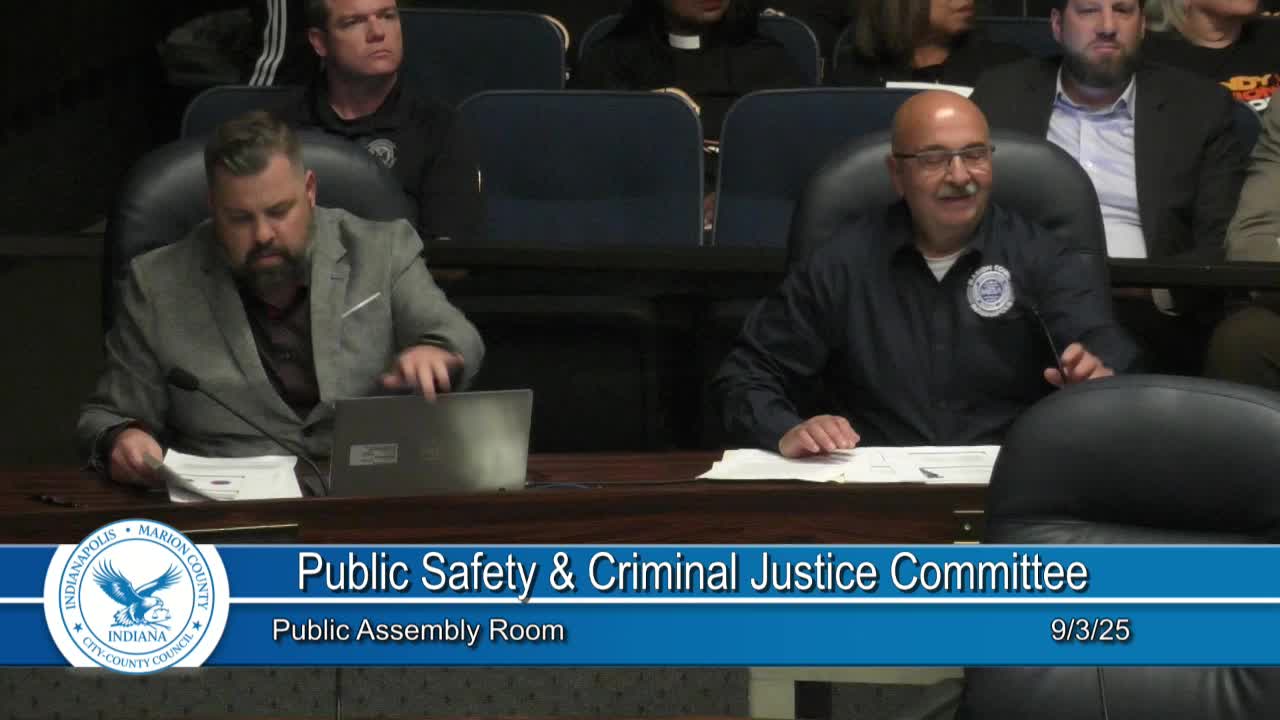
Chief Tom Sullis of the Metropolitan Emergency Services Agency (MESA) briefed the Indianapolis City-County Council Public Safety and Criminal Justice Committee on Sept. 3, 2025, outlining staffing and technology priorities tied to the agency’s 2026 budget request.
MESA told the committee the 9-1-1 center handled roughly 1.6 million calls for service in 2024 and credited telecommunicators with phone CPR instruction that helped save 40 lives and with assisting in four deliveries so far in 2025. Chief Tom Sullis said the agency is working toward nationally recognized accreditation and improved call performance: “Since then, we've definitely decreased that timing. And so far, here in 2025, we are at 15 seconds before we answer that call,” Sullis said, describing the agency’s progress from an average 34-second hold time in 2022.
The nut of MESA’s pitch was that sustaining and improving public-safety communications requires both people and technology. The agency is pursuing CALEA accreditation, seeks to reduce hold times further (noting industry standards from APCO and NENA that 90% of calls be answered within 15 seconds and 95% within 20 seconds), and plans radio-system upgrades, replacement of outdoor warning sirens and dispatch equipment updates.
CFO Frank Barelli walked the committee through budget “characters” (budget categories). He described a modest overall increase in operating funds to support hiring and day-to-day needs, a roughly $7.2 million portfolio of recurring radio-contract costs, and reallocation of contract expenses that made one category look larger year-over-year though the underlying vendor increases were about 3%.
MESA described its funding mix to the committee: a state 9-1-1 telephone service charge collected from phone carriers, a local public safety income tax component, and federal grant funding such as EMPG (which typically covers about 50% of emergency management salaries) and irregular Urban Areas Security Initiative (UASI) awards. The agency said it received two typical federal grants this year (EMPG and a UASI allocation), and it continues to seek grant opportunities for situational-awareness, backup power and other capital needs. MESA also noted investments in redundancy (battery backups and three new generators) and portable vehicle barriers used to secure large public events.
On workforce, MESA said hiring and retention remain active priorities. The agency reported near-budget staffing levels overall and said its leadership team reflects gender and racial diversity; Chief Sullis told the committee that leadership positions are about 60% female and the executive branch is roughly 49% minority. MESA described outreach at job fairs and community events and cited training, nationally recognized certifications and internal peer-support efforts as retention strategies.
Committee members asked specifically about grant continuity, 9-1-1 wait-time outliers and mental-health triage for crisis calls. Director Andrea Brown of CLCR (the local crisis/behavioral health routing partner) was referenced as providing on-site training and real-time support when available. Sullis said the agency can and does transfer callers to 988 and to community-based crisis teams (CLCR and MCAT) depending on the caller’s needs and the availability of partner resources.
Why this matters: the committee’s decisions on character-level budgeting and support for grants and staffing affect response times for every 9-1-1 call in Marion County and the resilience of the city’s public-safety communications during storms, flooding and large events.
MESA asked the committee to support the 2026 budget allocations that prioritize increased 9-1-1 staffing, modernization of dispatch consoles, radio-system maintenance, and capital improvements that include siren replacements and redundant power systems. The agency also asked to continue pursuing grant funds to offset local costs.
MESA presenters at the meeting included Chief Tom Sullis, CFO Frank Barelli, CLCR Director Andrea Brown, Deputy Director David Schwartz, and Emergency Management Director Jake Spence. The committee did not take a formal vote during the presentation; members said they would follow up with requests for additional data on outlier calls and call-routing figures.