Get Full Government Meeting Transcripts, Videos, & Alerts Forever!
Get email alerts on the Transportation topic
No spam. Unsubscribe anytime.
Queen Creek presents 2025 transportation master plan; MAG data shows rapid local growth
Summary
Town staff and consultants presented a 25‑year Transportation Master Plan that identifies 96 projects and a 10‑year portfolio of 37 priorities. Regional data from Maricopa Association of Governments underscores fast population and jobs growth that will affect local congestion, safety, and housing needs.
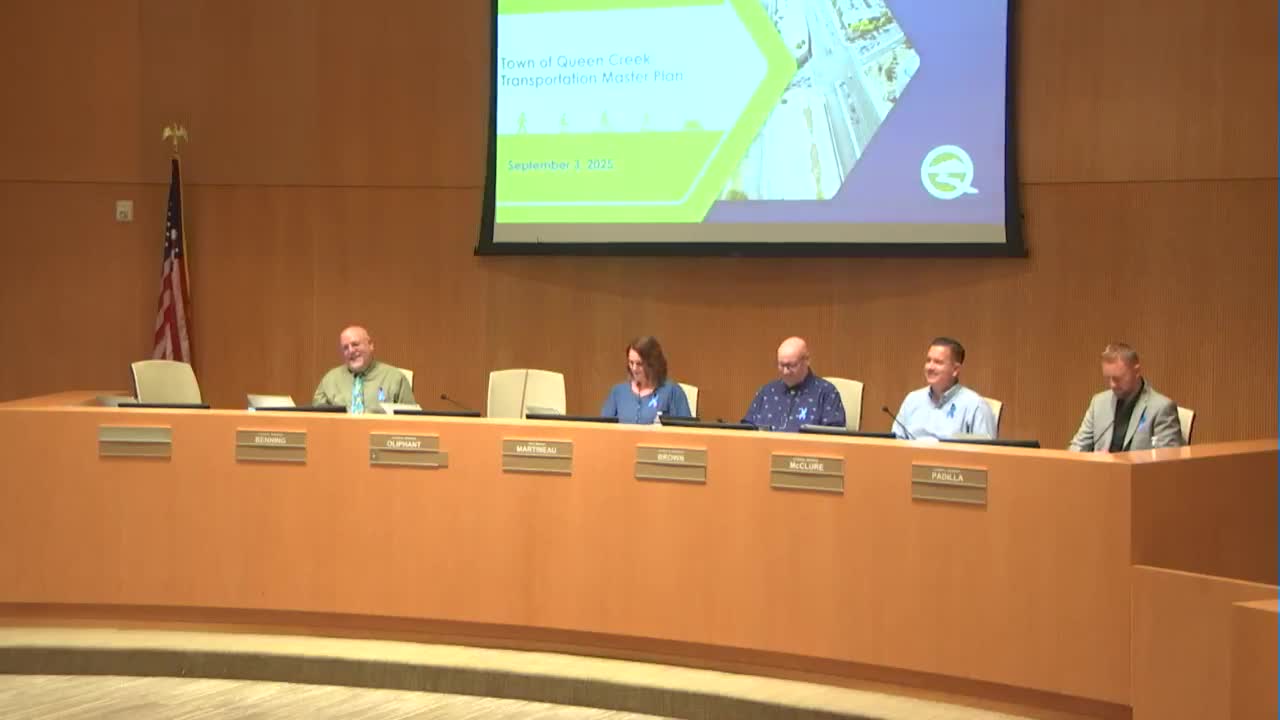
The Queen Creek Town Council on the regular agenda heard a presentation of the town’s 2025 Transportation Master Plan and companion regional data from the Maricopa Association of Governments (MAG), outlining 96 projects to address capacity, safety and multimodal gaps as the town grows.
The plan, presented by Public Works Director Mohammed Youssef and Kimley‑Horn senior project manager Anita Johari, calls for 64 capacity projects and complementary pedestrian, bicycle, intersection and signal improvements; staff identified 37 projects intended for the town’s 10‑year capital improvement program (CIP). MAG socioeconomic data presented by Peter Burnett showed continued rapid population growth in the region and in Queen Creek, reinforcing the plan’s urgency.
Why it matters: the plan projects growth pressures through 2050 that, if unaddressed, would push parts of the street network to failing levels of service. Council members and consultants said the plan is intended to guide the town’s capital investments, grant requests and coordination with regional partners such as MAG and the Arizona Department of Transportation.
Mohammed Youssef, Queen Creek’s public works director, described the plan as the result of “a long process” of technical work and public outreach, and said it draws on model forecasts from MAG and local technical advisory input. Anita Johari, the consultant project manager, said the outreach included in‑person events and an online survey that generated roughly 850 responses with about 620 completed surveys, where respondents cited congestion and safety as top concerns.
The master plan ranks projects by a prioritization matrix tied to measurable goals. Johari described the result as a menu of projects the town can advance as funding and right‑of‑way become available. The plan assigns projects to high, medium and low priority and produces a fiscally informed subset of 37 projects for the next 10 years.
On costs, Youssef told council that the consultant and CIP team estimate town spending in the near term will match recent years’ pace: roughly $25 million to $30 million per year, or “about 3 to 3.5 projects every year for the next 10 years.” He noted developers will continue to build many improvements as part of private development obligations, and the town’s role will often be to complete connections or fund critical segments.
Maricopa Association of Governments Executive Director Ed Zirker and MAG data manager Peter Burnett linked the transportation discussion to regional trends. Burnett’s MAG “Region in Review” slides showed Queen Creek’s recent high growth rate and projections that the town’s population could nearly double by 2050. MAG highlighted completed and upcoming regional funding programs, including Prop 400 (historical) and Prop 479 (new transportation sales tax beginning Jan. 1, 2026), and noted State Route 24 construction is scheduled to begin bidding this fiscal year.
Council response centered on funding and timing. Councilmember Brown asked whether the 10‑year suite of projects fits within recent spending levels; Youssef replied with the $25M–$30M annual estimate. Councilmember Benning asked about treatment of State Route 24 in the town’s maps; staff clarified SR‑24 is a regional project primarily led by ADOT and MAG and may be reflected separately in future project coordination.
Next steps: staff said the town will return in the fall seeking formal adoption of the transportation master plan and continue coordination with MAG on mobility and safety programs and grant opportunities.
Ending: the presentation closed with council agreement to continue technical review and public outreach before a fall adoption vote.