Get Full Government Meeting Transcripts, Videos, & Alerts Forever!
Get email alerts on the Small Business Regulation topic
No spam. Unsubscribe anytime.
Planning Commission asks staff to study local rules for cottage food operations and microenterprise kitchens
Summary
Commissioners discussed cottage food operations (CFOs) and microenterprise home kitchens (MECOs) and directed staff to include review of local regulations for CFOs in the city’s development code update; no immediate ordinance changes were adopted.
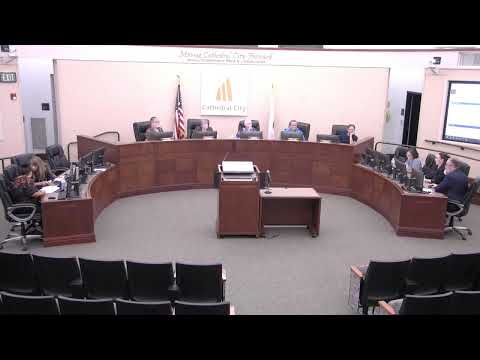
The Cathedral City Planning Commission on Sept. 3 discussed cottage food operations and microenterprise home kitchens and asked staff to include consideration of local land‑use regulations for cottage food operations in the city’s development code update.
Staff explained that microenterprise home kitchens (MECOs) are authorized and permitted by the Riverside County Department of Environmental Health and that Cathedral City cannot impose an additional permitting layer for MECOs; the county inspects MECOs and sets limits on menu, hours, meals per day and annual gross sales. “MECOs are authorized in the jurisdiction of the Department of Environmental Health through ordinance 949, which has been in effect since 2019,” staff said.
By contrast, cottage food operations (CFOs) — such as home bakers and packaged food producers covered by the California Homemade Food Act — may be inspected by the county for health and safety, but state law allows local planning agencies to apply non‑discretionary land‑use rules for spacing, parking, traffic and hours. Staff recommended the city consider amending its zoning code to incorporate CFO regulations but said the low number of existing permits (eight active CFO permits and nine MECO permits reported by county records) and low complaint counts meant an immediate change was not urgent.
Commissioners debated competing priorities: supporting small entrepreneurial activity and preserving residential neighborhood character. Commissioner Bedard described the need to modernize home‑occupation rules to allow more legitimate home businesses; Vice Chair Mead suggested that rather than broadly restricting CFOs, the city should consider targeted limits (hours, parking, concentration) that mitigate neighborhood impacts such as traffic, noise or odor. Commissioner Malacoff said he favored preserving commercial districts for restaurant‑scale businesses and raised health and oversight concerns for large home food operations.
After discussion the commission voted 4–1 to direct staff to study potential local land‑use limitations for cottage food operations — examples to include distance/concentration limits, on‑site customer caps, hours for on‑site customer visits and parking — and to return recommendations as part of the development code update process. The motion was made by Vice Chair Mead and seconded by Chair Lee.
Staff said it would also increase public education about available county permits and consider posting information about CFO and MECO permitting on the city website while the code update is in progress. No immediate changes to the Cathedral City Municipal Code were adopted at the meeting.
Because MECO permitting and health inspections are within the county’s authority, staff noted the city can continue to enforce noise and nuisance ordinances but cannot impose a separate county‑style permitting requirement for MECOs.