Get Full Government Meeting Transcripts, Videos, & Alerts Forever!
Get email alerts on the County Budget topic
No spam. Unsubscribe anytime.
Washtenaw County projects modest general‑fund surplus; finance rolls out 1,177‑page program inventory
Summary
County finance presented a second‑quarter budget update showing a roughly $3.3 million projected general‑fund surplus and highlighted public safety costs driving most shortfalls. Separately finance released a detailed resource‑management “program inventory” that maps mandates, funding and staffing across county services.
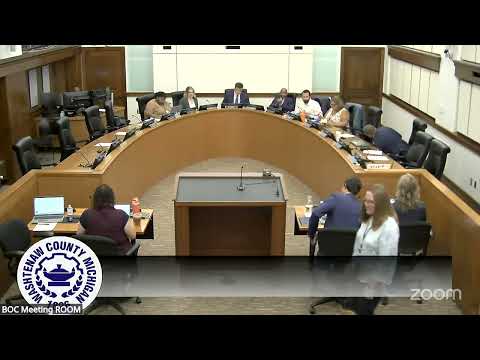
Deputy finance director Catherine Jones Alter told the Washtenaw County Board of Commissioners on Sept. 3 that year‑to‑date financial data through June 30 show the county projecting a small net surplus in the general fund while also identifying multi‑million‑dollar shortfalls concentrated in public safety operations.
Jones Alter said the county’s projected general‑fund revenues and expenditures currently produce a net projected surplus of roughly $3.3 million after technical adjustments and transfers. She said the outlook has shifted since the first‑quarter update because of two sets of changes: a $2.6 million technical reduction built into this quarter’s projections (a planned contribution into fund balance plus transfers), and a mix of revenue and expenditure movements driven primarily by sheriff’s office contract policing billing, overtime and legal costs.
Why it matters: County officials and commissioners said the report is a working picture heading into budget season. The surplus provides short‑term flexibility but hides material variance inside major service areas — notably public safety and justice — that will shape board budget choices for 2026.
Major drivers and clarifying details - Contract policing: Jones Alter said contract policing revenue is trending down, in part because the sheriff’s office shifted from an annual year‑end “banked hours” adjustment to monthly billing of filled positions, which county finance estimates reduces revenue recognition for 2025 by about $400,000 in the general fund projection. The county is also projecting a large general‑fund supplement to policing operations. Commissioners pressed for a municipality‑level breakdown of who is being billed and which townships are receiving fewer deputy hours than contracted; county staff agreed to produce that breakdown. - Sheriff overtime and personnel costs: The sheriff’s personnel budget is projecting a $3.3 million shortfall, driven by overtime to backfill leaves, hospital guards and court transport needs even as vacancies create offsetting savings. Jones Alter said some overtime assumptions are conservative while new hires complete training and vacancy savings materialize. - Jail food and medical: The county is projecting continuing shortfalls for jail medical and food contracts; an active RFP for medical services is under way and past millage surplus funds hid some of last year’s structural costs. - Interest and other revenue: Higher interest earnings to date have added roughly $200,000 to forecasted revenue; some ancillary sheriff revenue is down but other revenues are trending positive in the clerk/register of deeds lines.
Resource‑management program inventory: finance presented a companion program inventory and service‑area analysis designed to inform budget choices. The inventory maps each county program to: program description, performance measures, residents served, mandate source (federal, state, county policy, grant, contract or best practice), staffing and all revenue and expenditure lines. Jones Alter said the full document is 1,177 pages and will be published on the board portal.
Key findings from the inventory - Scale: The county’s mapped 2025 budgeted expenditures across funds total roughly $460 million; about 71% of that (approximately $328 million) is tied to state or federal mandates when viewed by program classification. Health and human services and public safety comprise roughly half of mandate‑driven expenditures. - General‑fund support: Roughly $116 million of general‑fund support underpins many mandated programs; the largest share of that support — about three‑quarters of the county’s general‑fund support directed at mandated work — flows to public safety and justice. - Mandate buckets: Finance organized programs into four buckets — mandated (statute/regulation), committed (county policy or grant obligation), contracted (longer‑term contracts), and non‑mandated/best practice — to help define which services the board can change quickly and which are legally or contractually constrained.
Next steps and board response Commissioners complimented the level of detail and asked follow‑up requests: a municipal breakdown of sheriff contract billing and vacancies, a revenue‑side breakdown of federal pass‑through funds in the inventory, and a staff timetable for the next (Q3) financial update. Finance said it will return with the requested detail in the Q3 report and publish the full program inventory materials on the board portal for commissioners and the public.
Ending Jones Alter said the inventory is a working draft and that departments and elected offices participated heavily in mapping programs. She told commissioners the tools and the data will be refined but that the county now has the program‑level view officials asked for to guide budget choices this fall.