Get Full Government Meeting Transcripts, Videos, & Alerts Forever!
Get email alerts on the Mining Project topic
No spam. Unsubscribe anytime.
Developer says Hermosa project will cut water use, expand local jobs; monitoring and well-protection emphasized
Summary
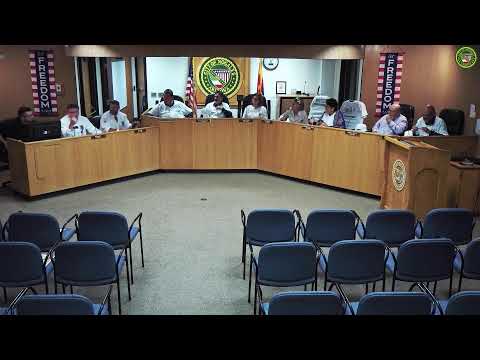
Representatives from the Hermosa/South32 project briefed the Nogales City Council on construction progress, a voluntary well-protection program, expanded air and groundwater monitoring, workforce training and a timeline that anticipates first underground production in 2027 and full ramp by 2029.
Pat Reisner, senior representative for the Hermosa project, told the Nogales City Council the project is roughly 40% through construction and will use “90% less water than any other mine in Arizona” by employing new on-site processes. He said baseline groundwater monitoring of private wells began in 2021 and that the company has offered voluntary well-protection agreements to owners within a five-mile radius, to provide alternate water supply at the company’s expense if an operational impact occurs.
The presentation emphasized that the well monitoring and protection actions are voluntary and not required by law. Reisner said the company already operates more than 100 piezometers and continuous sensors around the site and that “the movements we’ve seen in these wells are very consistent with the movements we see from wet season to dry season prior to any of our activities commencing.” He described the well-protection agreement as “belt and braces insurance” so private well owners would have a covered remedy if impacts occur.
On air quality, Reisner said the company is deploying community air monitors and portable monitors along transportation routes to collect multi-year baseline data on dust and metals. He said the company is coordinating its monitoring program with University of Arizona efforts and that ADEQ will hold a public meeting Sept. 25 to explain requested administrative updates to the existing air permit. Reisner said the U.S. Environmental Protection Agency asked ADEQ to revise reporting and record-keeping language but did not revoke or deny the permit.
Reisner outlined workforce and community programs: a memorandum of understanding with the Santa Cruz County provisional community college, an electrician certification cohort of 16 (mostly local residents), and a target that “at least 80%” of long-term operational jobs will be filled by Santa Cruz County residents. He said the company is funding training cohorts larger than its immediate hiring need so the community benefits even if not all trainees are hired directly.
Timeline and permitting notes included: continued construction on shafts and a decline, a pilot manganese testing program, and first underground production scheduled for early 2027 with product hauled off-site and full ramp up occurring through 2029. Reisner said the Forest Service draft environmental impact statement (EIS) process is ongoing and that the final EIS is expected in February with a record of decision in July (dates cited by the presenter). He said the preferred Forest Service alternative reduces some community impacts by distributing treated discharge to aid aquifer recharge and by enabling a power-line solution that lowers on-site emissions.
Council members asked several technical and legal questions about monitoring, enforcement and how community benefit and protection agreements would be written and made legally binding. Reisner said the community protection-benefit agreement being negotiated with the municipalities will be legally binding and reviewed by signatory legal counsel before execution.