Get Full Government Meeting Transcripts, Videos, & Alerts Forever!
Get email alerts on the Homelessness Older Adults topic
No spam. Unsubscribe anytime.
Family Elder Care outlines services aimed at preventing homelessness among older Austinites
Summary
Family Elder Care told the Austin City Council Public Health Committee it provides rapid rehousing, permanent supportive housing, financial advocacy and service coordination that helped hundreds of older adults keep or regain housing; agency leaders detailed program outcomes and service limits.
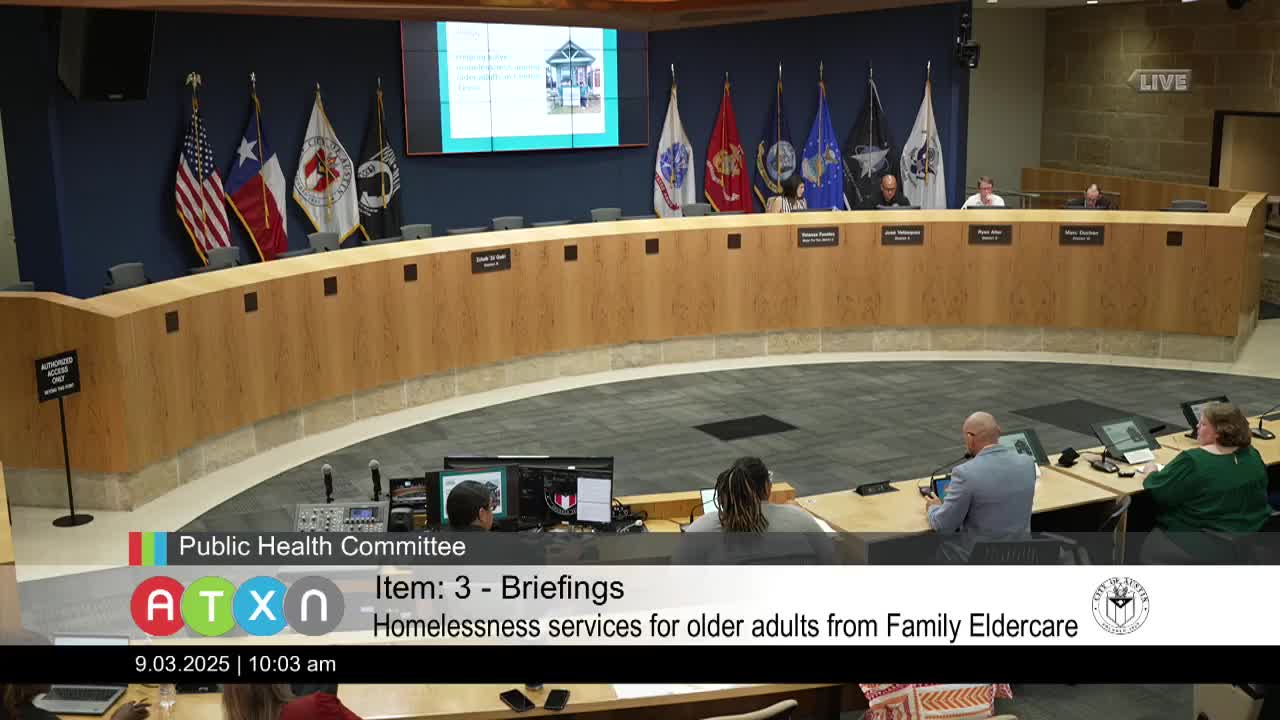
Family Elder Care presented its programs and outcomes to the Austin City Council Public Health Committee on Sept. 3, describing a multi-pronged effort to prevent and end homelessness among older adults in Central Texas.
The presentation, delivered by Dr. Erin Alarcon, chief executive officer of Family Elder Care, and by program staff, outlined four core program areas: service coordination, rapid rehousing, permanent supportive housing (PSH) and financial advocacy. "First and foremost, I want to express my gratitude for the invitation to present," Dr. Alarcon said, and summarized the organization's 42-year history serving older adults and people with disabilities.
Family Elder Care said it served more than 16,000 individuals last year through 12 programs across four departments. Service coordination operates on-site at low-income senior housing properties to connect residents with benefits, transportation, medical appointments and crisis support; the agency reported assisting about 1,014 residents in fiscal year 2024 and 677 year-to-date in 2025. Program staff said service coordinators helped roughly 412 residents obtain government benefits and engaged 79 residents in eviction prevention and housing retention services.
The agency described its rapid rehousing program as a trauma-informed, individualized program that provides short-term rental assistance, housing identification and case management, with assistance available up to 24 months. "We're not just doing the minimum for what our contract says," a Family Elder Care representative said, describing a level-of-service assessment the agency uses to tailor supports and smooth transitions out of homelessness.
Family Elder Care detailed three PSH offerings: Downtown Austin Community (DAC) project, which includes 46 scattered-site efficiency units; Pecan Gardens, a 78-unit site converted from the Austin Motel with on-site case management; and a HUD-funded PSH program (2022) providing 37 scattered-site units in partnership with Central Health. The agency said PSH services are grounded in housing-first and trauma-informed care models.
On financial advocacy, Family Elder Care reported serving 640 clients in 2024; 358 were age 55 or older and 345 identified as a racial or ethnic minority. The program manages benefits and household funds for clients, and staff said they pay about $200,000 per month in housing expenses using clients' benefits to keep households stable. The program also reported that 94% of surveyed clients said services helped them live independently and that 100% obtained or maintained public benefits.
Committee members asked about program eligibility and referral sources. Family Elder Care clarified that services are for people age 55 and older and for adults with disabilities; rapid rehousing and PSH referrals largely come through ECHO (Ending Community Homelessness Coalition), with the exception of the DAC project, which takes referrals directly from DAC. The agency said it provides on-site service coordination in facilities where it holds contracts; it had previously provided service coordination at the Lady Bird facility but that contract ended for financial reasons.
Committee members also pressed staff on differences between scattered-site PSH and congregate models. Family Elder Care said scattered-site housing offers clients flexibility to live across the community, while congregate sites such as Pecan Gardens provide immediate access to staff and services and foster resident community.
The presentation included individual success stories — for example, a 70-year-old resident who obtained Social Security disability after staff helped gather medical documentation, and another client who avoided eviction when an account navigator assisted with paperwork and housing placement — which Family Elder Care used to illustrate program impacts.
The committee did not take formal action on the briefing. Chair Vanessa Fuentes thanked the presenters and opened the floor for questions before moving on to other agenda items.
Ending: The committee scheduled further discussion items for future meetings but took no funding or policy votes on Family Elder Care's programs during the Sept. 3 briefing.