Get Full Government Meeting Transcripts, Videos, & Alerts Forever!
Get email alerts on the Tax Increment Reinvestment Zones topic
No spam. Unsubscribe anytime.
San Antonio reviews tax‑increment reinvestment zones as council debates housing, board oversight
Summary
City staff briefed the City Council on the structure, finances and projects tied to San Antonio's tax increment reinvestment zones (TIRZ), saying the zones generate about $45 million in annual increment for fiscal 2025. Councilmembers pressed staff on affordability, board composition and whether TIRZ funds can be shifted to the general fund.
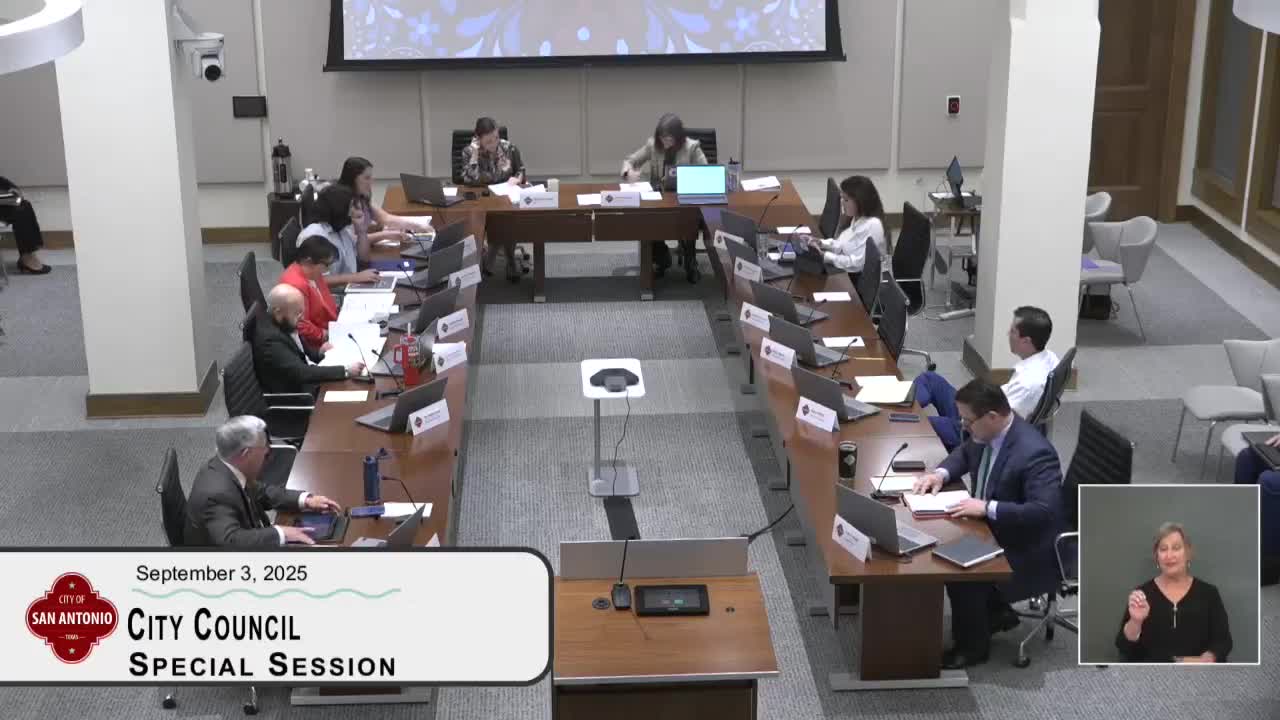
SAN ANTONIO ' Sept. 3, 2025 ' The San Antonio City Council on Wednesday used a budget work session to review the city's tax increment reinvestment zones, or TIRZ, hearing from finance and housing staff about how the zones are structured under state law, how much revenue they generate and how the city and private developers use that money for infrastructure and development.
City finance staff told the council the TIRZ program is producing about $45 million in tax increment in fiscal 2025, roughly $37 million from city‑initiated zones and about $8 million from developer‑initiated zones; staff said that total is about 5 percent of the city's $819 million levy that supports the general fund and debt service.
Why it matters: TIRZ are long‑running financing tools that freeze assessed value in an area, let new value accumulate as an "increment," and then use that increment for public improvements or to reimburse developers for infrastructure. Council members at the briefing pressed staff on whether the program is producing affordable housing at scale, how displacement risk is assessed, and whether elected representatives should serve on TIRZ boards that oversee spending.
What staff presented
Eric (city manager) introduced the briefing and turned the presentation to Troy Elliott, the city's chief financial officer, and Veronica Garcia, director of Neighborhood Housing Services. Elliott summarized how TIRZ work under the Tax Increment Financing Act (Chapter 311 of the Texas Tax Code): at zone creation the current assessed value is set as a base and future growth above that base is captured as increment and reinvested into the zone. "At the time that we create the TIRZ and we establish the zone, the actual base or the assessed value is frozen," Elliott said.
Elliott said the city revised its internal TIF policy in December 2022 after an initial policy adopted in 2015; the updated policy emphasizes city objectives including housing and affordable housing, economic development, transportation and historic preservation. Staff also said the policy requires market analyses for market‑rate housing and contributions toward affordable housing and added a displacement impact assessment requirement for new proposals.
City‑initiated TIRZ highlights
Staff reviewed nine city‑initiated zones around San Antonio, giving board participation rates, recent balances and example projects. Highlights included:
- Houston Street TIRZ: established 1999 and extended to 2060; city participation at 100 percent for both operations and debt service; 2024 ending city balance reported at about $7.3 million with estimated FY25 increment near $5.96 million and an anticipated FY25 ending balance of roughly $6.9 million. Staff noted the Mission Ballpark term sheet will require a revised project and finance plan before any commitments are incorporated into the Houston Street TIRZ finance plan.
- Inner City TIRZ: established 2000 and currently terminating in 2035 (staff said an extension would likely be needed to fund additional projects through debt); reported as producing roughly $10.1 million in annual increment and an estimated 2025 ending balance around $4.5 million. Sample funded projects listed by staff include Ella Austin Community Center and Midtown land acquisition.
- Midtown TIRZ: staff reported a beginning balance of about $12 million and annual increment near $11.3 million; current expenses and commitments increased projected outlays to about $18.8 million for FY25, yielding an estimated ending balance of about $4.5 million. Staff said the Midtown project plan has not yet been updated to incorporate the city's planned ITC property purchase.
- Brook City Base and Brooks Development Authority: staff said the council recently approved a defeasance with the Brooks Development Authority that will shift an unused balance (roughly $17 million through 2031, per staff) to the authority; Brook City Base was described as having an ending balance of zero after that action.
- Hemisphere (Hemisphere Park) TIRZ: established 2017 and producing about $660,000 a year in increment, which staff said is dedicated to funding the Hemisfair Park Area Redevelopment Corporation (HPARC) operations; staff noted the Hemisfair TIRZ will be a primary zone for capturing increment pledged to revenue contract bonds if the arena/sports and entertainment district project proceeds under its recent term sheet.
Developer‑initiated TIRZ and housing production
Veronica Garcia described developer‑initiated TIRZs, where a private developer builds infrastructure and public improvements and is reimbursed over time from the increment the project generates. Garcia gave project‑by‑project summaries for 10 developer zones, many on the South and Southeast sides, and described eligibility rules for reimbursement (streets, drainage, utilities, certain park or soft costs). Examples staff described:
- Roseel/"Rosie O" Creek (largest): staff said the project includes about 5,200 single‑family homes, 67 acres set aside for multifamily and significant commercial/light industrial acreage; as part of that project the developer will donate roughly 50 acres to the San Antonio Housing Trust for future affordable housing.
- Multiple completed or near‑complete subdivisions: Lackland Hills (171 single‑family homes), Northeast Crossing (about 1,300 single‑family plus 250 multifamily), Hunters Pond (about 449 homes), Theo Meadows (about 400 homes, staff said roughly half priced below $200,000), Somerset Grove (about 603 homes) and others. Garcia said many developer zones are at varying stages of reimbursement; some are nearly complete with reimbursements continuing for years set by their agreements.
Garcia told the council that across city‑initiated TIRZs staff counted roughly 721 affordable units produced to date; staff also said developer‑initiated TIRZ projects account for roughly 2,300 homes (not including Roseel/Creek), and that about 54 percent of those developer‑initiated units meet the affordability thresholds described in staff's summary. Garcia added that projects adopted under the department's post‑2022 policy now undergo a displacement impact assessment during review.
Displacement and policy safeguards
Garcia described the displacement impact assessment (DIA) used since the 2022 policy update: "We look at vulnerability factors ... about over 20 different data points that we review," she said, and staff will rate projects from low to high risk; for medium or high risk the evaluation committee or board may require developer outreach or funding for mitigation such as home repairs.
Council reaction and debate
Councilmembers across districts praised examples of development enabled by TIRZ while raising three recurring concerns: representation on TIRZ boards, affordable housing outcomes, and whether TIRZ funds should be routed into the general fund to help close budget gaps.
- Councilmember Munguia said developer‑initiated zones "have very minimal impact" on city operations because developers bear upfront costs and are reimbursed only from increment the project produces, and he praised the tool for creating new communities where infrastructure did not exist.
- Several councilmembers, including Councilwoman Castillo and Councilmember Galvan, pressed staff for more granular housing data (AMI breakouts for units produced before and after the 2022 policy), and asked why projects tied to downtown financing (including a Mission Ballpark term sheet and a sports and entertainment district term sheet) were not incorporating affordable housing assumptions.
- Multiple councilmembers proposed or supported having council representation on city‑initiated TIRZ boards; staff said appointments can be made by council without an ordinance change but adding council seats would still require council appointments.
- Council members also asked staff for follow‑ups: a breakdown of units by AMI pre‑ and post‑2022 policy, a list of TIRZs and the years their agreements or terms expire, and analysis of where incremental revenue may return to the general fund in the near term without violating existing agreements.
Formal actions noted at the briefing
Staff and council referenced several formal or semi‑formal actions connected to TIRZ administration and projects; these were reported by staff rather than enacted at the session:
- Extension/realignment: Houston Street TIRZ was extended and its boundaries realigned (staff said the term was extended to 2060). (Action note: extension previously approved; staff said a revised finance plan will be required to incorporate the Mission Ballpark financing.)
- Midtown: staff said the Midtown TIRZ boundary changes and an extension to 2060 have been adopted and staff will bring a revised project and finance plan to council to incorporate the ITC purchase.
- Brook City Base/Brooks Development Authority: staff said council approved a defeasance that shifts an unused balance (staff cited about $17 million through 2031) to the Brooks Development Authority per the approved agreement.
- Terminations: staff said four TIRZs have been terminated in recent years (Stablewood Farms, Mission Creek, Halley Heights and another) and that the four returned about $1.0 million collectively to the city across the recent terminations.
No formal votes on new TIRZs or changes were taken at the briefing; staff said any board recommendations for allocations still require separate council approval.
What council asked staff to do next
Council asked staff to provide follow‑up documents and analyses including: an AMI breakdown of the 721 affordable units and the developer‑initiated units (pre‑ and post‑2022 policy), a list of TIRZ expirations and the incremental revenue history since each zone's inception, and options for board composition changes (appointments vs. ordinance). Staff said they would return with those analyses and revise project and finance plans where specific developments (for example Mission Ballpark) require it.
Ending
Staff and council agreed to continue the discussion in committee and with further analysis. "We took an allocation from each of the inner city area TIRZs to create more of a funding source for gap financing," Garcia said in describing earlier uses, and councilmembers repeatedly signaled they want more data to balance TIRZ'driven development with the city's affordable housing goals.
(Reporting note: the briefing was a staff presentation and policy discussion; no new TIRZ ordinances or council votes were adopted during the Sept. 3 session.)