Get Full Government Meeting Transcripts, Videos, & Alerts Forever!
Get email alerts on the City Budget topic
No spam. Unsubscribe anytime.
San Antonio proposes no property tax rate increase as public hearing opens on roughly $4 billion FY2026 budget
Summary
City budget staff presented the proposed fiscal 2026 plan and a proposed zero increase to the property tax rate at a public hearing; presentation outlined major budget components, proposed property tax relief, and a state-law change to food-establishment fees. One public commenter urged cuts to arts funding.
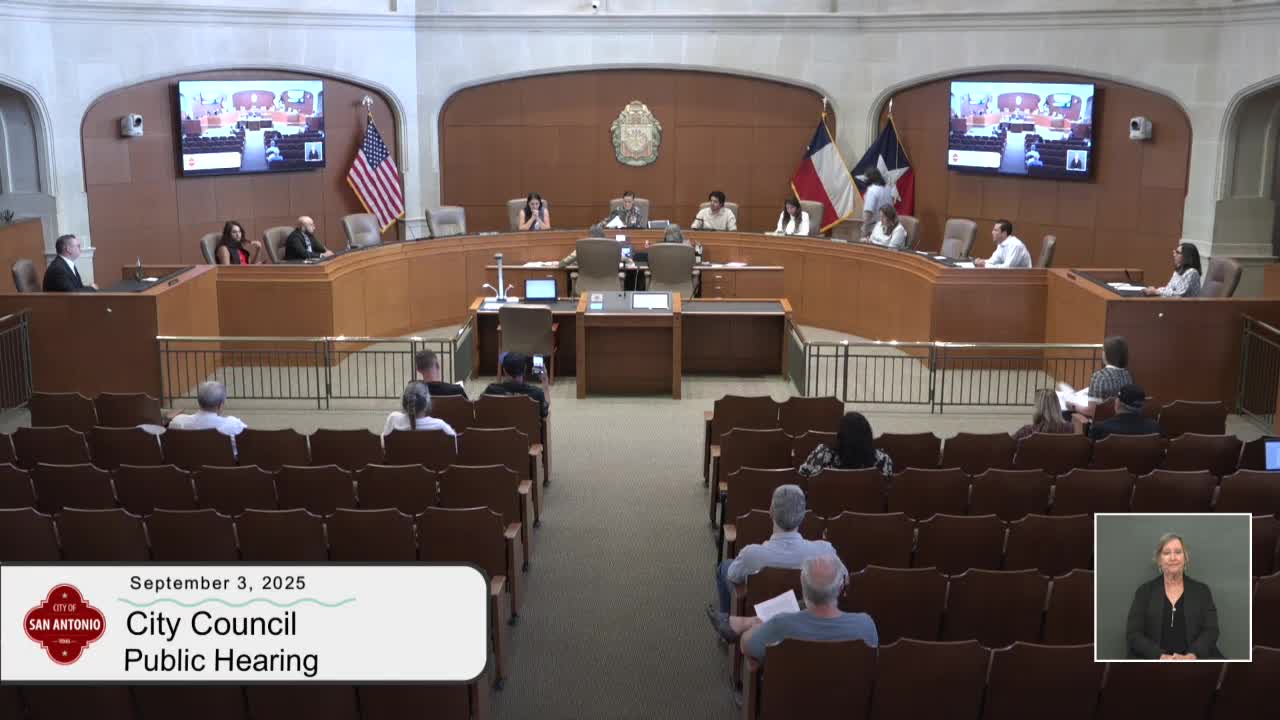
Cristina Tell, San Antonio’s budget director, opened a public hearing on the city’s proposed fiscal 2026 budget and said the city is proposing no increase to its property tax rate while seeking public feedback on the proposal.
Tell said the proposed FY2026 budget is about $4 billion in total and described three main components: a general fund of roughly $1.69 billion, a capital budget near $1.1 billion and other funds (enterprise and restricted funds) around $1.2 billion. She said the proposal would keep the property tax rate at roughly 54 cents per $100 of assessed value and noted the city has not raised that rate for more than three decades. Tell also described planned property-tax relief and said the presentation included proposed changes to food-establishment fees required by a recently enacted state law.
The presentation emphasized the hearing’s purpose as soliciting public comment on the proposed tax rate and budget ahead of an anticipated adoption later in September. Tell said this was the first of two public hearings and identified a council adoption date in mid-September; she also asked members of the public to limit remarks to two minutes (six minutes for groups of three).
During the presentation Tell listed figures for potential property-tax relief and fee adjustments. She said the proposed budget “includes over $152,000,000 of property-tax relief” and later referenced a different relief figure of about $54,000,000; the transcript contains those differing numbers. Tell also described a July assessment roll increase and cited an assessment change of about 1.9 percent and a valuation change of about 1.676 percent.
A member of the public, Jack Finger, used his allotted time to criticize elements of the budget. Finger urged deeper cuts to address the city’s deficit and singled out arts and culture spending as an area for reduction, while also making remarks about the city’s diversity and inclusion work. The council did not take action during the hearing; the presentation and comments were part of the formal public-comment process required before final adoption.
Council members and the mayor were present for the hearing but did not take a final vote during this session. Tell noted the city is complying with a new state law that changes how certain food-establishment fees are calculated (shifting from employee-count–based fees to a sales-volume basis effective Dec. 1), and she said the fee adjustments are intended to recover part of the cost of food-safety inspections.
The hearing record shows this public hearing on agenda item 11 (the proposed tax rate and FY2026 budget). The council will hold at least one more public hearing before the council considers final adoption in September.