Get Full Government Meeting Transcripts, Videos, & Alerts Forever!
Get email alerts on the Parks And Recreation topic
No spam. Unsubscribe anytime.
Oxnard staff outline Quimby-funded park projects; Campus Park bid package expected this month
Summary
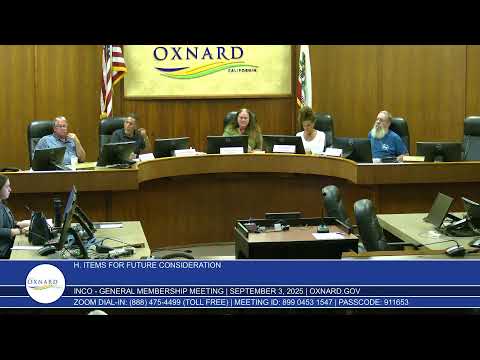
Oxnard city staff told the INCO on Sept. 3 that five neighborhood projects funded by Quimby developer fees are in design or near design, and that Campus Park’s construction documents are complete with a planned bid posting by the end of September.
Oxnard city staff told the INCO on Sept. 3 that five neighborhood projects funded by Quimby developer fees are in design or near design, and that Campus Park’s construction documents are complete with a planned bid posting by the end of September.
"It's collected, to basically offset, impacts from development projects to my understanding," Morgan Kessler, city engineer, said, describing how Quimby fees are generated and held for recreation uses within the neighborhoods where they originate.
Kessler and Steve Hallett, assistant public works director, reported that Carriage Square (Eastwood Park), Seaview Park, Hobson Community Center Park East, 5 Points Park and Via Marina Park are active Quimby-funded projects. Kessler said three of the projects were added during a mid-cycle Capital Improvement Program update and that designers are being selected; the Seaview designer is expected to go to council for contract award on Nov. 4.
Campus Park — a multi-phase regional project located adjacent to Oxnard airport property — has completed plans and specifications and has received a conditional construction permit from the city, Kessler said. He added that the Federal Aviation Administration issued a "determination of no aviation hazard" this week and that the city expects NEPA and Section 106 environmental clearances by Sept. 19. "We're hoping to have this thing on the street for, for bids by the end of the month," he said, adding the team plans a 45-day bid period because of the project’s complexity.
Speakers at the meeting pressed staff on funding rules and project scope. Walter Hagenham (Oxnard Shores) asked which revenue sources feed parks projects; Kessler and Hallett said the staff presentation focused specifically on Quimby funds and that Quimby cannot be used for maintenance or salaries. "QMB funds are a developer fee that are generated within the community where a construction event happens," Kessler said, and staff later stated the city now holds more than $10,500,000 in Quimby balances across neighborhoods.
The meeting included detailed questions about what Quimby will and will not pay for. Staff said Quimby funds can be used for new or replacement recreational components — playgrounds, new turf areas with separate irrigation, walking tracks or new court facilities — but cannot be used for routine maintenance or to replace irrigation tied to existing landscaped areas. For example, staff said an irrigation replacement in an existing park would be considered maintenance and not eligible, while installing new metered water and services for a vacant lot converted to a new park could qualify.
Residents and neighborhood leaders raised several contentious, long-running topics. Michael Gleeson (West Village) and others criticized the Sports Park acquisition and planning process, saying the city paid substantially more than an appraised value years earlier and that park design choices (baseball fields vs. soccer fields) have not reflected community requests. "We got 2,500 homes out there, and guess what? We got 25 acres of land that has not been irrigated for 25 plus years," Gleeson said, summarizing concerns about an undeveloped site and past expenditures.
On Campus Park, residents asked whether air-quality testing for lead from low‑lead avgas has been done given the park’s proximity to aircraft. Kessler said he could not confirm a site-specific air test: "I can't speak to whether the air has been tested specifically for this project." He added that environmental documents addressed a range of impacts and that the city would consider additional studies if warranted.
Staff also summarized elements of the Parks and Recreation Master Plan and recent work: a Clean California grant-funded turf conversion project in four parks; an approved agreement with Arbor Pro for an urban-forest inventory and LiDAR canopy analysis; and continuing consideration of alternative uses for underused tennis courts (pickleball, futsal, or other community-requested conversions). Staff said the Parks and Recreation Commission had recommended pursuing tree‑canopy work and reviewed a proposal to keep larger sports and community parks open until 10 p.m.
Two staffing or program ideas — a park ranger program and a park ambassador program — remain with the city attorney for legal review because of liability and safety questions, Hallett said. Playground lifecycle and replacement work was also discussed: staff said playgrounds typically have a 12–15 year life cycle and that 14 playground replacements have been completed in prior years; in the most recent year staff said nine playgrounds were completed, two are under construction and Orchard Park is out to bid.
Next steps staff described include final designer selections for several Quimby projects and returning draft designs to neighborhood councils for review over the coming weeks. Kessler said the designer selections and early designs should be available to neighborhoods within "the next 6 weeks" for several projects, and that some projects could still take another year to reach groundbreaking after design and bidding.
The INCO meeting also featured a separate update from a parade/tamale-festival subcommittee and routine neighborhood reports, but no council or commission votes on parks projects were taken at the Sept. 3 meeting. The only formal action recorded in the transcript was INCO’s approval of the Aug. 6, 2025 minutes (motion made by an unnamed member, seconded by Alfonso Arroyo).