Get Full Government Meeting Transcripts, Videos, & Alerts Forever!
Get email alerts on the Leachate Pfas Treatment topic
No spam. Unsubscribe anytime.
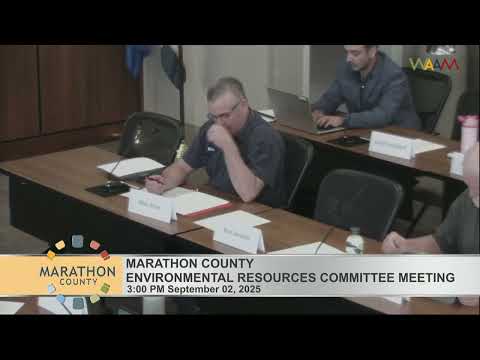
ERC discusses regional leachate treatment, reverse-osmosis option and long-term cost allocation
Summary
Committee members and staff discussed a proposal to use reverse osmosis and leachate recirculation at the Marathon County landfill as a regional service for neighboring counties, emphasizing the need for contractual protections, funding clarity and long-term liability allocation.
The Environmental Resources Committee on Sept. 2 considered a regional approach to controlling PFAS in landfill leachate that would center on a reverse-osmosis and concentrate-recirculation system at the Marathon County landfill.
Supervisor Robinson introduced the item, praising the Solid Waste Manager for proposing a regional system that could accept leachate from neighboring counties and use reverse osmosis to concentrate contaminants. Committee members, county administrator Lance Leonard, corp counsel and solid waste staff discussed tradeoffs: reverse osmosis concentrates PFAS into a small-volume concentrate that would be returned to the landfill cell for sequestration, not destroyed, meaning Marathon County would assume operational and long-term treatment responsibilities potentially for decades after active landfill operations cease.
Presenters noted several points for policymakers to consider: capital and operating costs, whether partners (Portage County, Shawano County and others) should contribute to capital and ongoing costs, the implications of the existing intergovernmental agreement that obligates some counties to deliver trash to Marathon County through 2032, and the difference between establishing a separate joint‑venture governance structure versus addressing cost and liability sharing through contractual amendments to current agreements.
County corp counsel observed that a formal joint venture under board rules would typically create an independent governance board and that the current intergovernmental agreement contains language supporting proportional cost sharing; counsel recommended evaluating whether the current contract suffices or should be amended to explicitly cover treatment-plant costs and long-term liabilities.
Solid waste staff and the administrator said they are pursuing two tracks: (1) an application for principal‑forgiveness funding via an environmental loan (application due Oct. 1; results in December) and (2) discussions with municipal wastewater partners (for example, the City of Wausau) to determine whether off-site treatment is feasible. Staff estimated current transport-and-treatment costs at about $1,000,000 per year and suggested a debt-service add-on of roughly $4–$5 per ton if a capital project moves forward; staff emphasized the need to ensure long-term cost allocation so Marathon County taxpayers are not left holding disproportionate legacy costs.
Committee members asked staff to continue discussions with partner counties and to return with proposed contractual language/options that define capital contributions, operational roles and long-term responsibilities. No committee vote was taken; the matter was advanced as a topic for further evaluation and for possible intergovernmental negotiation.