Get Full Government Meeting Transcripts, Videos, & Alerts Forever!
Get email alerts on the Land Use Development topic
No spam. Unsubscribe anytime.
Kalispell council annexes North Meadows parcel but rejects proposed 99‑unit apartment plan
Summary
City Council voted to annex the North Meadows site and adopt an R‑4 residential zoning amendment but denied a conditional use permit for a proposed 99‑unit apartment complex after extended public testimony raising traffic, drainage, wildfire and school‑capacity concerns.
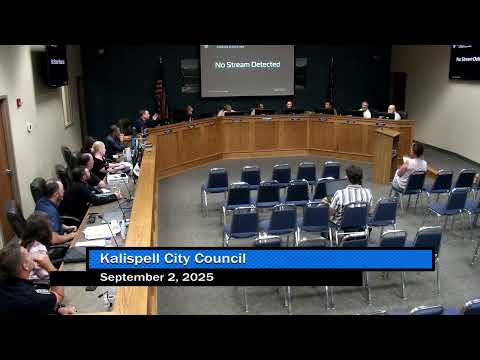
Kalispell — The City Council voted to annex a 12.13‑acre parcel known as North Meadows and to adopt residential zoning that favors single‑family/duplex development, but the council denied a conditional use permit for a proposed 99‑unit apartment development after more than three hours of public comment and technical testimony.
The action on annexation (Resolution 62‑91) and the zoning ordinance (Ordinance 19‑45, amended on the council floor to R‑4 residential) clears the property to be served by city utilities while blocking the developer’s requested RA‑1/multifamily configuration. The council then voted to deny the conditional use permit for a 99‑unit multifamily project.
Why it matters: Residents said the site’s single access, neighborhood street widths, documented groundwater and drainage problems, and proximity to Ashley Creek and a wildland‑urban interface create unacceptable public‑safety and environmental risk for a high‑density project. Councilors said they wanted a development path that better matches the surrounding single‑family neighborhood and preserves options for trail connections and riparian protection.
City planner Donny McBath presented staff analysis and the planning commission’s recommendation, telling the council, “Tonight, we are presenting the annexation and conditional use permit request for the North Meadows multifamily.” McBath said the planning commission recommended approval of annexation, zoning and the CUP subject to 20 conditions after receiving supplemental traffic and geotechnical materials.
Staff and consultants outlined technical findings: an independent traffic impact study found the project would generate about 667 trips per day (the consultant’s distribution was roughly 70% eastbound and 30% westbound), increasing average daily traffic on Bluestone Drive from about 1,000 vehicles to roughly 1,500 vehicles per day. Public‑works figures cited an available fire flow of about 2,300 gallons per minute at the nearest hydrant and downstream sewer capacity described by staff as having roughly 167 gallons per minute remaining; the project was estimated to add under 50 gallons per minute during peak hour. A geotechnical report said 11 borings encountered groundwater about 12–15 feet below grade and recommended slab‑on‑grade foundations with a design bearing capacity around 2,000 pounds per square foot.
Dozens of neighbors and technical witnesses urged the council to deny the multifamily plan. Common concerns included narrow local streets without sidewalks, seasonal drainage and standing water, prior slope movement and bank erosion along Ashley Creek, the neighborhood’s single ingress/egress, and school capacity.
“Rankin Elementary…is over capacity,” resident and educator Ricky Moffett told the council, adding the district already faces staffing and space pressures. Multiple speakers said Bluestone Drive lacks sidewalks and that adding hundreds of daily trips will create pedestrian safety hazards for children and trail users. Several residents also cited past localized flooding and a nearby historic slope failure as evidence the site has geotechnical risk.
The applicant’s technical representative, Toby McIntosh of Jacola Engineering, told council members that many of the CUP conditions are standard and intended to ensure the project built as reviewed, and he noted the development would provide impact‑fee payments the applicant estimated at roughly $414,000 to offset service impacts.
After lengthy council discussion, members proposed an amendment to the zoning ordinance changing the requested RA‑1 designation to R‑4 (single‑family and duplex residential) to better match neighborhood character. The council adopted the amendment by roll call and then approved the zoning ordinance as amended. The council subsequently voted to deny the conditional use permit for multifamily housing as incompatible with the newly adopted R‑4 zoning.
Council votes and motions (reported from roll calls): Resolution 62‑91 (annexation) passed (Yes: Nunnally, Carlson, Graham, Hunter, Mayor Johnson; No: Dahlmann, Fisher). Ordinance 19‑45 was amended on the floor to R‑4 and passed as amended. The conditional use permit for the 99‑unit multifamily project was denied on a roll‑call motion.
What’s next: Annexation and R‑4 zoning are now in place; any developer wishing to pursue housing on the site would have to submit proposals consistent with the R‑4 zone (subdivision or duplex/townhome designs would require separate review). Council members and residents said they want to pursue pedestrian and trail improvements, stormwater protections, and riparian buffers in future planning steps.
Ending note: The council’s actions preserve the city’s ability to extend services while rejecting a high‑density multifamily configuration for the site. Multiple residents and several councilors urged follow‑up work — including sidewalk planning and riparian protections — before future development applications are accepted.